Naval Systems

Project 12061 Murena air-cushion landing craft

Also known as
  • Project 12061 Murena
  • Project 12061E Murena-E
  • Tsaplya-class LCAC
  • Murena-E
  • Solgae 621 class
  • Solgae 621
  • Project 1206.1 Murena

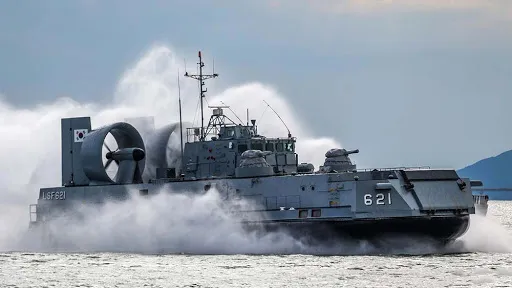
Project 12061 Murena is a Soviet/Russian medium air-cushion landing craft family for moving troops, vehicles, or naval mines across shallow coastal approaches and onto unprepared beaches. Almaz Central Marine Design Bureau designed the class, Khabarovsk Shipyard built the Soviet/Russian Project 12061 and export Project 12061E boats, and the export line includes the South Korean Solgae 621 craft.

Profile / Specs

Profile

Origin
Soviet Union / Russia
Type
Air-cushion landing craft
Service note
1980s-present
Designer
Almaz Central Marine Design Bureau
Produced
1985-2006 for listed Soviet/Russian and export hulls
Number built
11 completed according to RussianShips.info

Specifications

Displacement
132 tons standard / about 148.6-150 tons full load
Length
31.3-32 m overall
Beam
13.1-15 m overall
Draft
About 1.0 m according to RussianShips.info
Speed
55 knots
Range
About 200 nautical miles at 50 knots, or more than 200 miles in GlobalSecurity's summary
Endurance
1 day
Crew
12
Cargo capacity
One medium tank, two light armored vehicles, three BRDM-2 vehicles, 130 troops, or about 42 tons of cargo according to RussianShips.info
Landing capacity
GlobalSecurity describes carriage of one medium tank up to 50 tons, two armored personnel carriers, two infantry fighting vehicles, or up to 140 troops on removable benches
Armament
Two 30 mm automatic gun mounts, Igla-family portable SAM armament, grenade launchers on non-export Project 12061 boats, and 10-24 naval mines depending on type
Electronics
Lazur navigation radar and MR-244-1 Ekran-1 listed by RussianShips.info
Propulsion
Two 10,000 hp MT-70K gas turbines driving cushion blowers and propellers
Service And Export Context

Murena sits between small landing boats and the much larger Project 12322 Zubr in the Soviet/Russian air-cushion craft lineage. Public sources reviewed for this entry document production, export, payload, and service context, but do not directly tie Murena to a specific armed conflict.

Domestic boats

Eight Project 12061 boats are listed from Khabarovsk production between 1985 and 1992.

Export boats

Three Project 12061E Murena-E craft are listed for South Korea as the Solgae 621 type.

Almaz context

Almaz sources list Murena-E alongside Project 12322 Zubr as part of the bureau's air-cushion vessel portfolio.
Variants

Open sources separate the domestic Project 12061 Murena boats from the Project 12061E Murena-E export craft. Both are treated here as the same Murena/Tsaplya air-cushion landing-craft family.

VariantConfigurationDesignation notes
Project 12061 MurenaSoviet/Russian air-cushion landing craft

RussianShips.info lists eight baseline Project 12061 craft built at Khabarovsk Shipyard for Soviet and Russian service.

Sources: Project 12061 - RussianShips.info

Project 12061E Murena-EExport air-cushion landing craft

RussianShips.info lists three Project 12061E export boats built at Khabarovsk Shipyard for South Korean service.

Sources: Project 12061 - RussianShips.info

Timeline

Project 12061 Murena air-cushion landing craft Key Events

  1. First listed Project 12061 boat commissioned

    RussianShips.info lists D-453 as the first completed Project 12061 Murena craft, commissioned from Khabarovsk production on 28 November 1985.

  2. Domestic production run reaches eighth craft

    The same ship list records eight baseline Project 12061 boats from the Khabarovsk yard, with D-143 commissioned on 24 July 1992.

  3. First Project 12061E export boat commissioned

    RussianShips.info lists the first Project 12061E Murena-E export craft as commissioned in September 2005; its export section identifies the three boats as South Korea's Solgae 621 type.

  4. Murena-E included in Rosoboronexport naval display

    Rosoboronexport named the Murena-E Project 12061E landing craft among naval products promoted at Euronaval 2014.

Related Weapon Systems
Zubr-class air-cushion landing craft (Project 12322 Pomornik), Air-cushioned landing craft, Naval SystemsNaval SystemsZubr-class air-cushion landing craft (Project 12322 Pomornik)Air-cushioned landing craftThe Zubr class is a Soviet-designed Project 12322 Pomornik air-cushion landing craft developed by Almaz for high-speed amphibious lift. It can carry tanks, armored vehicles, troops, cargo, or naval mines directly onto prepared or unprepared shores, using bow and stern ramps and integral close-in armament. Greece operates the type as the Kefalonia/PTM class, while China acquired and locally expanded the related Project 958/Type 958 line.
Project 1204 Shmel / Shmel-class patrol boat, Armored patrol boat / river gunboat, Naval SystemsNaval SystemsProject 1204 Shmel / Shmel-class patrol boatArmored patrol boat / river gunboatThe Project 1204 Shmel class is a Soviet armored river gunboat family designed by Almaz Central Marine Design Bureau for shallow rivers, lakes, and coastal waters. It put a PT-76-derived 76 mm turret, a BM-14-17 rocket launcher, automatic cannon, machine guns, and mine rails on a compact shallow-draft hull, making it a fire-support and patrol craft rather than an oceangoing combatant. Russian Shmel boats were documented in the Kerch and Sea of Azov security context during the Russo-Ukrainian War, while Ukrainian Sea Guard Dzhmil examples survived in Danube-area service and training.
Dyugon-class landing craft (Project 21820), Air-cavity landing craft, Naval SystemsNaval SystemsDyugon-class landing craft (Project 21820)Air-cavity landing craftThe Dyugon-class landing craft, Project 21820, is a Russian air-cavity fast landing craft developed by the Nizhny Novgorod Central Design Bureau for Hydrofoils as a larger successor to the Serna family. Built across Volga, Vostochnaya Verf, and Yaroslavl shipyards, the class moves tanks, armored vehicles, cargo, or marines to unimproved shores, and Russia used Dyugon craft around Snake Island in 2022 as part of Black Sea logistics and air-defense reinforcement activity.
BK-18 high-speed landing / assault craft (Project 02511), High-speed landing / assault craft, Naval SystemsNaval SystemsBK-18 high-speed landing / assault craft (Project 02511)High-speed landing / assault craftThe BK-18 high-speed landing / assault craft (Project 02511) is an enlarged Russian BK-series combat boat built by Rybinsk Shipyard for Kalashnikov Concern. Public references describe a 25-ton, 18.6-meter craft with pump-jet propulsion, a 40-knot top speed, 3 crew, and space for 19 embarked personnel; Russian Black Sea Fleet reporting places BK-18-type boats in anti-sabotage and base-protection duties connected to Tartus, Syria.
BK-16 high-speed assault / landing craft (Project 02510), High-speed assault and landing craft, Naval SystemsNaval SystemsBK-16 high-speed assault / landing craft (Project 02510)High-speed assault and landing craftThe BK-16 is a Russian high-speed assault and landing craft of Project 02510, developed by Kalashnikov Concern's Rybinsk Shipyard for coastal, river-mouth, and unequipped-shore operations. Public sources distinguish domestic Project 02510 craft from the BK-16E export model, with both centered on troop transport, landing support, patrol, and modular fire-support or specialist mission fits; Russian craft are documented in wartime use or losses in the Black Sea and occupied Crimea during the Russia-Ukraine war.
Serna-class landing craft (Project 11770), Air-cavity fast landing craft, Naval SystemsNaval SystemsSerna-class landing craft (Project 11770)Air-cavity fast landing craftProject 11770 Serna is a Russian air-cavity fast landing craft built for over-the-beach movement of vehicles, cargo, and assault troops to unimproved shores. KCHF and RussianShips list a 25.65 m, five-person craft capable of 35 knots and carrying one main battle tank, two BTRs, 92 troops, or 50 tons of cargo. During the Russia-Ukraine War, Russian Serna craft appeared as Black Sea logistics and air-defense transport targets around Snake Island and occupied Crimea.

Sources