Aircraft & UAVs

Palianytsia

Also known as
  • Palyanytsia
  • Palianytsia missile-drone
  • Palianytsia rocket drone
  • Palianytsia cruise missile
  • Palyanytsya

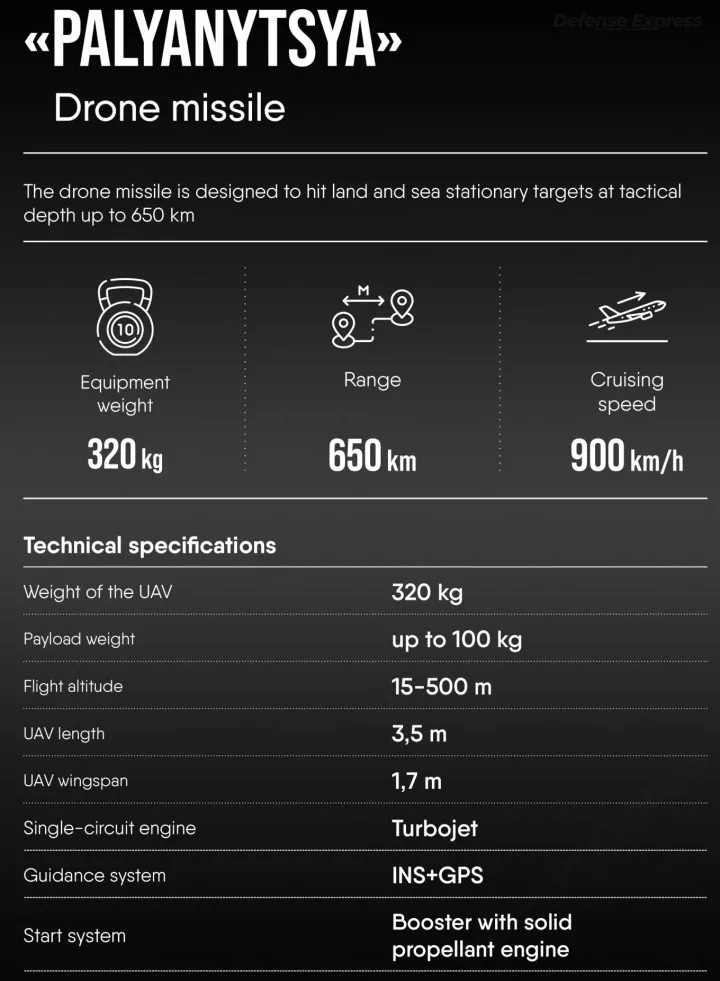
Palianytsia is a Ukrainian turbojet missile-drone developed during the 2014 Russia-Ukraine War to give Ukraine a domestically produced long-range strike option against Russian military targets. Ukraine first disclosed it after a successful August 2024 use, later described Palianytsia as hitting Russian ammunition depots in repeated cases, and has released public specifications showing a ground-launched booster, inertial and satellite navigation, a 100 kg payload, and a 650 km class range while keeping inventory and detailed strike attribution limited.

Role in Conflicts

Ukraine revealed Palianytsia during the 2014 Russia-Ukraine War after announcing its first successful use against a Russian military target in August 2024; by October 2025, Ukrainian reporting quoted Zelenskyy as saying the weapon had begun hitting Russian ammunition depots in dozens of cases. Official and Ukrainian media sources place it in serial domestic production, while individual strike logs and independently verified target lists remain limited.

Role details
Profile / Specs

Profile

Origin
Ukraine
Type
Long-range rocket drone / missile-drone
Service note
2014 Russia-Ukraine War domestic long-range strike program
Designer
State Kyiv Design Bureau Luch
Designed
About 18 months of development before the August 2024 public announcement
Unit cost
Less than US$1 million per missile-drone in August 2024 reporting attributed to Mykhailo Fedorov and an Associated Press interview.
Produced
Serial production reported from December 2024
Number built
Not publicly confirmed

Specifications

Range
650 km maximum range reported from MSPO 2025 disclosures
Takeoff weight
320 kg
Payload
Up to 100 kg
Speed
Up to 900 km/h
Operating altitude
15-500 m
Length
3.5 m
Wingspan
1.7 m
Propulsion
Solid-fuel booster for launch, then jet engine
Guidance
GPS and inertial navigation
Disclosed Configuration

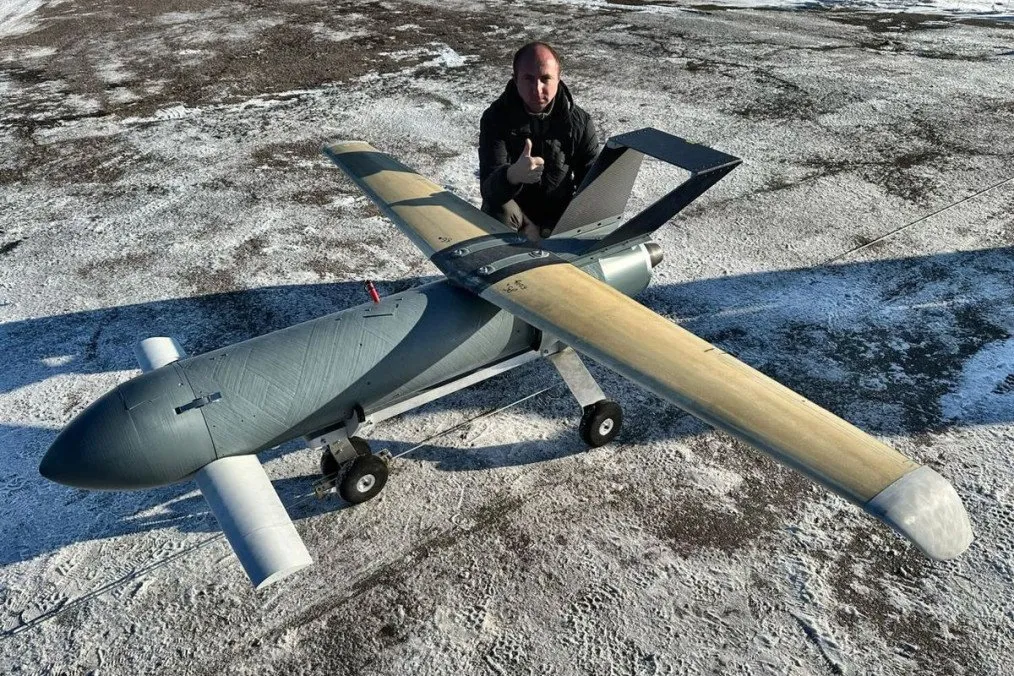
Public information on Palianytsia remains deliberately narrow. The disclosed details support a jet-powered one-way strike weapon that sits between small long-range UAVs and larger cruise missiles.

TopicDisclosed detailReader context
Launch methodGround launch with a solid-fuel booster before transition to jet propulsionExplains why Ukrainian sources call it a rocket drone or missile-drone rather than a reusable UAV.
NavigationInertial and satellite navigation reported in public specificationsPlaces the weapon in the guided long-range strike category while avoiding unsupported seeker or terminal-guidance claims.
Production supportUkraine's Ministry of Defense described Lithuanian funding for Palianytsia production through direct support to a Ukrainian manufacturer.Shows how partner funds were routed toward domestic long-range weapons rather than foreign-supplied missiles.
Operational reporting limitUkraine has acknowledged first use, serial production, and repeated ammunition-depot strikes, but public reports have not confirmed a complete strike log, wreckage record, or total inventory.Keeps the record separate from speculative attributions of later Russian depot and airfield strikes.
Timeline

Palianytsia Key Events

  1. First combat use announced

    Ukraine publicly revealed Palianytsia on Independence Day and said the new missile-drone had successfully struck a Russian military target.

    Sources: Ukrainska Pravda Palianytsia Details, Kyiv Independent Palianytsia Cost

  2. Cost and private-sector development reported

    Reporting attributed to Mykhailo Fedorov and the Associated Press put Palianytsia below US$1 million per weapon and described the project as a new domestic development supported by private-sector production speed.

    Sources: Kyiv Independent Palianytsia Cost

  3. Lithuanian production investment detailed

    Ukraine's Ministry of Defense said Lithuania would invest 10 million euros in Palianytsia production through direct funding of a Ukrainian manufacturer under the Danish-model approach.

    Sources: Ukraine MoD Palianytsia Lithuania Funding

  4. Serial production reported

    The Kyiv Independent reported Defense Minister Rustem Umerov's statement that Palianytsia had entered serial production with Defense Ministry support.

    Sources: Kyiv Independent Palianytsia Serial Production, President Borys Paton Palianytsia Serial Production

  5. Specifications disclosed at MSPO 2025

    UNITED24 Media reported the first public technical figures shown at MSPO 2025, including weight, payload, range, altitude band, dimensions, navigation, booster launch, and jet propulsion.

    Sources: UNITED24 Palianytsia Specs

  6. Repeated ammunition-depot strikes reported

    UNITED24 Media reported Zelenskyy's statement that Palianytsia had reached ten confirmed Russian military-target hits and was no longer limited to isolated ammunition-depot strikes.

    Sources: UNITED24 Palianytsia Dozens Targets

  7. Luch developer connection reported

    Defense Express reported that official Ukrainian context identified State Kyiv Design Bureau Luch as the developer/manufacturer connection for Palianytsia.

    Sources: Defense Express Palianytsia Developer

  8. Listed among proven Ukrainian long-range weapons

    The Ukrainian presidential office listed Palianytsia among Ukrainian long-range missile weapons developed during the war, describing it as turbojet-powered and first successfully used in August 2024.

    Sources: Presidential Office Arms Makers Palianytsia

Long-Range Weapons Context

Official Ukrainian references present Palianytsia as one member of a wartime long-range weapons push rather than as an isolated missile program.

ContextSource-backed pointCatalog treatment
Missile-drone family contextPresidential remarks grouped Palianytsia with systems such as Peklo, Ruta, Neptune, Flamingo, and Vilkha as Ukrainian long-range strike weapons.This supports program context, not a same-family variant or launcher relationship.
Known developerDefense Express connected Palianytsia to State Kyiv Design Bureau Luch after an official Ukrainian foreign-ministry meeting with Luch and Fire Point leadership.The builder field links to Luch, while broader design-solution overlap with Neptune remains limited to sourced background.
Public evidence boundaryUNITED24 Media reported Zelenskyy's later claim of repeated hits, but detailed public attribution still does not identify every target, launcher, or production batch.The conflict row records Ukrainian use while avoiding unsupported per-strike claims.
Media
Related Weapon Systems
BARS-SM Gladiator, Long-range one-way attack UAV / drone-missile, Aircraft & UAVsAircraft & UAVsBARS-SM GladiatorLong-range one-way attack UAV / drone-missileBARS-SM Gladiator is a Ukrainian long-range one-way attack unmanned system publicly named by Ukraine's General Staff in the May 16-17, 2026 strikes on Moscow-region military-industrial and fuel-logistics targets. Open sources treat it as a previously little-known Bars-family weapon, so the record separates the confirmed Ukrainian conflict-use claim from family-level range, payload, speed, and manufacturer details that remain only partly disclosed.
Blyskavka, Fixed-wing strike UAV, Aircraft & UAVsAircraft & UAVsBlyskavkaFixed-wing strike UAVBlyskavka is a Ukrainian fixed-wing strike UAV from Vyriy Industries, developed from captured Russian Molniya-family design ideas but rebuilt with Ukrainian electronics, warheads, and production standardization. Sources document Ukrainian Special Operations Forces deliveries, Ukrainian Defense Forces fielding, a 40 km recorded combat-use strike with a 9 kg warhead, and a later aerodynamic fairing that increased range while retaining a low-cost catapult-launched twin-propeller airframe.
Bars RS-1, Jet-powered long-range one-way attack UAV / drone-missile, Aircraft & UAVsAircraft & UAVsBars RS-1Jet-powered long-range one-way attack UAV / drone-missileBars RS-1 is a Ukrainian long-range jet-powered one-way attack UAV, often described in local reporting as a drone-missile or cruise-missile-like unmanned system. Public sources identify it as part of Ukraine's domestically developed deep-strike inventory, with direct official reporting placing RS-1 Bars in the May 2026 Moscow-region strike package and later defense reporting describing a Bars RS variant with a larger fuel tank, higher takeoff weight, and 1,000 km class use claims.

Sources