Russian forces use Molniya fixed-wing FPV drones in Ukraine as cheap catapult-launched strike, reconnaissance, targeting-support, and experimental carrier UAVs; reporting since late 2025 also documents Molniya-2R reconnaissance, machine-vision, fiber-optic, and newer Lightning 13 / Molniya-13 family adaptations.
Molniya
- Molniya UAV
- Molniya FPV drone
- Molniya-1
- Molniya-2
- Molniya-2R
- Lightning
- Lightning 13
- Molniya-13
- Lightning 2
- Lightning P
- Molniya-P
Molniya is a Russian low-cost fixed-wing FPV UAV family used in the Russia-Ukraine War 2014-present for one-way attacks, reconnaissance, targeting support, and experimental carrier roles. Ukrainian intelligence, UNITED24, and Business Insider reporting describe a modular aircraft-type design built from inexpensive materials, with documented Molniya-1, twin-engine Molniya-2, Molniya-2R reconnaissance, fiber-optic, machine-vision, Lightning 13 / Molniya-13, and Lightning P / Molniya-P adaptations attributed in 2026 reporting to Atlant Aero.
Use in Conflicts
Profile / Specs
Profile
- Origin
- Russia
- Built by
- Atlant AeroRussian developers
- Type
- One-way attack UAV
- Service note
- Russia-Ukraine War 2014-present low-cost FPV UAV family
- Designer
- Russian developers; Atlant Aero reported for the Lightning 13 / Molniya-13 variant
- Developed into
- Ukrainian Blyskavka reverse-engineered counterpart
Specifications
- Role
- Low-cost fixed-wing FPV UAV family for one-way attack, reconnaissance, targeting support, fiber-optic strike control, and experimental carrier roles
- Airframe class
- Small aircraft-type fixed-wing FPV UAV
- Launch method
- Catapult launch reported for the baseline Molniya
- Typical frontline performance
- UNITED24 reports common Molniya figures of about 1.5 m wingspan, up to 10 kg weight, 3-5 kg payload, 30-40 km range, up to 90 km/h speed, and up to 40 minutes endurance
- Guidance and control
- Operator-guided FPV control for strike variants; reported adaptations include machine-vision target tracking, fiber-optic control links, mesh modems, and Starlink-supported Molniya-2R video/telemetry/control links
- Propulsion
- Electric motor on baseline models; Molniya-2 reported with two wing-mounted engines; Lightning 13 reported with four electric motors
- Reconnaissance payload
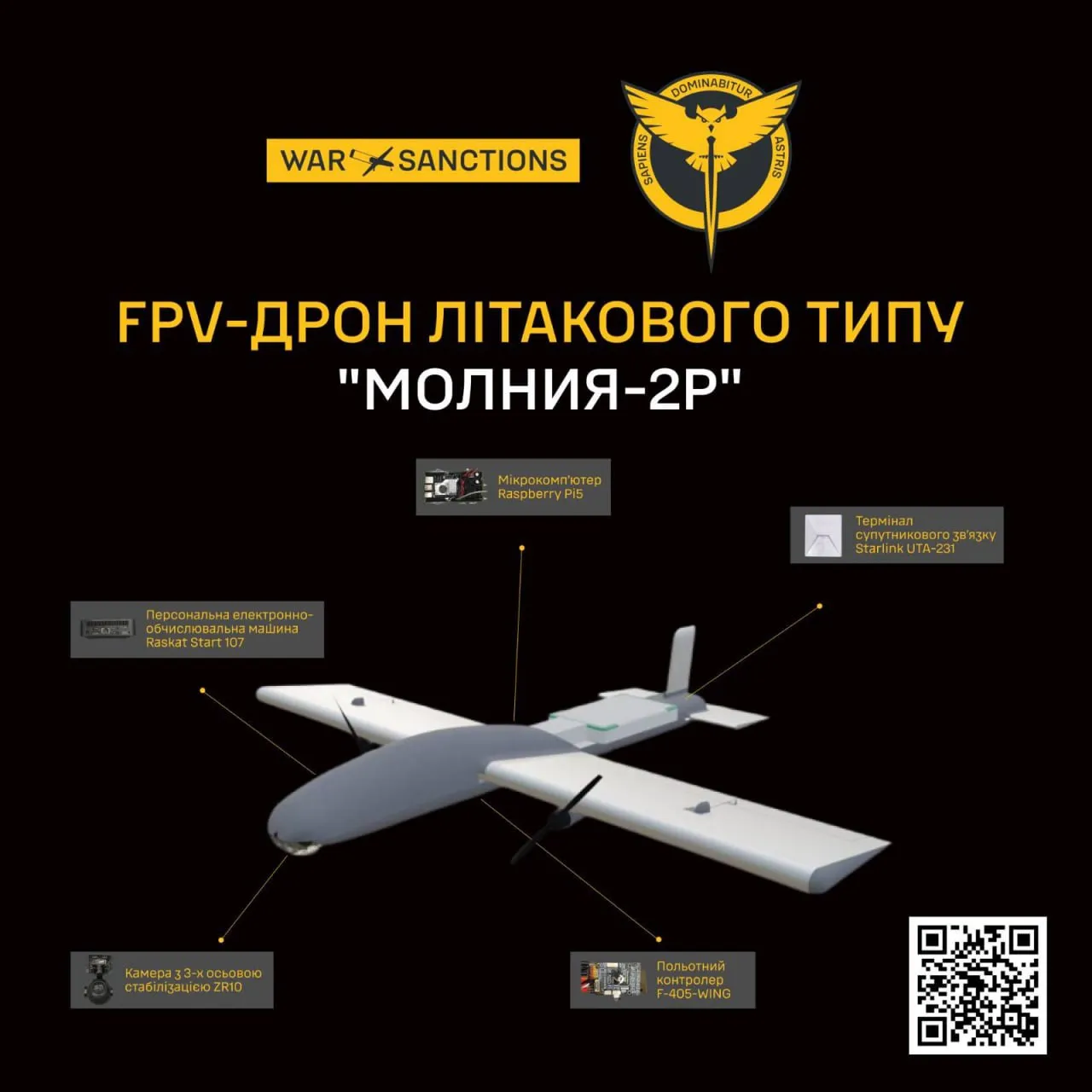
- Molniya-2R reported with SIYI ZR10 stabilized 10x zoom camera, forward FPV camera, Raspberry Pi 5, Raskat/Windows 11 computer, and Starlink terminal
- Warhead and payload
- Common frontline Molniya payload reported at 3-5 kg; Molniya-1 comparison reporting cites up to 7 kg, fiber-optic examples around 10 lb, and Lightning 13 promotional claims up to 13 kg
- Construction and cost context
- Open reporting describes inexpensive plywood, foam, plastic, cardboard, lightweight composite, aluminum, and commercial electronics; cost estimates range from a few hundred dollars for simple frontline drones to roughly $1,600 for Molniya-2 claims and higher outside estimates for more capable examples
- Countermeasure context
- Ukrainian reporting describes electronic warfare, FPV interceptors, and specialized counter-drone units as common responses to mass Molniya use
Variants
Open reporting treats Molniya as a fast-changing family rather than one fixed production model; the rows below separate supported configurations without duplicating the current record's alias list.
| Variant | Configuration | Designation notes |
|---|---|---|
| Baseline attack configuration | Baseline strike UAV | Aircraft-type FPV kamikaze drone reported with catapult launch, operator guidance, and a low-cost fixed-wing airframe used by Russian forces in Ukraine. Sources: ArmyInform Molniya-2R Reconnaissance Report, UNITED24 Molniya Frontline Report |
| Twin-engine strike configuration | Improved twin-engine strike UAV | Reported as an improved configuration with two wing-mounted engines, longer range emphasis, and heavier warhead options compared with the baseline model. Sources: ArmyInform Molniya-2R Reconnaissance Report, UNITED24 Molniya Frontline Report |
| Fiber-optic control configuration | Electronic-warfare-resistant strike UAV | Business Insider, citing Ukrainian and US military information, reported fixed-wing Molniyas using fiber-optic control links near the Donetsk front, trading payload and range for jamming resistance and stable video. |
| Reconnaissance 2R configuration | Reconnaissance and targeting-support UAV | Ukrainian HUR component data and ArmyInform reporting identify this adaptation with extra computing, a stabilized zoom camera, and a Starlink terminal for reconnaissance and targeting support. Sources: ArmyInform Molniya-2R Reconnaissance Report, War and Sanctions Molniya-2R Components, Business Insider Molniya ISR Report |
| Lightning 13 export display configuration | Export-promoted multi-role family member | UNITED24 reported a June 2026 Rostec display of Lightning 13 with four electric motors, up to 120 km/h speed, 50 km range, and a claimed 13 kg payload. Sources: UNITED24 Lightning 13 Variant |
| Lightning P display configuration | Promoted fast interceptor-style variant | The same 2026 reporting identified Lightning P / Molniya-P as a displayed fast variant; current open reporting supports promotional display context, not confirmed combat use in that role. Sources: UNITED24 Lightning 13 Variant |
Timeline
Molniya Key Events
Molniya appears in Russian frontline use
UNITED24 traced the public emergence of Molniya to late 2024, when the Russian defense industry sought a simple low-cost aircraft-type drone for front-line attacks.
Sources: UNITED24 Molniya Frontline Report
Machine-vision guidance reported
UNITED24, citing Ukrainian electronic-warfare specialist Serhii Beskrestnov and Defense Express, reported machine-vision packages on Molniya-style fixed-wing drones to preserve guidance when radio links degrade.
Sources: UNITED24 Molniya Machine Vision Report
Molniya-2R reconnaissance adaptation documented
ArmyInform reported that Ukraine's HUR had published Molniya-2R components, showing a reconnaissance adaptation with extra computing, stabilized zoom camera, and Starlink communications.
Sources: ArmyInform Molniya-2R Reconnaissance Report, War and Sanctions Molniya-2R Components
Fiber-optic Molniyas reported near Donetsk
Business Insider reported that Russian forces had used fixed-wing Molniya drones with fiber-optic control links on strike missions near the eastern Donetsk front.
Sources: Business Insider Molniya Fiber-Optic Report
Low-cost ISR adaptations reported
Business Insider reported Molniya adaptations with additional batteries, HD cameras, mesh modems, and mothership roles, describing a shift toward expendable reconnaissance and targeting platforms.
Sources: Business Insider Molniya ISR Report
UNITED24 documents scale of frontline use
UNITED24 reported Ukrainian frontline accounts of constant Molniya launches, listed typical dimensions and performance, and described Ukrainian electronic-warfare and FPV-drone countermeasures.
Sources: UNITED24 Molniya Frontline Report
Lightning 13 / Molniya-13 reported
UNITED24 reported a new Lightning 13 / Molniya-13 family member displayed in Minsk, linking the Molniya series to Atlant Aero and listing claimed speed, range, payload, and Lightning P promotional context.
Sources: UNITED24 Lightning 13 Variant
Battlefield Adaptation Pattern
The Molniya family illustrates a wartime design pattern: keep the basic aircraft cheap and simple, then swap mission equipment for strike, jamming-resistant control, reconnaissance, targeting, or carrier tasks.
| Adaptation | Documented evidence | Why it matters |
|---|---|---|
| Cheap fixed-wing strike | UNITED24 lists plywood, plastic, cardboard, electric propulsion, 3-5 kg payload, and roughly 30-40 km range for common frontline Molniya drones. | Low cost enables frequent launches and forces Ukraine to use equally cheap FPV, electronic-warfare, and small-unit countermeasures. |
| Fiber-optic control | Business Insider reported Russian fixed-wing Molniyas with fiber-optic links near the Donetsk front, citing Ukrainian and US military information. | The tether reduces vulnerability to electronic jamming but costs payload and range. |
| Reconnaissance payload | ArmyInform and HUR component data identify Molniya-2R with Raspberry Pi 5, Raskat Mini PC, SIYI ZR10 stabilized zoom camera, and Starlink terminal. | A cheap expendable airframe can substitute for more expensive reconnaissance UAVs when interceptor drones threaten higher-value systems. |
| Machine vision and carrier use | UNITED24 and Business Insider reporting describe machine-vision guidance and Molniya use as a mothership for smaller FPV quadcopters. | The same airframe can extend strike reach or preserve guidance when radio control is disrupted. |
Related Weapon Systems