Artillery

KRL-122 Ghazab

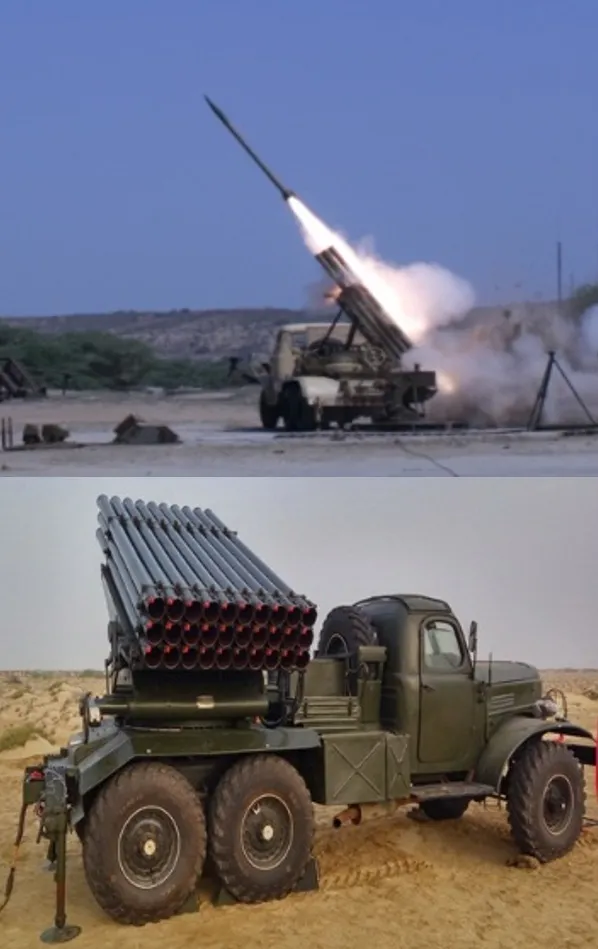
The KRL-122 Ghazab is a Pakistani 122 mm multiple rocket launcher derived from the BM-21 Grad family and associated with Yarmuk rockets from Pakistan Ordnance Factories. Public reporting in September 2023 identified Azerbaijani KRL-122 launchers in the Nagorno-Karabakh conflict, where the system filled an area-fire rocket artillery role against Armenian positions.

Conflict side
Azerbaijan
Built by
Khan Research LaboratoriesPakistan Ordnance Factories
Built in
Pakistan
KRL-122 Ghazab, 122 mm multiple rocket launcher, Artillery

Profile

Type
122 mm multiple rocket launcher
Conflict side
Azerbaijan
Origin
Pakistan
Service note
Modern Grad-derived rocket artillery
rocket artillerywheeledsaturation fires

Service History

In service
Reported in Pakistani and Azerbaijani service
Used by
Azerbaijani Armed Forces, Pakistan Army
Wars
Nagorno-Karabakh Conflict

Production History

Designer
Khan Research Laboratories
Designed
Open-source reporting identifies the system as a Pakistani Grad-derived design; exact design date not public
Built by
Khan Research LaboratoriesPakistan Ordnance Factories
Built in
Pakistan
Produced
Not publicly confirmed
Number built
Not publicly confirmed
Variants
KRL-122 / Ghazab, Yarmuk 122 mm rocket family

Specifications

Caliber
122 mm Grad-compatible rockets
Launcher
30 launch tubes reported for the KRL-122 Ghazab; related Grad-family systems commonly use truck-mounted launch racks
Range
More than 40 km reported with enhanced 122 mm rockets; the official Yarmuk MBRL product page lists range greater than 35 km
Rocket
Can fire standard Soviet-pattern 122 mm rockets and Pakistani Yarmuk rockets according to open-source defense reporting
Warhead
GIDS lists the Yarmuk high-explosive warhead at 18 kg with point-detonating or air-burst fuze options
Firing control
Army Recognition reports electric firing from the cabin or by a cable remote from a sheltered position
Mobility
Reported on Isuzu, Reo M35, and Ural-375D-style 6x6 truck chassis depending on variant or observed vehicle

Conflict Usage

Nagorno-Karabakh Conflict
Side: AzerbaijanRole: Area rocket artillery against Armenian positionsstrike

Reportedly fielded by Azerbaijani forces as a Pakistani-made 122 mm multiple rocket launcher against Armenian positions during the September 2023 Nagorno-Karabakh escalation; public reporting traces the evidence to social-media footage, so the entry treats the claim as reported rather than independently confirmed.

Related Weapon Systems

BM-27 Uragan, 220 mm self-propelled multiple launch rocket system, ArtilleryArtilleryBM-27 Uragan220 mm self-propelled multiple launch rocket systemThe BM-27 Uragan is a Soviet 220 mm wheeled multiple launch rocket system built around a 16-tube launcher on the ZIL-135LM chassis. Its heavier rockets give it greater payload and range than BM-21 Grad-class systems, with warhead options including high-explosive fragmentation, cluster, and mine-scattering rounds. In the Russia-Ukraine War it remains a legacy heavy rocket artillery system used for area fires, minelaying, and counter-battery targets by forces that inherited or captured Uragan-family stocks.
BM-30 Smerch, 300 mm heavy multiple launch rocket system, ArtilleryArtilleryBM-30 Smerch300 mm heavy multiple launch rocket systemThe BM-30 Smerch, also designated 9K58, is a Soviet-designed heavy multiple launch rocket system built around a 12-tube 300 mm launcher on an 8x8 wheeled chassis. Its long-range rockets can carry high-explosive, cluster, and thermobaric warheads, making it a deep-fire artillery system rather than a front-line direct-fire weapon. In the Russia-Ukraine War, documented Russian use of 9M55K Smerch cluster rockets has tied the system to attacks on Ukrainian urban areas including Kharkiv and Mykolaiv.

Sources