Russia has used Gerbera UAVs in the 2014 Russia-Ukraine War to imitate Shahed-136/Geran-2 drones, overload Ukrainian air defenses, conduct reconnaissance or signal-relay missions, and in some documented cases carry small warheads or other payloads.
Gerbera
- Gerber
- Gerbera UAV
- Gerbera drone
- Herbera
- Gerbera false target
- Gerbera decoy drone
- Gerbera strike drone
Gerbera is a Russian Shahed-shaped UAV used in Ukraine as a low-cost false target, reconnaissance platform, signal relay, and light one-way attack drone. Ukrainian intelligence links the design to Chinese Skywalker Technology-derived airframes and Alabuga-area assembly, while recovered examples show plywood-and-foam construction, imported electronics, Chinese model-aircraft engines, and variants ranging from unarmed decoys to warhead-carrying and FPV-carrier configurations.
Role in Conflicts
Profile / Specs
Profile
- Origin
- Russia / China-linked component and airframe supply network
- Type
- Multi-role decoy, reconnaissance, and one-way attack UAV
- Service note
- 2024-present 2014 Russia-Ukraine War
- Designer
- Skywalker Technology Co., Ltd. described by Defence Intelligence of Ukraine as the original UAV developer; Russian assembly attributed to Yelabuga/Alabuga production facilities
- Designed
- Publicly identified after July 2024 recoveries in Ukraine
- Unit cost
- Ukrainian and specialist reporting describes an approximate $10,000 low-cost decoy class
- Produced
- 2024-present reported production and fielding
- Developed from
- Shahed-136/Geran-2 visual and operational deception concept, with a smaller foam-and-plywood UAV structure
Specifications
- Role
- False target, reconnaissance/relay UAV, and light one-way attack UAV
- Wingspan
- 2.5 m declared on DIU War & Sanctions profile
- Maximum takeoff weight
- 18 kg declared on DIU War & Sanctions profile
- Maximum speed
- 160 km/h declared on DIU War & Sanctions profile
- Flight range
- 600 km declared on DIU War & Sanctions profile; additional-tank variants reported but not fully verified
- Useful altitude
- Up to 3,000 m declared on DIU War & Sanctions profile
- Launch method
- Elastic or pneumatic catapult in DIU War & Sanctions profile
- Airframe
- Plywood internal structure with foam or polystyrene body in DIU, ISIS, and Defense Express reporting
- Engine
- DLE60 engine from Mile Hao Xiang Technology identified by DIU; ISIS also cites a recovered Stinger 70CC engine example
- Payload
- Usually unarmed in decoy role; Defense Express reported warheads up to 5 kg and one 2.5 kg HE-fragmentation example
- Sensors and links
- Topotek KHY10S90 three-axis gimbal camera and Xingkai Tech Mesh Network XK-F358 modem identified by DIU
- Navigation electronics
- CRPA and flight-controller components using U.S., European, Swiss, and Chinese chips identified by DIU
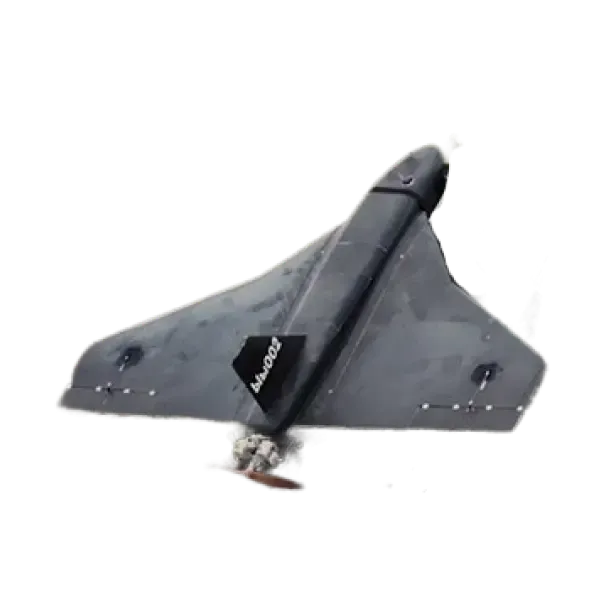
Configuration Logic
Gerbera is useful to Russian forces because the same low-cost airframe can create different problems for Ukrainian defenders. An unarmed airframe can consume attention and interceptor ammunition, a camera-and-modem fit can probe air-defense or communications positions, and an armed fit can turn a cheap decoy into a light strike weapon.
Shahed-like shape and mass use make each incoming UAV hard to dismiss until it is identified or intercepted.
Supported by DIU, ISIS, and AP reporting on Russian false-target tactics.
Recovered examples include camera and mesh-modem equipment that can support visual reconnaissance, relay, or air-defense geolocation tasks.
DIU identified Topotek and Xingkai equipment in Gerbera examples.
Some recovered drones have carried small explosive warheads, making the type unsafe to treat as a harmless decoy.
Defense Express reported warheads up to 5 kg and a photographed 2.5 kg example.
Variants
Open sources describe Gerbera less as a formal mark series than as a common airframe fitted for different Russian missions.
| Variant | Configuration | Designation notes |
|---|---|---|
| Decoy / false-target Gerbera | Unarmed air-defense saturation configuration | ISIS and AP reporting describe Gerbera as part of Russian decoy packages intended to draw Ukrainian sensors, interceptors, and ammunition away from more dangerous strike drones and missiles. Sources: ISIS Russian Decoy Drones Report, AP Operation False Target Investigation, DIU Gerbera Electronic Parts |
| Reconnaissance / relay Gerbera | Camera, modem, or signal-relay configuration | DIU reporting identified Topotek camera and Xingkai mesh modem equipment, while later Ukrainian reporting described Gerberas fitted without cameras or modems as possible electronic-intelligence probes. Sources: DIU Gerbera Electronic Parts, Ukrainska Pravda Gerbera Fuel Tanks |
| Warhead-carrying Gerbera | Light one-way attack configuration | Defense Express reported recovered Gerberas with explosive payloads up to 5 kg, including a photographed 2.5 kg high-explosive fragmentation warhead in the nose. Sources: Defense Express Armed Gerbera |
| FPV-carrier Gerbera | Carrier for a small FPV drone or relay payload | Ukrainian reporting in 2026 described Gerbera airframes adapted to carry or release FPV drones deeper inside Ukrainian territory, though exact payload purpose and frequency remain reported rather than comprehensively documented. Sources: Ukrainska Pravda Gerbera Fuel Tanks, NV Gerbera Fuel Tank Report |
Timeline
Gerbera Key Events
Unknown Shahed-like UAV recovered in Ukraine
Defense Express reported that a previously unidentified foam-bodied UAV shot down in Ukraine was subsequently shown in Russian material under the Gerbera name.
Sources: Defense Express Gerbera Presentation
Gerbera mission set is publicly described
Defense Express summarized Russian presentation material that described Gerbera versions for signals intelligence, explosive attack, and decoy missions.
Sources: Defense Express Gerbera Presentation
DIU publishes component and supply-chain details
Defence Intelligence of Ukraine said Gerbera UAVs were assembled at Yelabuga, used to imitate Shahed-136/Geran-2 drones, and built with foreign components including Chinese engines, cameras, modems, and Western microelectronics.
Sources: DIU Gerbera Electronic Parts
ISIS assesses Gerbera decoy role
The Institute for Science and International Security assessed Gerbera as a Shahed-shaped decoy UAV used in large Russian barrages to complicate Ukrainian air-defense decisions.
Sources: ISIS Russian Decoy Drones Report
Warhead-carrying Gerberas reported
Defense Express reported that recovered or suppressed Gerbera drones had been found with small warheads, shifting the airframe from an unarmed decoy-only assumption to a light strike threat.
Sources: Defense Express Armed Gerbera
War & Sanctions profile updated
DIU's War & Sanctions Gerbera profile listed declared characteristics including 2.5 m wingspan, 18 kg maximum takeoff weight, 160 km/h maximum speed, 600 km range, and catapult launch methods.
Sources: DIU War and Sanctions Gerbera Profile
Additional-fuel-tank Gerberas observed
Ukrainian reporting cited Serhii Flash Beskrestnov saying Russian Gerberas with added fuel tanks had been observed entering Ukrainian airspace and returning toward Russian-controlled territory, with possible electronic-intelligence use still treated as a hypothesis.
Sources: Ukrainska Pravda Gerbera Fuel Tanks, NV Gerbera Fuel Tank Report
Relationship To Shahed-Type Barrages
Gerbera is not a direct substitute for Shahed-136 / Geran-2. It is smaller, cheaper, and usually less destructive, but it is designed to appear in the same air-defense problem set. In mixed Russian attacks, Gerbera and similar false targets can mask the number of genuine strike drones, force defenders to spend scarce interceptors, and create uncertainty about which tracks carry warheads or sensors.
Related Weapon Systems


