Direct proof of use
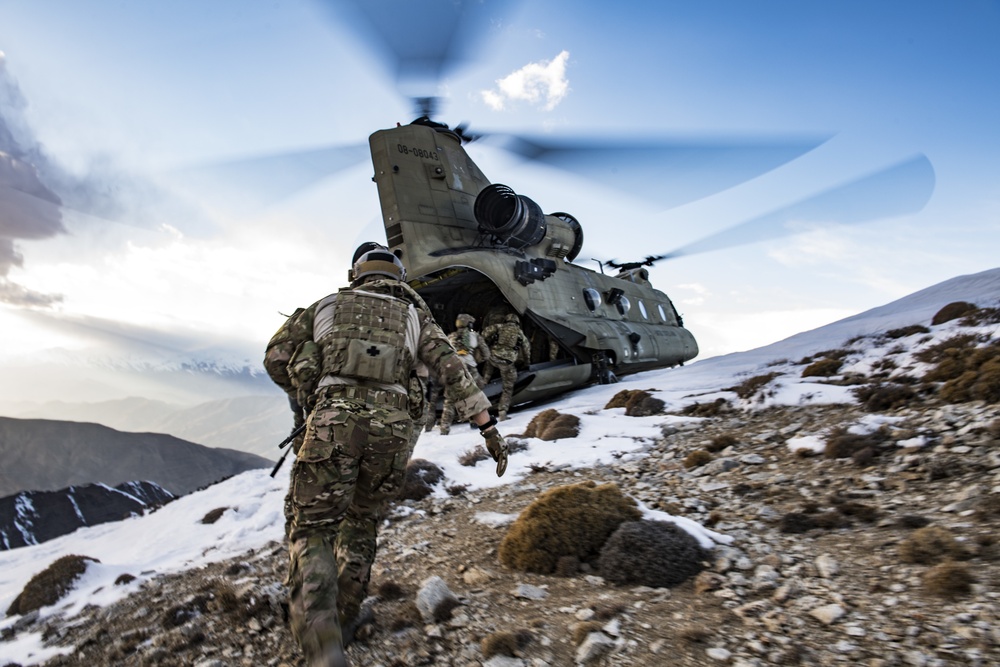
CH-47 and MH-47 Chinook helicopters are directly documented in Afghanistan from the opening combat phase of Operation Enduring Freedom through the post-2015 Operation Freedom's Sentinel period. Army University Press records three CH-47 helicopters delivering 10th Mountain and 101st Airborne troops into blocking positions during Operation Anaconda on March 2, 2002, while ARSOF History describes MH-47E Chinooks of the 160th Special Operations Aviation Regiment operating at Takur Ghar two days later.
Later official records show the aircraft family in routine mobility and rescue work. U.S. Army imagery from February 2010 places an aerial gunner in the rear door of a CH-47 above Khost Province; CENTCOM reporting from May 2011 describes CH-47 Chinooks extracting U.S. and Afghan soldiers after Operation Compass in Wardak; and 2018 Army/DVIDS reporting places U.S. Army CH-47F aircraft at Bagram with Air Force Guardian Angel rescue teams for dedicated personnel-recovery operations.
Sources: Army University Press Operation Anaconda, ARSOF Takur Ghar Chinook Recovery, U.S. Army Afghanistan CH-47 Aerial Security, CENTCOM Operation Compass CH-47 Extraction, U.S. Army Afghanistan CH-47F Rescue Missions, DVIDS Joint Personnel Recovery Operations
Operational roles
The Afghanistan record shows the Chinook primarily as a mobility and recovery aircraft rather than a strike platform. In early 2002, CH-47s inserted conventional infantry into high-altitude blocking positions in the Shah-i-Khot Valley and MH-47Es carried special-operations teams during the Battle of Takur Ghar. Those missions also exposed the aircraft to enemy fire; ARSOF History reports two MH-47E Chinooks downed at Takur Ghar, one of which was later recovered and returned to service.
By 2010 and 2011, official reporting shows the type supporting battlefield movement, aerial security, and extraction. The 2011 CENTCOM account of Operation Compass places CH-47 Chinooks at an improvised landing zone after two days of fighting in Wardak Province, where U.S. and Afghan troops boarded and returned to their combat outpost. A separate 2017 DVIDS report describes sling-load transport by helicopter as a common logistics method in Afghanistan and links the training to operational readiness across Combined Joint Operations Area-Afghanistan.
Sources: Army University Press Operation Anaconda, ARSOF Takur Ghar Chinook Recovery, U.S. Army Afghanistan CH-47 Aerial Security, CENTCOM Operation Compass CH-47 Extraction, DVIDS Afghanistan Sling Load Operations
Personnel recovery and losses
Personnel recovery became a documented post-2015 CH-47F task at Bagram. The U.S. Army reported in March 2018 that Army CH-47F crews and Air Force Guardian Angel teams conducted Operation Freedom's Sentinel personnel-recovery exercises from Bagram, with the aircraft valued for high-altitude lift, range, payload, medical evacuation, aircraft recovery, parachute-drop, disaster-relief, and combat search-and-rescue capabilities. DVIDS separately described the same joint approach as Air Force rescue teams integrating with U.S. Army CH-47 crews as the first dedicated joint personnel-recovery team in that theater.
The Chinook's Afghanistan use also included combat losses. An ISAF Joint Command release published by the U.S. Army says an inbound CH-47 carrying special-operations forces took fire from several insurgent locations on approach before the August 6, 2011 crash in Wardak Province that killed 38 Afghan and coalition service members. The same release says coalition forces later killed Taliban insurgents associated with the downing in Chak district.
Sources: U.S. Army Afghanistan CH-47F Rescue Missions, DVIDS Joint Personnel Recovery Operations, U.S. Army Wardak CH-47 Downing