- Side
- Ukraine

Oryx lists Swedish RBS-56 BILL anti-tank guided missiles among equipment delivered or pledged to Ukraine before March 2023, and Defence24 reported RBS 56 visible in Ukrainian hands during the full-scale war.
Role detailsBofors BILL is a Swedish wire-guided anti-tank guided missile family built around an overfly top-attack flight path, allowing the warhead to strike armor from above rather than through frontal armor. Bofors developed the original RBS 56 BILL after a 1979 order, Saab describes BILL 2 as the later dual-warhead upgrade, and open-source transfer tracking documents Swedish RBS-56 BILL missiles delivered or pledged to Ukraine before March 2023.
Oryx lists Swedish RBS-56 BILL anti-tank guided missiles among equipment delivered or pledged to Ukraine before March 2023, and Defence24 reported RBS 56 visible in Ukrainian hands during the full-scale war.
Role detailsPublic evidence for Ukraine currently supports transfer and fielding context, not a named launch event or unit-level engagement. Oryx places RBS-56 BILLs in Sweden's Ukraine aid record before March 2023, and Defence24 reported the system visible in Ukrainian hands.
The BILL family was built around a roof-attack solution rather than a simple frontal-armor shot. Saab's history says Bofors pursued a missile that would strike the tank roof, and Arboga Robotmuseum describes a missile path above the sightline with wire-transmitted steering commands from the sight.
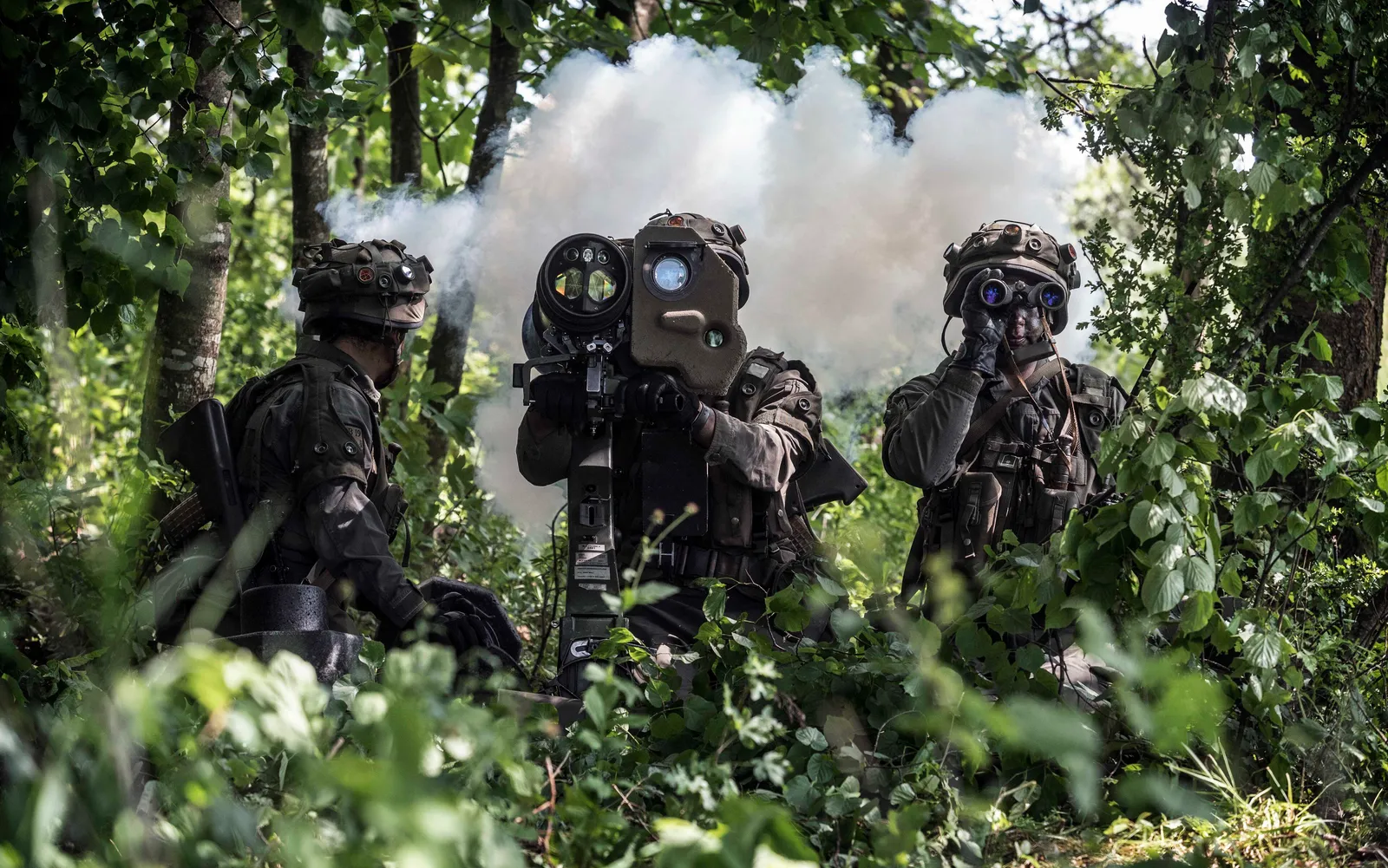
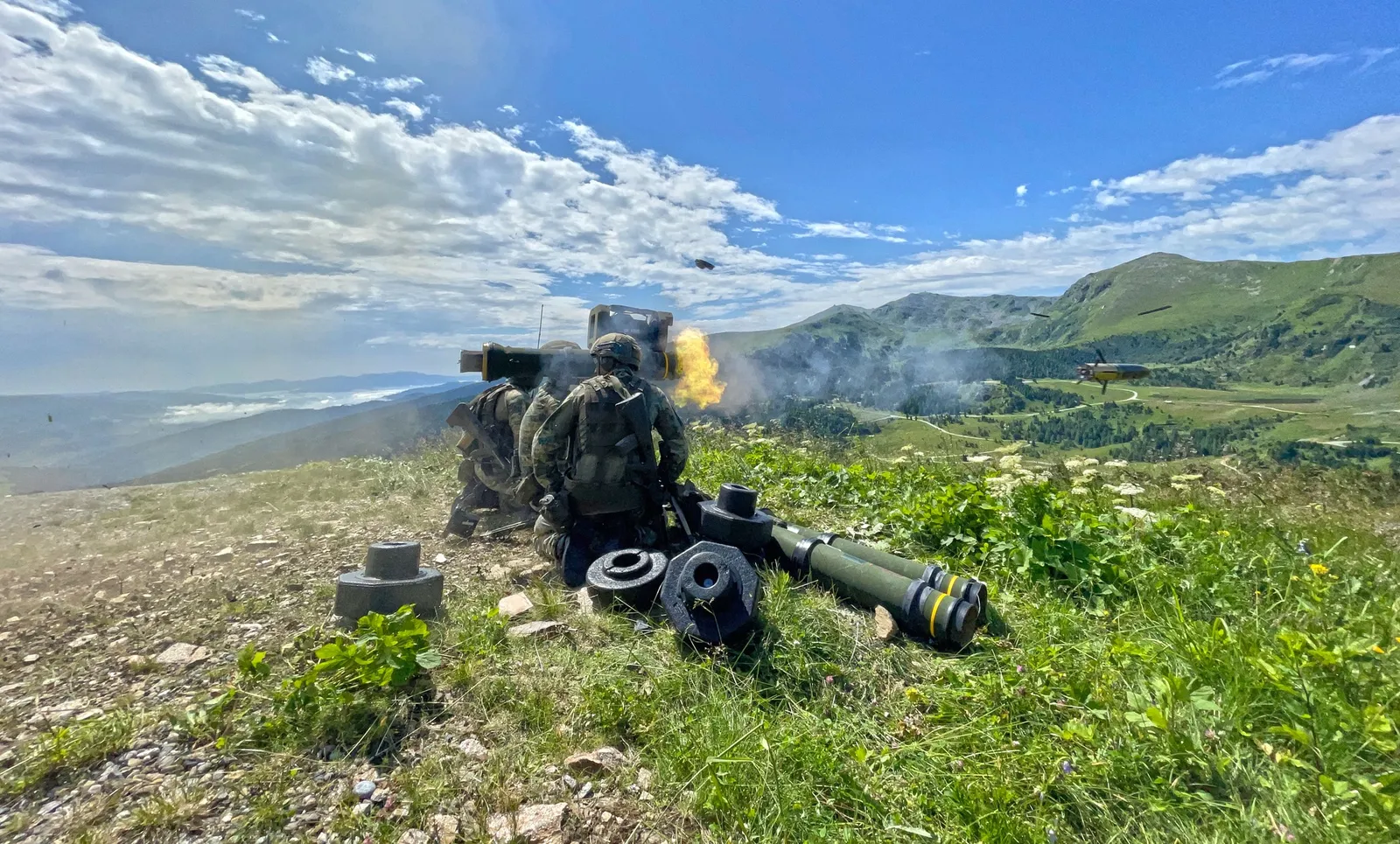
The gunner keeps the target in the day or thermal sight while commands travel to the missile over a wire.
Arboga Robotmuseum gives nominal overflight paths of 0.8 m for RB 56 and 1.2 m for RB 56B.
RB 56B/BILL 2 changed from one angled warhead to two downward-directed warheads and a more sophisticated proximity-fuze system.
The BILL family centers on the original RBS 56/BILL 1 and the later RBS 56B/BILL 2 upgrade, both retaining the overfly top-attack concept.
| Variant | Configuration | Designation notes |
|---|---|---|
| RBS 56 BILL | Original Swedish overfly top-attack missile | Saab's history says Bofors received the development order in 1979, demonstrated the first prototype in 1982, and began serial deliveries in 1988; Arboga Robotmuseum describes it as the original Swedish RBS 56 system. Sources: Saab history: From infantry guns to missiles, RBS56 |
| RBS 56B BILL 2 | Dual-warhead improved variant | Saab and Arboga Robotmuseum describe BILL 2/RB 56B as the version with two downward-directed warheads, while Army Technology adds the three selectable firing modes and vehicle-mounting options. Sources: Saab history: From infantry guns to missiles, RBS56, BILL 2 Anti-Tank Guided Weapon |
BILL 2 was also tested in vehicle-installation concepts beyond the tracked Bandvagn anti-tank carrier.
| Compatible item | Item type | Compatibility evidence |
|---|---|---|
 | Infantry fighting vehicle demonstrator | Army Technology says FMV awarded Saab Bofors a contract in 2000 for a technology demonstrator integrating BILL 2 into the turret of a Bofors Defence CV 9040 combat vehicle. Sources: BILL 2 Anti-Tank Guided Weapon |
The BILL family appears on the Bandvagn 2063 carrier variant for anti-tank defence.
| Carrier | Carrier type | Carriage evidence |
|---|---|---|
 | Tracked carrier vehicle | European Security & Defence describes the Pansarvarnsrobotbandvagn 2063 as a Bandvagn 206 variant equipped with TOW and BILL weapon systems for anti-tank defence. Sources: Mounted Missiles |
Saab's history says Sweden ordered both Saab and Bofors to study a future missile against all types of tanks, leading Bofors engineers toward a top-attack concept.
Sources: Saab history: From infantry guns to missiles
Bofors received the order to develop BILL, the Bofors Infantry Light and Lethal anti-tank missile.
Sources: Saab history: From infantry guns to missiles
Saab's history says the first BILL prototype was demonstrated in 1982.
Sources: Saab history: From infantry guns to missiles
Saab's history says serial deliveries of BILL began in 1988, and Arboga Robotmuseum says RBS 56 was introduced into Swedish service that year.
Sources: Saab history: From infantry guns to missiles, RBS56
Army Technology says FMV awarded Saab Bofors a contract to demonstrate BILL 2 integration in the turret of a Bofors Defence CV 9040 combat vehicle.
Sources: BILL 2 Anti-Tank Guided Weapon
Saab said BILL 2 would engage moving and static targets at ranges up to 2,200 metres and was wire guided, immune to jamming, and designed to attack from above.
Sources: Saab receives billion order
Oryx listed Swedish RBS-56 BILL missiles among anti-tank guided missiles delivered or pledged to Ukraine, with the delivery timing marked before March 2023; Defence24 also described RBS 56 as visible in Ukrainian hands.
Sources: No Assembly Required: Swedish Arms Deliveries To Ukraine, Swedish ATGM spotted in Ukraine