Direct proof of use
Defense News reported in February 2016 that the Q-53 Counterfire Target Acquisition Radar was deployed in support of Operation Inherent Resolve, the U.S.-led military operation against the Islamic State group. The same report attributed to an Army spokesman that the radar had been in continuous Operation Inherent Resolve service for eight months and had performed in real-world contingency operations in Iraq and Afghanistan.
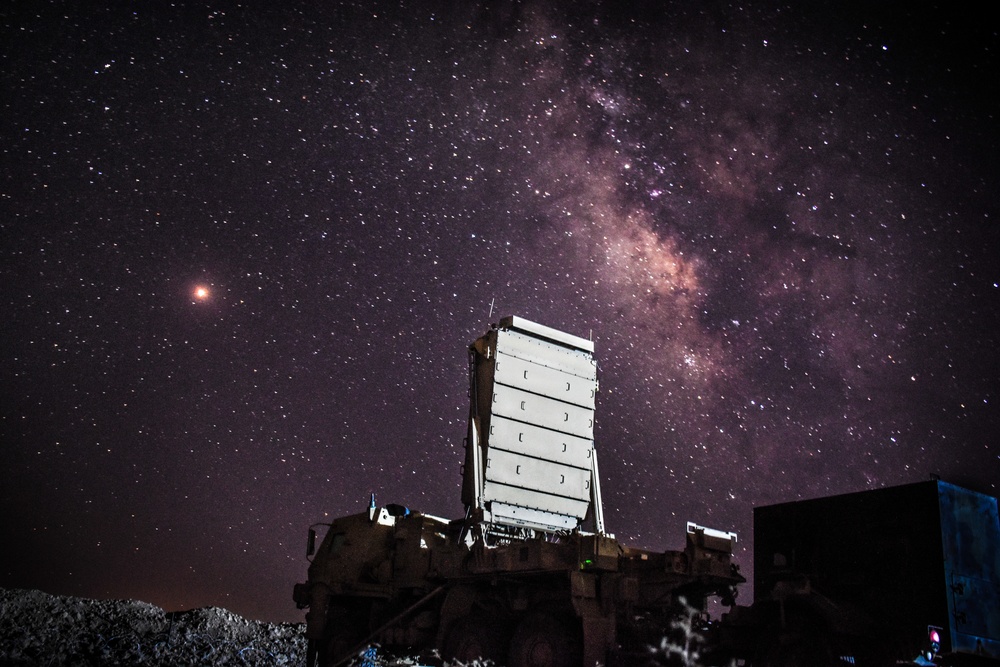
A U.S. Army DVIDS image from August 14, 2018, gives a later direct field example: a Q-53 radar with the 65th Field Artillery Brigade's Target Acquisition Platoon scanned to determine the point of origin of enemy indirect fire during Operation Inherent Resolve. The caption states that indirect-fire detection provided early warning and coalition counterfire capability as CJTF-OIR worked with partner forces against Daesh in Iraq and Syria.
Sources: Defense News Q-53 OIR Deployment, DVIDS America's Thunder Watches During OIR
Timeline
By early 2016, public reporting placed the Q-53 in Operation Inherent Resolve service, after the radar family had moved from urgent counterfire fielding into broader Army fleet adoption. Defense News described the radar as deployed for the anti-Islamic State operation and reported an eight-month continuous readiness period.
In November 2016, Defense Systems reported that the AN/TPQ-53 had deployed earlier that year as part of Operation Inherent Resolve and that Col. John Rafferty said the radar was exceptionally reliable during his unit's Iraq deployment. In August 2018, DVIDS documented a 65th Field Artillery Brigade Q-53 radar scanning for enemy indirect-fire origins during Operation Inherent Resolve.
Sources: Defense News Q-53 OIR Deployment, Q-53 Radar Upgrade Counters Drone Strikes, DVIDS America's Thunder Watches During OIR
Operational role
In the Islamic State campaign, the AN/TPQ-53 was documented as a coalition sensor rather than a strike weapon. Its direct-source role was to find enemy indirect-fire points of origin, provide early warning, and support counterfire options for coalition forces. Public reporting also tied the radar to emerging air-surveillance and counter-UAS work, with Defense Systems describing a 2016 Army award to add counter-unmanned-aircraft quick-reaction capability to the AN/TPQ-53.
The 2021 Field Artillery article on Q-53A Multi-Mission Radar integration described the system in the CENTCOM area of responsibility as tracking both indirect fire and unmanned aerial systems. It said the 130th Field Artillery Brigade developed integration methods for Operation Spartan Shield and Operation Inherent Resolve support, and identified one author as the CJTF-OIR sensor manager and liaison for the brigade.
Sources: DVIDS America's Thunder Watches During OIR, Q-53 Radar Upgrade Counters Drone Strikes, Q-53A MMR Integration with FAAD
Campaign context
CJTF-OIR was formally established on October 17, 2014, to command the fight against ISIS in Iraq and Syria. Its history describes coalition operations moving from degradation and counterattack phases into the 2017-2020 defeat phase, with Iraqi and Syrian partner forces clearing major ISIS-held areas and coalition forces continuing support after the loss of ISIS territorial control.
The Q-53 evidence fits that coalition force-protection and base-defense context. Public sources support use by U.S. Army and coalition forces, but they do not identify a specific ISIS unit, a named launch point found by a particular radar, or a specific counterfire engagement caused by an AN/TPQ-53 track.
Sources: CJTF-OIR History, DVIDS America's Thunder Watches During OIR, Defense News Q-53 OIR Deployment