Munitions

AIR-2A Genie rocket

Also known as
  • AIR-2 Genie
  • AIR-2A
  • Genie rocket
  • MB-1 Genie
  • ATR-2 training rocket

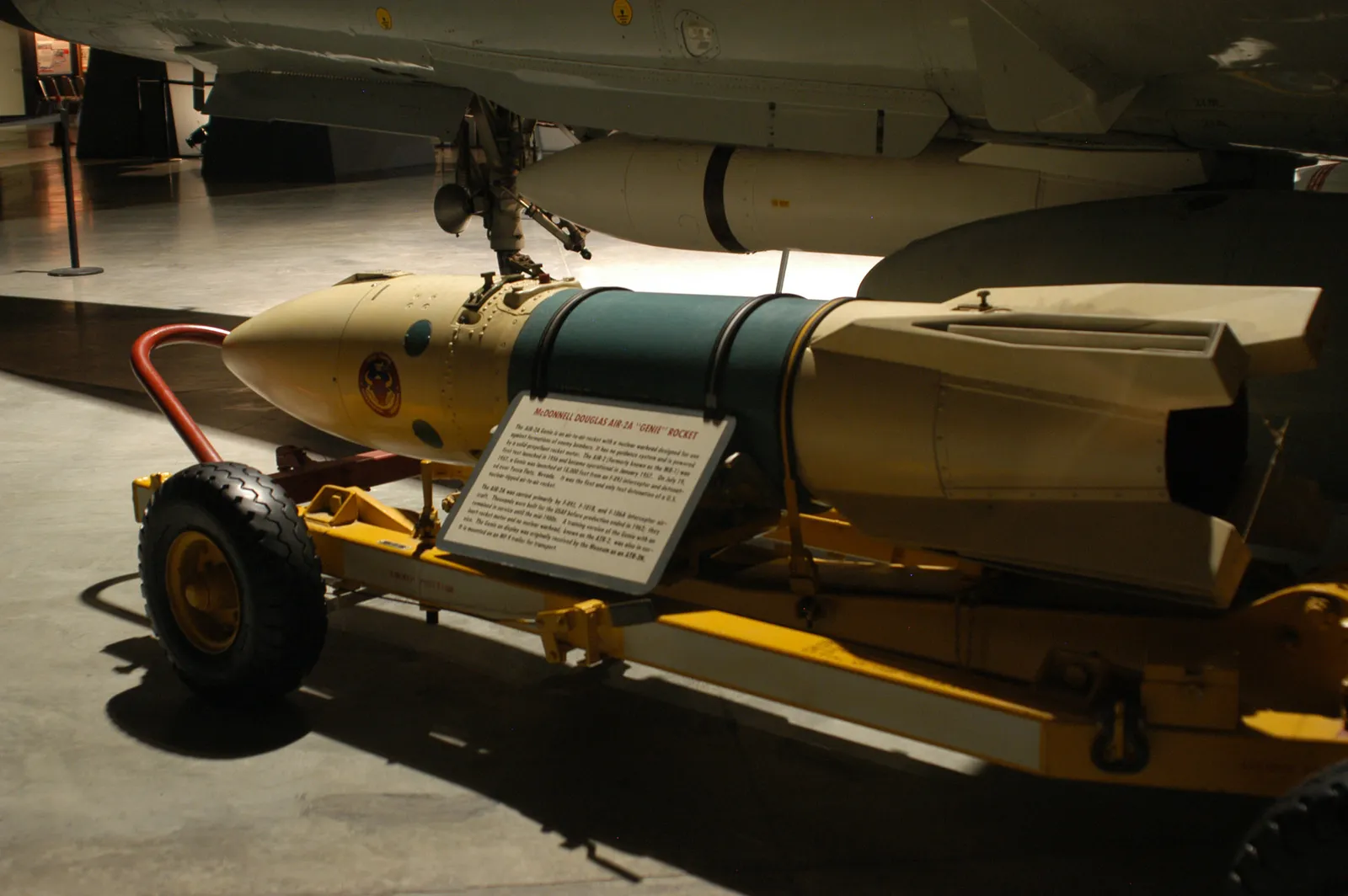
The AIR-2A Genie was a Douglas-built unguided nuclear air-to-air rocket for Cold War bomber-interceptor defense. It used blast effect rather than terminal guidance, pairing a W25 nuclear warhead with modified F-89J, F-101B/CF-101B, and F-106A interceptor aircraft in U.S. and Canadian air-defense service.

Profile / Specs

Profile

Origin
United States
Type
Nuclear air-to-air rocket
Service note
Cold War
Designer
Douglas Aircraft Company
Designed
Douglas began work in 1954; full-scale development began in 1955
Produced
Production ended in 1962
Number built
Thousands built; Air & Space Forces Magazine reports about 3,150 Genie weapons

Specifications

Guidance
Unguided
Warhead
W25 nuclear fission warhead, 1.5 kilotons
Propulsion
Thiokol SR49 solid-fueled rocket motor
Length
9 ft 8 in
Diameter
17.5 in
Weight
822 lb
Maximum speed
About Mach 3
Range
About 6 miles
Primary U.S. carrier aircraft
F-89J, F-101B, and F-106A interceptors
Canadian carrier aircraft
CF-101 Voodoo
Operational service
January 1957 to the mid-1980s
Training version
ATR-2A / ATR-2N training rocket with no nuclear warhead
Variants

The Genie designation changed as U.S. missile nomenclature shifted from MB-1 to the AIR-2 series, while training and later motor-upgrade rounds kept related but distinct designations.

VariantConfigurationDesignation notes
MB-1 GenieOriginal operational designation

Boeing heritage material says the weapon was designated MB-1 and became operational in 1957 before the later AIR-2 series redesignation.

Sources: Boeing Select Products - MB-1/AIR-2 Genie Missile

AIR-2A GenieOperational nuclear air-to-air rocket

The MB-1 became AIR-2A in the 1963 AIR-2 designation series; museum sources identify the AIR-2A as the nuclear-armed rocket carried by F-89J, F-101B, and F-106A interceptors.

Sources: Boeing Select Products - MB-1/AIR-2 Genie Missile, McDonnell Douglas Air-2A Genie Rocket

ATR-2A / ATR-2NTraining rocket

Boeing identifies the MB-1-T as ATR-2A and says the training rocket was also known as ATR-2N; the National Museum display example was received as an ATR-2N.

Sources: Boeing Select Products - MB-1/AIR-2 Genie Missile, McDonnell Douglas Air-2A Genie Rocket

AIR-2BMotor-upgraded rocket

Boeing says Thiokol began producing a longer-life AIR-2 motor in 1965 and that upgraded Genie rockets were designated AIR-2B after the mid-1970s.

Sources: Boeing Select Products - MB-1/AIR-2 Genie Missile

Carrier Aircraft

The Genie was built for bomber-interceptor aircraft rather than general fighter armament.

CarrierCarrier typeCarriage evidence
F-101 Voodoo, Supersonic fighter, interceptor, and reconnaissance aircraft, Aircraft & UAVsF-101 VoodooF-101B/CF-101B interceptor aircraft

The National Museum identifies the F-101B as a primary AIR-2A carrier and lists two AIR-2A rockets in F-101B armament. Canadian museum sources document CF-101 Voodoo service with Genie nuclear-tipped rockets under U.S.-Canadian/NORAD custody and release arrangements.

Sources: McDonnell Douglas Air-2A Genie Rocket, McDonnell F-101B Voodoo, CF-101 Voodoo, Air Force Museum of Alberta CF-101

Carrier And Release Context

The Genie was an interceptor weapon built around aircraft fire-control systems, rapid launch, and nuclear blast radius rather than missile guidance. Official museum pages identify the F-89J, F-101B, and F-106A as Genie-capable U.S. interceptors; Canadian CF-101 Voodoos also carried AIR-2A rockets in NORAD air-defense service.

F-89J Scorpion

The F-89J fired the 19 July 1957 live Genie test and carried two AIR-2A rockets with four AIM-4C Falcon missiles.

Source: Northrop F-89J Scorpion.

F-101B / CF-101B Voodoo

The F-101B carried two AIR-2A rockets; Canadian CF-101s later carried Genie rockets under U.S. custody and joint NORAD release arrangements.

Sources: McDonnell F-101B Voodoo; CF-101 Voodoo; Air Force Museum of Alberta CF-101.

F-106A Delta Dart

The F-106A technical notes list one AIR-2A Genie and four AIM-4 Falcon missiles, with the MA-1 fire-control system able to manage the attack run and weapon release.

Source: Convair F-106A Delta Dart.
Timeline

AIR-2A Genie rocket Key Events

  1. Douglas begins Genie work

    Douglas Aircraft began work on a small unguided nuclear air-to-air weapon for interceptor defense.

    Sources: Boeing Select Products - MB-1/AIR-2 Genie Missile

  2. Full-scale development starts

    Boeing heritage material places full-scale Genie development in 1955, after early code names including Bird Dog, Ding Dong, and High Card.

    Sources: Boeing Select Products - MB-1/AIR-2 Genie Missile

  3. First test launch

    The AIR-2, formerly known as the MB-1, was first test-launched in 1956.

    Sources: McDonnell Douglas Air-2A Genie Rocket

  4. Operational service begins

    The Genie became operational in January 1957; Air & Space Forces Magazine describes the initial operational capability as a small force of rockets and modified F-89 interceptors at Wurtsmith and Hamilton air bases.

    Sources: McDonnell Douglas Air-2A Genie Rocket, The Heyday of Nuclear Air Defense

  5. F-89J nuclear rocket test

    An F-89J fired the only live nuclear Genie test over the Nevada test range, demonstrating the nuclear air-to-air rocket concept with a W25 warhead.

    Sources: McDonnell Douglas Air-2A Genie Rocket, Northrop F-89J Scorpion, Boeing Select Products - MB-1/AIR-2 Genie Missile

  6. F-89 conversions expand

    By the next year, Air & Space Forces Magazine reports that 268 F-89s had received the wing-pylon and fire-control modifications needed for Genie carriage.

    Sources: The Heyday of Nuclear Air Defense

  7. Production ends

    Thousands of Genie rockets had been built for the USAF before production ended in 1962.

    Sources: McDonnell Douglas Air-2A Genie Rocket

  8. AIR-2 series redesignation

    Boeing says the Genie rockets were designated in the AIR-2 series in June 1963, with MB-1 becoming AIR-2A and MB-1-T becoming ATR-2A.

    Sources: Boeing Select Products - MB-1/AIR-2 Genie Missile

  9. Genie becomes available in Canada

    The Air Force Museum of Alberta says nuclear AIR-2A Genie rockets became available in Canada after a 1963 agreement with the United States.

    Sources: Air Force Museum of Alberta CF-101

  10. Longer-life motor production

    Thiokol began producing a longer-life AIR-2 rocket motor with wider firing-temperature limits.

    Sources: Boeing Select Products - MB-1/AIR-2 Genie Missile

  11. Canadian CF-101 service ends

    Canadian museum sources place CF-101 Voodoo service from 1961 to 1984, ending the Canadian Genie carrier context as CF-101s were replaced by CF-18s.

    Sources: CF-101 Voodoo, Air Force Museum of Alberta CF-101

Related Weapon Systems
Stunner interceptor, Missile interceptor, Air DefenseAir DefenseStunner interceptorMissile interceptorThe Stunner interceptor is the two-stage hit-to-kill missile fired by David's Sling, Israel's mid-tier air and missile-defense layer co-developed by Rafael and Raytheon. CSIS describes the missile as using radar datalink updates and onboard terminal seekers, while RTX markets SkyCeptor as a Stunner-family variant for short- to medium-range missile-defense threats. Source-backed operational use is documented in Gaza-related interceptions and the post-October 2023 Israel-Hezbollah fighting.
F/A-18 Hornet (Tactical), Carrier-capable multirole strike fighter, Aircraft & UAVsAircraft & UAVsF/A-18 Hornet (Tactical)Carrier-capable multirole strike fighterThe F/A-18 Hornet (Tactical) is the National Naval Aviation Museum's label for the original McDonnell Douglas F/A-18 A-D Hornet family, a twin-engine carrier-capable strike fighter that entered Marine Corps service in 1983 and U.S. Navy service in 1984. NAVAIR describes the Hornet as the nation's first all-weather fighter and attack aircraft; its documented combat record spans Libya, Desert Storm, Kosovo, Afghanistan, Iraq, and later coalition campaigns.
Python-5 air-to-air missile, Fifth-generation dual-use air-to-air and air-defense missile, MunitionsMunitionsPython-5 air-to-air missileFifth-generation dual-use air-to-air and air-defense missilePython-5 is Rafael's fifth-generation dual-use air-to-air and air-defense missile, built around a dual-waveband imaging infrared seeker, lock-on-before-launch and lock-on-after-launch modes, and a full-sphere launch envelope. Public sources document Israeli F-16 use against Hezbollah UAVs in 2006 and Gaza-launched drones in 2021, while SPYDER batteries use Python-5 as the infrared-imaging interceptor alongside Derby-family radar-guided missiles.

Sources