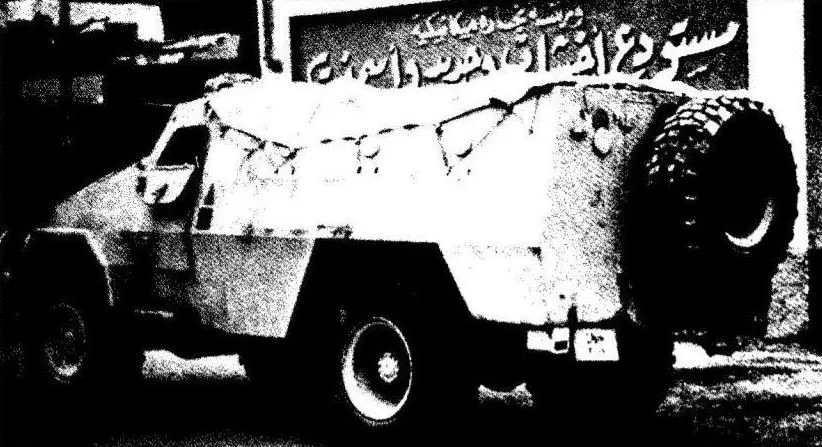
Army Guide says the Walid, also referred to as the Waleed, was used in combat for the first time in the 1967 Middle East campaign; GlobalSecurity likewise places Egyptian Walid use in the 1967 war with Israel.
Armored Vehicles
Walid armored personnel carrier
Also known as
- Walid
- Al Walid
- Al-Walid
- Waleed
- Walid 1
- Walid 2
- Kader Walid
The Walid, also rendered Al Walid or Waleed, is an Egyptian 4x4 armored personnel carrier produced by Kader Factory for Developed Industries. Open sources describe it as a BTR-40-like open-topped APC using a German Magirus-Deutz/UNIMOG-derived truck chassis made under licence in Egypt with a locally produced armored body, two crew, space for about ten troops, a pintle 7.62 mm machine gun, central tire-pressure regulation, and no amphibious, NBC, or night-vision equipment. It first saw combat in the 1967 Arab-Israeli war, later appeared in captured Israeli service, and was followed in Egyptian production by the Fahd APC family.
Role in Conflicts
Profile / Specs
Profile
- Origin
- Egypt
- Type
- 4x4 wheeled armored personnel carrier
- Service note
- 1960s-1980s production family
- Designer
- Kader Factory for Developed Industries
- Designed
- 1960s
- Produced
- Late 1960s through the early 1980s
- Number built
- Reference sources report about 1,000 vehicles or list known operator holdings below that total
- Developed from
- German Magirus-Deutz/UNIMOG-derived 4x4 truck chassis with Soviet BTR-40/BTR-152 design influence
- Developed into
- Fahd armored personnel carrier
Specifications
- Crew and passengers
- 2 crew plus about 10 troops
- Configuration
- 4x4 wheeled APC with front engine, central driver/commander positions, and rear troop compartment
- Chassis
- German Magirus-Deutz/UNIMOG-derived truck chassis manufactured under licence in Egypt
- Dimensions
- 6.12 m long, 2.57 m wide, and 2.3 m high
- Weight and payload
- About 12,000 kg combat weight with a listed 2,800 kg payload
- Mobility
- 168 hp diesel engine, about 86 km/h road speed, and about 800 km road range
- Protection
- All-welded steel hull; reference sources list light steel armor in the 8 mm range, with heavier frontal estimates in some summaries
- Armament
- Basic APC with a pintle-mounted 7.62 mm machine gun; other weapons could be mounted around the open hull top
- Troop access and firing ports
- Rear door with spare wheel, three firing/observation ports per side, and additional rear ports
- Equipment limits
- Army Guide lists no NBC system, no night-vision equipment, and no amphibious capability; central tire-pressure regulation fitted as standard
Operators And Captured Examples
Published open sources support a cautious operator section rather than a precise current-inventory table. Army Guide lists Walid quantities for Egypt, Sudan, Yemen, Burundi, and Israel, while GlobalSecurity says the Egyptian-made APC was supplied to Burundi, Iraq, Sudan, and Yemen and was often used for internal security or riot-control roles outside Egypt.
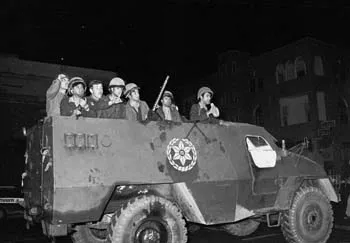
Captured Israeli example
The Commons image used in the gallery identifies the photographed vehicle as an IDF Walid 4x4 APC on 6 March 1975.
Export/operator caveat
Army Guide quantity figures are useful as reference holdings, but they are not treated here as current inventories without a newer military-balance source.
Variants
Walid sources use the name for the baseline Egyptian 4x4 APC and several adaptations; published references disagree on whether the closest Soviet analogue should be treated as BTR-40-like or BTR-152-derived.
| Variant | Configuration | Designation notes |
|---|---|---|
| Walid 1 | Baseline 4x4 APC | Open-topped troop carrier on a Magirus-Deutz-derived chassis, normally armed with a pintle 7.62 mm machine gun. Sources: Army Guide Walid, GlobalSecurity Walid |
| Walid 2 | Improved automotive variant | Introduced in 1981 and described by Army Guide as based on Mercedes-Benz automotive components. Sources: Army Guide Walid |
| Walid minelayer | Mine-laying adaptation | Reference sources describe a minelayer conversion fitted with a mine-laying chute or rear ramp at the troop-compartment door. Sources: Army Guide Walid, Tank AFV Kader Walid |
| Walid multiple-rocket launcher | Rocket launcher adaptation | GlobalSecurity describes a self-propelled Walid rocket-launcher variant with either six or twelve 80 mm launcher tubes. Sources: GlobalSecurity Walid |
| Walid command vehicle | Command adaptation | Specialist reference material lists a command-vehicle adaptation with additional communications equipment. Sources: Tank AFV Kader Walid |
| Walid riot-control vehicle | Internal-security adaptation | GlobalSecurity says Walids supplied outside Egypt were often used for internal-security or riot-control roles, and Tank AFV lists a riot-control car among Walid adaptations. Sources: GlobalSecurity Walid, Tank AFV Kader Walid |
Design Lineage And Replacement
The Walid is best explained as an Egyptian armored body on a German-derived 4x4 truck chassis, shaped by Soviet APC experience and later displaced in Egyptian service by Kader's Fahd.
| System | Relationship | Supported context |
|---|---|---|
 | Design analogue | Army Guide and Military Periscope describe the Walid as visually and functionally similar to the Soviet BTR-40. |
 | Lineage caveat | GlobalSecurity instead calls Al-Walid an Egyptian-produced variant of the BTR-152, so the entry preserves the source disagreement. |
 | Replacement | Army Guide says the Fahd replaced the Walid in Egyptian Army service; AOI places Fahd's Kader launch after Al Walid. |
Timeline
Walid armored personnel carrier Key Events
Al Walid enters Kader armored-vehicle production history
AOI says Kader produced the Middle East's first armored vehicle, Al Walid, in 1967; Army Guide says the Walid was first used in combat during the 1967 Middle East campaign.
Sources: AOI Kader Factory, Army Guide Walid
Captured example photographed in Israeli service
The Commons page for the Savoy Hotel attack image identifies the vehicle photographed in Israel as an IDF Walid 4x4 wheeled APC.
Sources: Savoy Hotel attack III Walid image
Walid 2 introduced
Army Guide describes the Walid 2 as an improved version based on Mercedes-Benz automotive components.
Sources: Army Guide Walid
Fahd follows the Walid in Kader production
AOI says Kader launched the Fahd APC in 1984, while Army Guide describes the Fahd as the Egyptian Army replacement for the Walid.
Sources: AOI Kader Factory, Army Guide Walid
Media
Walid armored personnel carrier Images
Related Weapon Systems


Sources
Army Guide WalidPublisher: Army Guide | Note: Supports Walid manufacturer attribution, Kader development background, APC description, variants, core specifications, replacement context, and 1967 Six-Day War direct conflict-use context for the system. | Accessed: 2026-07-13GlobalSecurity WalidPublisher: GlobalSecurity.org | Note: Supports Walid background and says the vehicle was first used by Egypt during the 1967 Six-Day War with Israel, plus export/operator context, rocket-launcher variant context, and general configuration details. | Accessed: 2026-07-13GlobalSecurity Walid SpecificationsPublisher: GlobalSecurity.org | Note: Supports Walid country of origin, Kader manufacturer attribution, configuration, crew, armament, dimensions, mobility, and armor data. | Accessed: 2026-07-13Tank AFV Kader WalidPublisher: Tank AFV | Note: Supports Walid design context, variant list, operator overview, and supplemental specification details. | Accessed: 2026-07-13Military Periscope Walid OverviewPublisher: Military Periscope | Note: Supports open-source description of the Walid as an Egyptian open-top 4x4 APC also known as Al Walid or Waleed, with BTR-40 resemblance and UNIMOG-chassis context visible in the public preview. | Accessed: 2026-07-13AOI Kader FactoryPublisher: Arab Organization for Industrialization | Note: Supports Kader factory history, Al Walid production in 1967, Fahd APC launch in 1984, and Kader's armored-vehicle manufacturing role. | Accessed: 2026-07-13Walid CIA file photoPublisher: Wikimedia Commons | Note: Image provenance and public-domain licensing page for a November 1987 CIA Office of Scientific Weapons Research file photo of a Walid armored personnel carrier. | Accessed: 2026-07-13Savoy Hotel attack III Walid imagePublisher: Wikimedia Commons | Note: Image provenance and CC BY-SA 3.0 licensing page for an IDF Walid 4x4 APC photograph from the 1975 Savoy Hotel attack scene. | Accessed: 2026-07-13