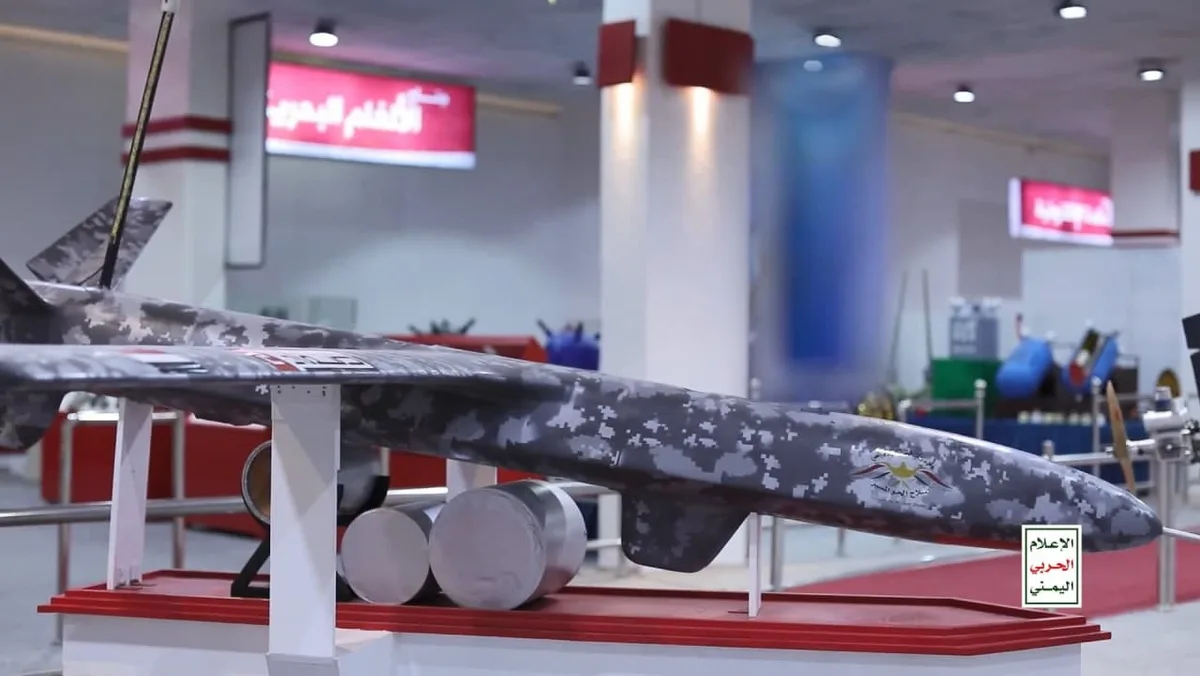

Used by Houthi-aligned forces in the 2014 Yemen Civil War as a long-range reconnaissance and attack UAV; the UN Panel of Experts inspected UAV-X/Samad-2-type drones in reconnaissance and loitering-munition configurations, while later technical analysis cautioned that Samad-2 range was more limited than Samad-3.
Role detailsAircraft & UAVs
Samad-2 UAV
Also known as
- Sammad-2
- UAV-X
- Samad 2
- Sammad 2
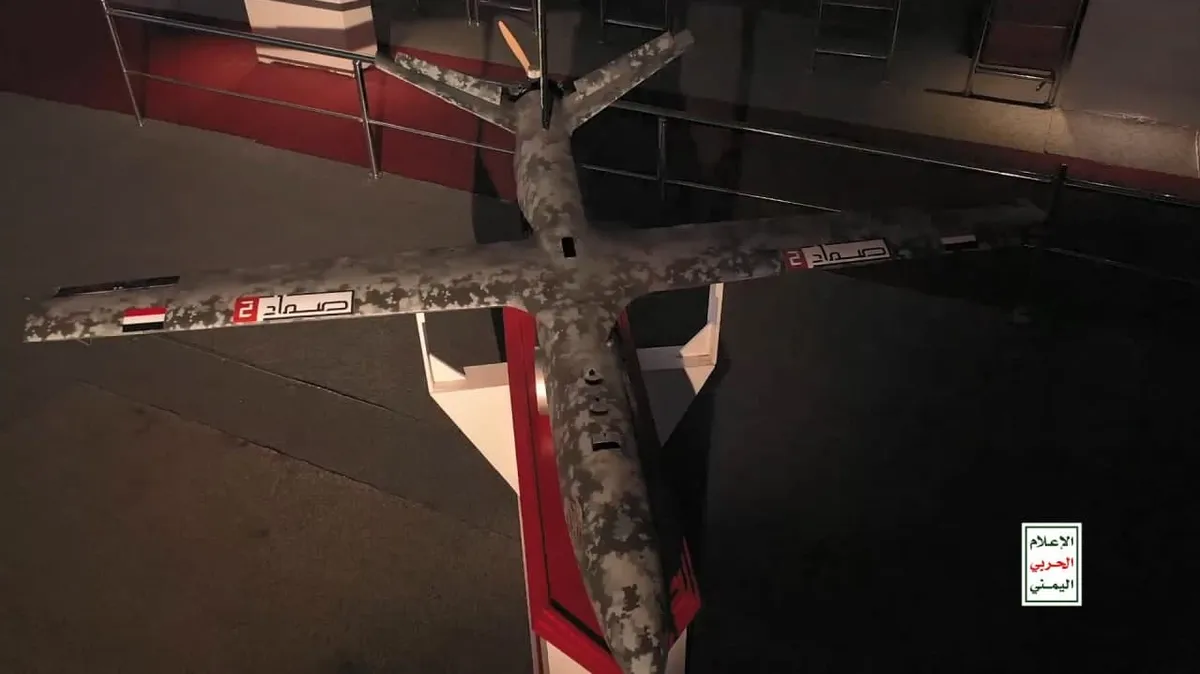
The Samad-2 is the Houthi Samad family’s UAV-X long-range reconnaissance and attack variant, documented in 2014 Yemen Civil War reporting with a V-tail pusher layout, camera fit, and 18 kg explosive warhead option. UN investigators inspected examples in Houthi service, while flight-performance work distinguishes the Samad-2 from the longer-ranged Samad-3 despite their shared airframe family.
Role in Conflicts
Profile / Specs
Profile
- Origin
- Yemen
- Built by
- Houthi movement
- Type
- Reconnaissance and loitering munition UAV
- Service note
- 2014 Yemen Civil War, late 2010s-present
- Designer
- Houthi military-industrial network
- Designed
- 2019
- Unit cost
- Unknown
- Produced
- Late 2010s-present
- Number built
- Unknown
Specifications
- Length
- About 2.8 m
- Wingspan
- About 4.5 m
- Fuselage circumference
- About 84 cm
- Payload
- Reconnaissance camera, including Nikon D810 in one recovered configuration, or about 18 kg explosive warhead with ball bearings
- Fuel capacity
- About 21 L main fuselage tank in UN-reported UAV-X/Samad-2 data
- Propulsion
- Rear-mounted 3W110i B2 or DLE 170 pusher engine
- Configuration
- Fixed-wing UAV with V-tail, rear pusher propeller, ventral protrusion, and wing skids
- Early UN-estimated UAV-X range
- About 1,200-1,500 km depending on wind conditions
- Modeled Samad-2 range
- Science & Global Security modeled median Samad-2 range around 887-989 km in standard no-wind conditions
Airframe And Payload Profile
Samad-2 is best read as the baseline weaponized UAV-X airframe rather than the longest-range member of the family. UN investigators documented the same basic platform in reconnaissance and loitering-munition roles, while later flight modeling separated its practical reach from the external-tank Samad-3.
UAV-X identification
UN reporting used UAV-X for recovered Houthi drones with V-shaped tail fins, a rear pusher engine, and Samad-2/3 public naming overlap.
Mission fits
Recovered examples included reconnaissance camera equipment and attack versions with an 18 kg explosive payload mixed with ball bearings.
Range caution
The UN range estimate was 1,200-1,500 km under favorable assumptions; independent modeling gave Samad-2 a shorter median range and treated Samad-3 as the long-reach variant.
Variants
UN reporting used UAV-X for the airframe later associated with the Samad-2/Samad family. Later technical reporting generally treats Samad-2 as the larger reconnaissance and attack airframe, Samad-3 as the external-fuel-tank extended-range derivative, and Samad-1 as the smaller reconnaissance member.
| Variant | Configuration | Designation notes |
|---|---|---|
 | Smaller reconnaissance family member | UN and technical reporting identify Samad-1 as the reconnaissance member of the family, distinct from the larger Samad-2/UAV-X airframe. Sources: UN Security Council Panel of Experts on Yemen, S/2020/326, Flight Performance Analysis of the Samad Attack Drones Operated by Houthi Armed Forces |
 | Extended-range attack variant | Samad-3 is described as a Samad-2-derived aircraft with an external upper fuel tank that extends range. Sources: Flight Performance Analysis of the Samad Attack Drones Operated by Houthi Armed Forces |
Samad Family Links
The Samad-2 sits between the smaller Samad-1 reconnaissance UAV and the longer-range Samad-3 attack variant in the Houthi-operated Samad line.
| Compatible item | Item type | Compatibility evidence |
|---|---|---|
| Reconnaissance UAV | Samad-1 is the shorter-range reconnaissance baseline in the family, while Samad-2 uses the larger UAV-X airframe for reconnaissance or attack roles. Sources: UN Security Council Panel of Experts on Yemen, S/2020/326, Flight Performance Analysis of the Samad Attack Drones Operated by Houthi Armed Forces |
| Extended-range attack UAV | Samad-3 is the Samad-2-derived extended-range model, distinguished by added fuel capacity. Sources: Flight Performance Analysis of the Samad Attack Drones Operated by Houthi Armed Forces |
Timeline
Samad-2 UAV Key Events
UAV-X deployment noted
The UN Panel of Experts reported that Houthi forces began deploying a new longer-range UAV type it called UAV-X from August 2018.
Sources: UN Security Council Panel of Experts on Yemen, S/2019/83
UN inspection of UAV-X debris
Panel investigators inspected UAV-X examples recovered in Saudi Arabia and the United Arab Emirates, documenting reconnaissance and attack configurations.
Sources: UN Security Council Panel of Experts on Yemen, S/2019/83
Flight-performance analysis published
A Science & Global Security study modeled Samad-2 and Samad-3 performance and found the external-tank Samad-3 had substantially greater reach than the Samad-2.
Sources: Flight Performance Analysis of the Samad Attack Drones Operated by Houthi Armed Forces
Media
Related Weapon Systems


Sources
Flight Performance Analysis of the Samad Attack Drones Operated by Houthi Armed ForcesPublisher: Science & Global Security | Note: Supports Samad family background, Samad-2 dimensions and payload, Samad-3 external-tank distinction, pusher-engine layout, and modeled range limits for Samad-2 versus Samad-3. | Accessed: 2026-07-01UN Security Council Panel of Experts on Yemen, S/2019/83Publisher: United Nations Security Council | Note: Supports 2014 Yemen Civil War conflict-use: used by Houthi-aligned forces; the UN panel documents UAV-X/Samad-2-type drones in Houthi reconnaissance and attack roles, including dimensions, engines, payload, range estimate, and recovered examples inspected in Saudi Arabia and the United Arab Emirates. | Accessed: 2026-07-01UN Security Council Panel of Experts on Yemen, S/2020/326Publisher: United Nations Security Council | Note: Supports 2014 Yemen Civil War conflict-use and designation context: used by Houthi-aligned forces; the panel describes UAV-X/Samad family development, separates the extended-range fuel-tank version from the original UAV-X, and documents Samad-family component supply patterns. | Accessed: 2026-07-01The Missile War in YemenPublisher: Center for Strategic and International Studies | Note: Supports 2014 Yemen Civil War conflict-use context: used by Houthi-aligned forces; CSIS identifies the Samad-1/-2/-3 family in the Houthi arsenal and treats Samad-2 as a UAV-X-derived extended-range variant while noting limits and disputes around some Houthi strike claims. | Accessed: 2026-07-01Houthi Rebels Unveil Host of Weaponry, Compounding Drone and Missile ThreatPublisher: Oryx | Note: Supports 2014 Yemen Civil War conflict-use: used by Houthi-aligned forces; the article identifies the Samad-2 loitering munition as first publicly unveiled in 2019 and says it has been used in many attacks since. It also supports the image provenance for the Samad-2 and related Samad-family images. | Accessed: 2026-07-01PAX Violent Skies Yemen Drone WarfarePublisher: PAX for Peace | Note: Supports 2014 Yemen Civil War conflict-use: used by Houthi-aligned forces; the report describes UAV-X/Samad-type drones used by the Houthis for long-range attacks on military, airport, air-defense, radar, and oil-infrastructure targets. | Accessed: 2026-07-01