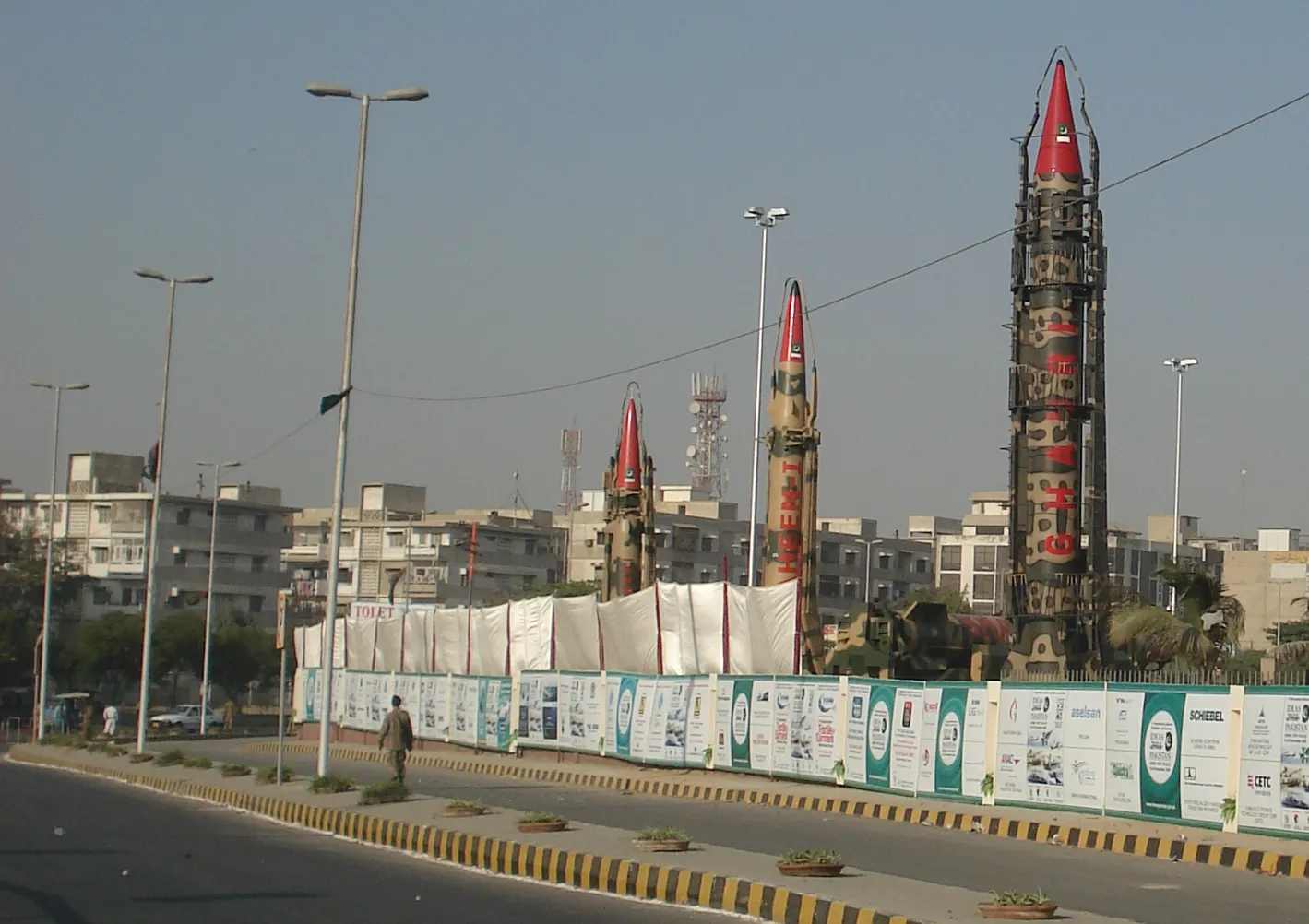
Munitions

Ghauri / Hatf-5

Also known as
  • Ghauri
  • Hatf-5
  • Hatf 5
  • Hatf V
  • Hatf-5A
  • Hatf V-A
  • Ghauri-I
  • Ghauri-1
  • Ghauri-II
  • Ghauri-2

Ghauri, also designated Hatf-5, is a Pakistani road-mobile, single-stage, liquid-fueled medium-range ballistic missile associated with Kahuta Research Laboratories' strategic missile work and with North Korean Nodong design lineage in Western open-source assessments. CSIS Missile Threat lists the baseline system as operational with 1,250 to 1,500 km range, while Pakistani training-launch reporting commonly cites a 1,300 km conventional or nuclear-capable missile.

Profile / Specs

Profile

Origin
Pakistan
Type
Road-mobile medium-range ballistic missile
Service note
Entered Pakistani service in 2003; CSIS listed the system as operational in its 2024 update
Designer
Khan Research Laboratories / Kahuta Research Laboratories
Designed
Public sources describe the first Ghauri/Hatf-5 flight test in 1998
Produced
In service from 2003 according to CSIS Missile Threat
Developed from
North Korean Hwasong-7 / Nodong 1 design lineage reported by CSIS Missile Threat and NTI

Specifications

Class
Medium-range ballistic missile
Basing
Road-mobile
Propulsion
Single-stage liquid propellant
Range
1,250 to 1,500 km according to CSIS Missile Threat; Pakistani 2018 launch reporting cited up to 1,300 km
Payload
Single warhead; CSIS lists 700+ kg payload class and a separating warhead weighing up to 1,200 kg
Warhead options
CSIS lists nuclear, high-explosive, submunition, and chemical warhead options; Pakistani test reporting describes conventional and nuclear warhead capability
Dimensions
15.9 m length and 1.35 m diameter according to CSIS Missile Threat
Launch weight
15,850 kg according to CSIS Missile Threat
Guidance and accuracy
CSIS reports 2,500 m CEP and notes that guidance improvements could make the system more accurate than that public estimate
Launch platform
Transporter-erector-launcher; CSIS describes modified Scud-B TEL vehicles and The Diplomat reported 2018 launch footage from a TEL
Operational limitation
Liquid propellant can increase launch-preparation time and complicate storage and transportation compared with solid-fuel systems

Variants

Public sources use Ghauri and Hatf-5 for a Pakistani liquid-fueled MRBM line: Ghauri-1/Hatf-5 is the baseline operational missile represented by this page, Hatf-5A/Ghauri-2 is the longer-range variant, and Ghauri-3 appears in open sources as a reported development program rather than an established operational missile.

VariantConfigurationDesignation notes
Hatf-5A / Ghauri-2Longer-range liquid-fueled variant

CSIS describes Ghauri-2 as a longer-range Hatf-5 variant using lighter construction and improved propellants, with an expected range of at least 1,800 km; Arms Control Association lists Ghauri-2/Hatf-5a as tested or in development at 1,800 km.

Sources: Ghauri (Hatf 5), Worldwide Ballistic Missile Inventories

Ghauri-3Reported development program

Arms Control Association lists Ghauri-3 as a 3,000 km liquid-fueled development item, while NTI says KRL had repeatedly indicated that Ghauri-3 was ready for testing; this record does not treat it as an operational variant.

Sources: Worldwide Ballistic Missile Inventories, Khan Research Laboratories (KRL)

Design Lineage And Adjacent Systems

Open-source missile references connect Ghauri to the North Korean Nodong/Hwasong-7 design line rather than to a documented combat-use record. CSIS describes Hwasong-7/Nodong 1 as the design basis for Pakistan's Ghauri and Iran's Shahab-3, and NTI ties KRL's Ghauri work to liquid-fueled medium-range missiles built with North Korean assistance.

Parent lineage

CSIS identifies the Hwasong-7/Nodong 1 as the design basis for Ghauri; no separate public catalog page for Nodong/Hwasong-7 was found during this enrichment.

Adjacent branch

Shahab series ballistic missiles cover Iran's related Shahab branch, including Shahab-3, which CSIS also connects to the Nodong design family.

Launcher context

CSIS describes Hatf-5 as designed for launch from modified Scud-B transporter-erector-launcher vehicles; the catalog keeps that as context rather than a precise named launcher link.

Timeline

Ghauri / Hatf-5 Key Events

  1. First Ghauri test noted in public reporting

    Dawn reported that the Ghauri missile was first test-fired on April 6, 1998; NTI ties the April 1998 Ghauri-1/Hatf-5 test to KRL's liquid-fueled missile-development effort.

    Sources: Pakistan succesfully test-fires Hatf-V Ghauri missile: ISPR, Khan Research Laboratories (KRL)

  2. Ghauri-2 flight-test context enters public references

    NTI describes KRL's Ghauri-2/Hatf-5A test activity after the 1998 Ghauri-1 flight, while CSIS describes Ghauri-2 as the longer-range Hatf-5 variant.

    Sources: Khan Research Laboratories (KRL), Ghauri (Hatf 5)

  3. CSIS lists Ghauri in service

    CSIS Missile Threat lists Hatf-5/Ghauri as entering service in 2003 and remaining operational in its April 2024 update.

    Sources: Ghauri (Hatf 5)

  4. Dawn reports Hatf-V test

    Dawn reported an ISPR-announced test of the Hatf-V Ghauri missile and described it as a liquid-fueled missile with a 1,300 km range.

    Sources: Pakistan succesfully test-fires Hatf-V Ghauri missile: ISPR

  5. Army Strategic Forces Command training launch

    Dawn and The Diplomat reported an October 2018 Ghauri training launch by Pakistan's Army Strategic Forces Command, with Pakistani reporting citing a 1,300 km missile able to carry conventional or nuclear warheads.

    Sources: Pakistan conducts training launch of nuclear-capable Ghauri Missile System, Pakistan Conducts Test of Ghauri Medium-Range Ballistic Missile

Media
Related Weapon Systems
Shahab series ballistic missiles, Iranian short- and medium-range ballistic missile family, MunitionsMunitionsShahab series ballistic missilesIranian short- and medium-range ballistic missile familyThe Shahab series is Iran's older liquid-fuel ballistic-missile line, spanning Scud-derived Shahab-1 and Shahab-2 short-range missiles and the No-Dong-derived Shahab-3 medium-range missile. CSIS and IISS describe Shahab-1 as a Scud-B copy with roughly 300 km class range, Shahab-2 as Iran's Scud-C line with roughly 500 km range, and Shahab-3 as the road-mobile MRBM that entered Iranian service in 2003 and became the basis for later Ghadr/Qadr and Emad variants.
Fatah-I 301 mm guided rocket, 301 mm guided artillery rocket, MunitionsMunitionsFatah-I 301 mm guided rocket301 mm guided artillery rocketThe Fatah-I 301 mm guided rocket is a Pakistan-origin guided artillery rocket associated with the Fatah-I/Fatah-1 multiple-launch rocket system. GIDS lists Fatah-I with at least 140 km range, sub-50 m CEP, and eight rockets per launch vehicle, while Janes described a 2025 Fatah GMLRS display model with a four-round pod for 301 mm Fatah-I rockets. Pakistan state media reported Fatah-1 and Fatah-2 use in Operation Bunyan-un-Marsoos during the 2025 India-Pakistan Conflict.
Fatah-I / Fatah-1, Guided multiple launch rocket system, ArtilleryArtilleryFatah-I / Fatah-1Guided multiple launch rocket systemThe Fatah-I, also written Fatah-1, is a Pakistani guided multiple launch rocket system developed by NESCOM and marketed by GIDS for conventional precision fires. GIDS lists a range of at least 140 km, CEP under 50 m, and eight rockets per launcher, while Dawn reported Pakistan's first public test announcement in August 2021. In the 2025 India-Pakistan Conflict, Pakistani accounts and subsequent reporting identified Fatah-1 alongside Fatah-2 as part of Operation Bunyan-un-Marsoos strikes against Indian military targets.
North Korean KN-23 / KN-24, Road-mobile short-range ballistic missile family, ArtilleryArtilleryNorth Korean KN-23 / KN-24Road-mobile short-range ballistic missile familyThe KN-23 and KN-24 are North Korean solid-fuel short-range ballistic missiles in the Hwasong-11 family. The KN-23 is a road-mobile, quasi-ballistic SRBM with an estimated maximum range of about 690 km, while the KN-24 is a smaller ATACMS-like tactical ballistic missile assessed at roughly 410 km. Recovered debris, official U.S. and Ukrainian analysis, UN-panel inspection work, and independent component tracing tie transferred DPRK missiles to Russian strikes in the 2014 Russia-Ukraine War.
Fatah-II / Fatah-2, Surface-to-surface guided multiple launch rocket system, ArtilleryArtilleryFatah-II / Fatah-2Surface-to-surface guided multiple launch rocket systemFatah-II, also written Fatah-2, is a Pakistani surface-to-surface guided multiple launch rocket system developed by NESCOM and marketed by GIDS for long-range conventional precision fires. GIDS's current product page lists a 250 km range, 150 kg warhead, INS+GNSS guidance, and sub-10 m CEP, while earlier launch-era reporting cited 400 km and 365 kg claims. In the 2025 India-Pakistan Conflict it was tied to Pakistan's Operation Bunyan-un-Marsoos strike narrative and to a reported intercept near Sirsa.

Sources