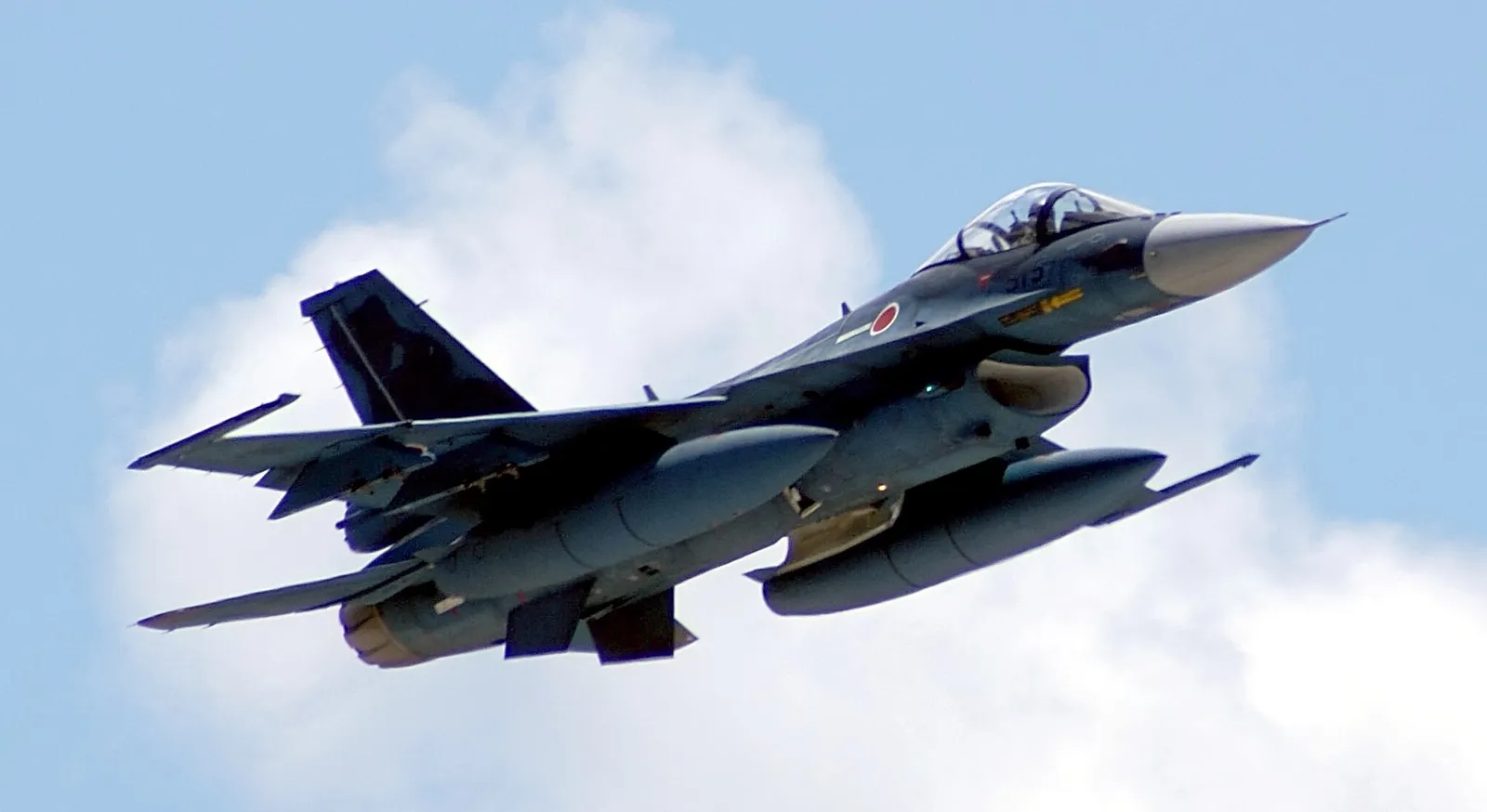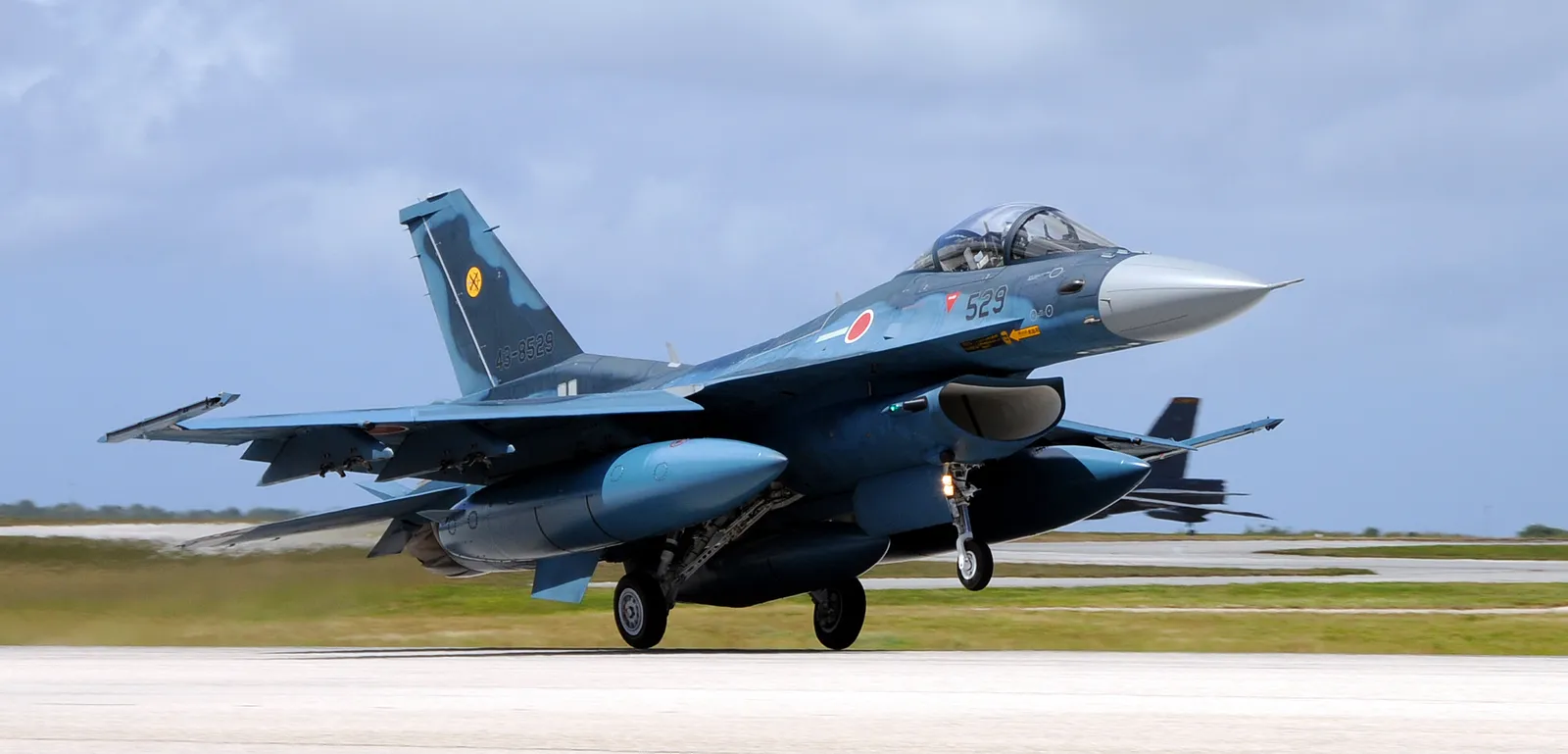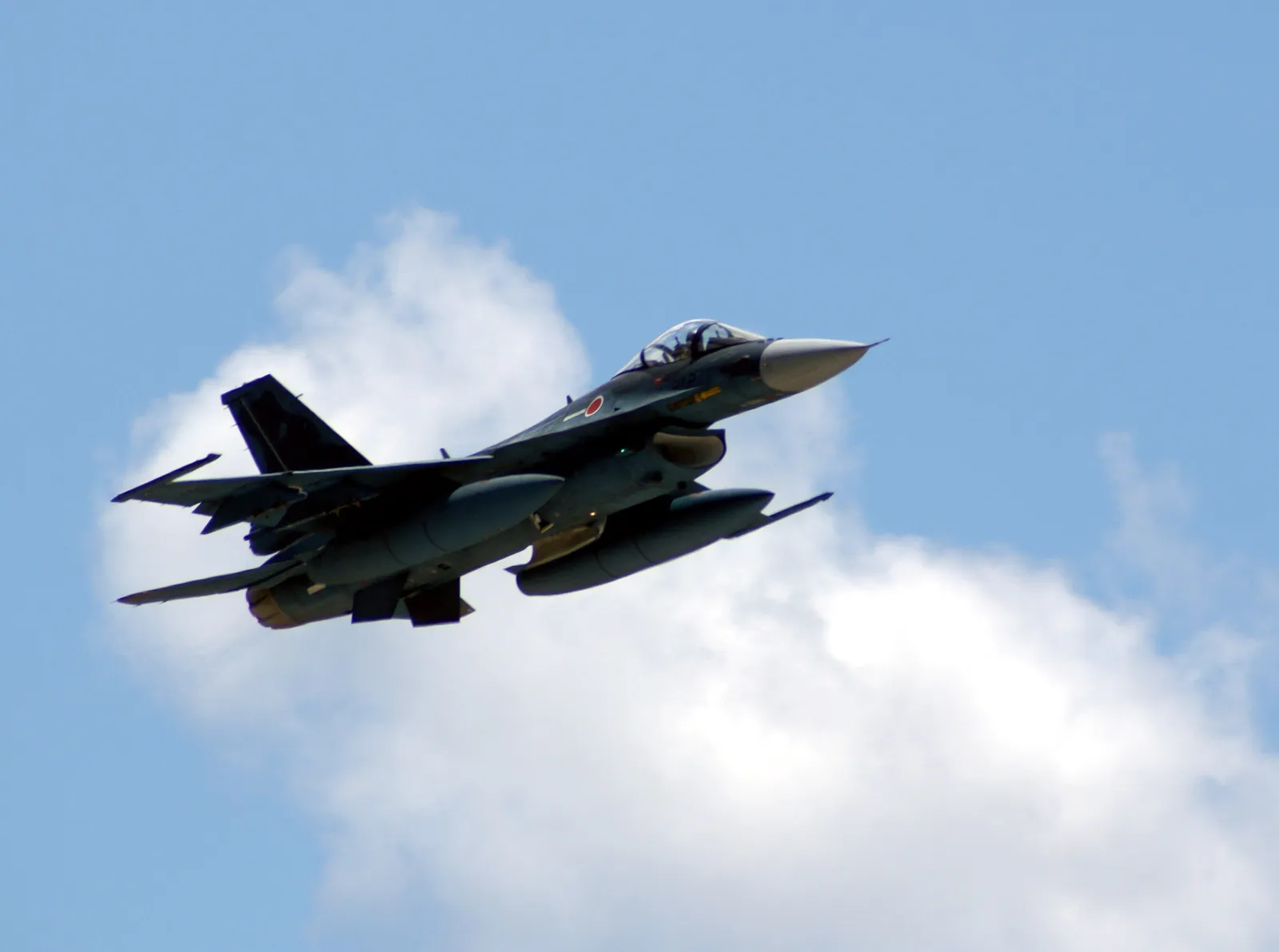
- Side
- Unconfirmed conflict context

Exact model: Mitsubishi/Lockheed Martin F-2A/F-2B Support Fighter. It remains in this holding bucket because public sources document JASDF service and modernization, but not confirmed combat use in a named conflict.
The Mitsubishi F-2 is a Japan Air Self-Defense Force close-support fighter developed with the United States from the F-16 to replace the F-1. Official Japanese and Mitsubishi material highlights a larger composite wing, domestically oriented avionics, a single F110-GE-129 engine, and Mach 2.0 performance.
Exact model: Mitsubishi/Lockheed Martin F-2A/F-2B Support Fighter. It remains in this holding bucket because public sources document JASDF service and modernization, but not confirmed combat use in a named conflict.
JASDF equipment material lists the F-2 with an internal 20 mm cannon, radar-guided air-to-air missiles, infrared air-to-air missiles, and anti-ship missiles. Japanese budget and overview sources separately document JDAM, AAM-4B, and ASM-3A integration or procurement for the F-2 fleet.
The F-2 was built around the F-16 Fighting Falcon in a Japan-U.S. development program to replace the F-1, but its support-fighter role drove several Japan-specific changes.
MHI highlights a composite structure, lighter materials, and a larger wing intended to improve maneuvering and mission load.
Official and program material describes Japanese-developed systems including fly-by-wire controls, integrated electronic warfare equipment, and a glass cockpit.
The JASDF equipment page lists a single F110-GE-129 engine and Mach 2.0 performance.
The production F-2 family is normally divided between the single-seat F-2A fighter and the two-seat F-2B training version.
| Variant | Configuration | Designation notes |
|---|---|---|
| F-2A | Single-seat fighter version | Code One describes the F-2A as the single-seat production fighter version. Sources: Japan's F-2 Support Fighter |
| F-2B | Two-seat training version | Code One describes the F-2B as the two-seat version used primarily for pilot training. Sources: Japan's F-2 Support Fighter |
The F-2's official equipment page identifies the installed engine, which is also a cataloged aircraft powerplant.
| Compatible item | Item type | Compatibility evidence |
|---|---|---|
 | Afterburning turbofan engine | The JASDF equipment page lists a single F110-GE-129 engine for the F-2. Sources: JASDF F-2A/B Equipment Page |
Japanese budget material identifies the carried munitions documented for the F-2.
| Carried item | Item type | Carriage evidence |
|---|---|---|
 | 20 mm aircraft cannon | JASDF material lists the M61 aircraft gun as compatible with the F-2, and the F-2 equipment page lists a 20 mm cannon among the aircraft's armament. Sources: JASDF M61 Aircraft Gun, JASDF F-2A/B Equipment Page |
 | GPS/INS-guided bomb | Japanese Ministry of Defense fighter-production material lists JDAM carriage as an F-2 capability improvement. |
 | Air-to-ship missile | The Ministry of Defense lists ASM-3A as an F-2 weapon, and JASDF overview material shows ASM-3A with the F-2. Sources: FY2023 Defense Programs and Budget of Japan, JASDF Overview 2024 |
 | Medium-range air-to-air missile | The Ministry of Defense says AAM-4B is obtained for F-2 and F-15 aircraft. Sources: FY2021 Supplementary Defense Budget |
MHI says Japan and the United States signed a memorandum of understanding in November 1988 for F-2 development.
Sources: F-2 Fighter
MHI says the support fighter design team was formed in March 1990.
Sources: F-2 Fighter
MHI says the F-2 program completed an actual-scale model in June 1992.
Sources: F-2 Fighter
MHI says the first F-2 prototype flew in October 1995.
Sources: F-2 Fighter
MHI says the first prototype was delivered in March 1996.
Sources: F-2 Fighter
MHI says Japan and the United States signed a production memorandum of understanding for the F-2 in July 1996.
Sources: F-2 Fighter
MHI says the first production F-2 was delivered in September 2000.
Sources: F-2 Fighter
Code One says the 3rd Tactical Fighter Squadron at Misawa formally switched from the F-1 to the F-2 in March 2001.
Sources: Japan's F-2 Support Fighter
A Ministry of Defense report says F-2 production ended in FY2011 after 94 aircraft were built.
Sources: Defense Aircraft Production Report
The Ministry of Defense says the next-generation fighter program started in 2020 to replace the F-2.
Sources: GCAP Overview
The Ministry of Defense identifies the F-2 as one of Japan's current fighter types alongside the F-35 and F-15, while the Global Combat Air Programme page frames the next-generation fighter as the F-2 successor path. FY2023 budget material lists capability upgrades for nine F-2 aircraft worth 128 billion yen; that line is upgrade spending, not a published aircraft purchase price.