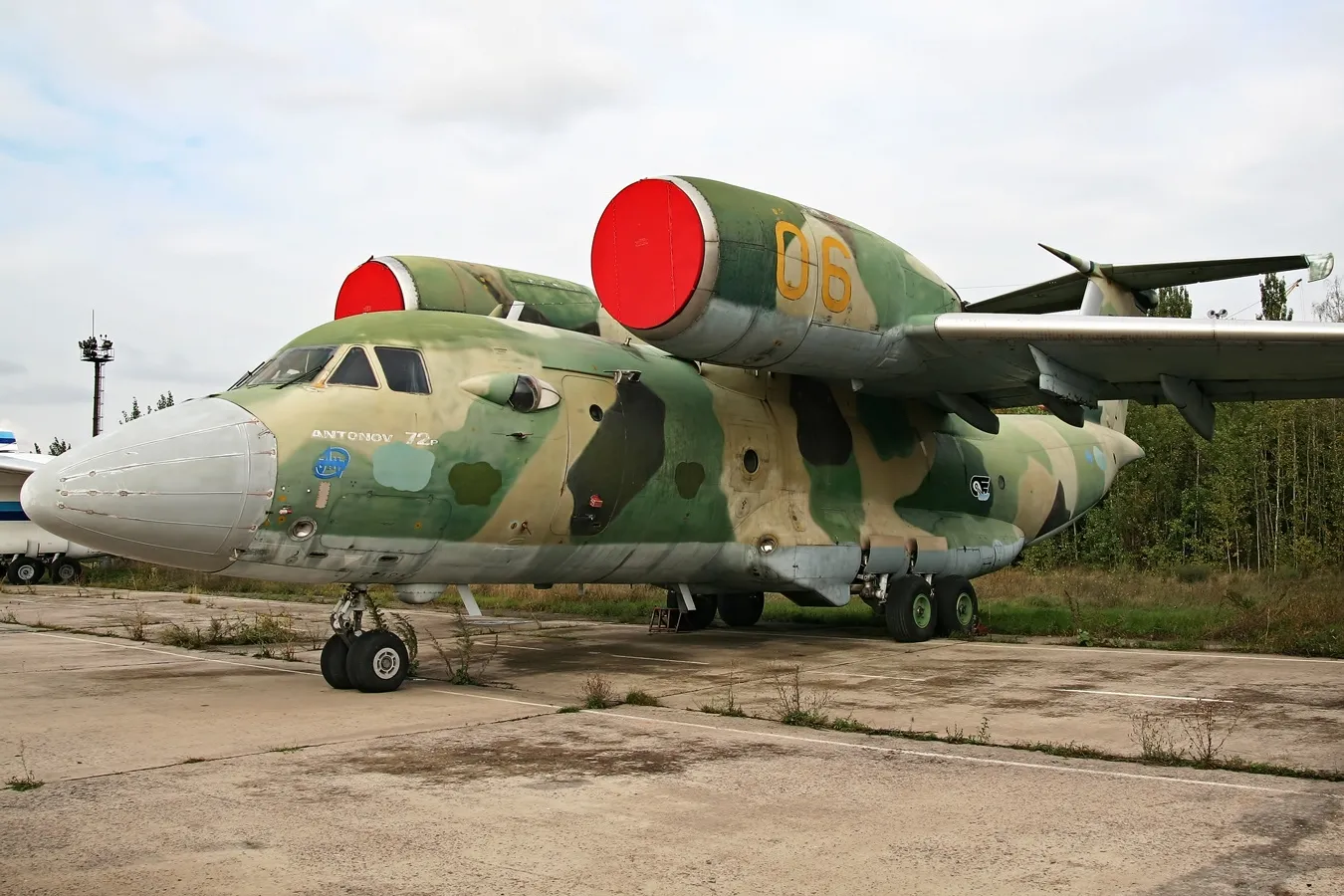
A Russian An-72P patrol aircraft was reported destroyed at Kirovske airfield in occupied Crimea during an April 2, 2026 Ukrainian strike conducted with Ukraine's Unmanned Systems Forces and Defence Intelligence; reporting described the airfield as a Russian aviation and drone hub in the full-scale war.
Role detailsAn-72
- Antonov An-72
- AN-72
- An-72 Coaler
- Coaler
- NATO reporting name Coaler
- Cheburashka
- An-72P
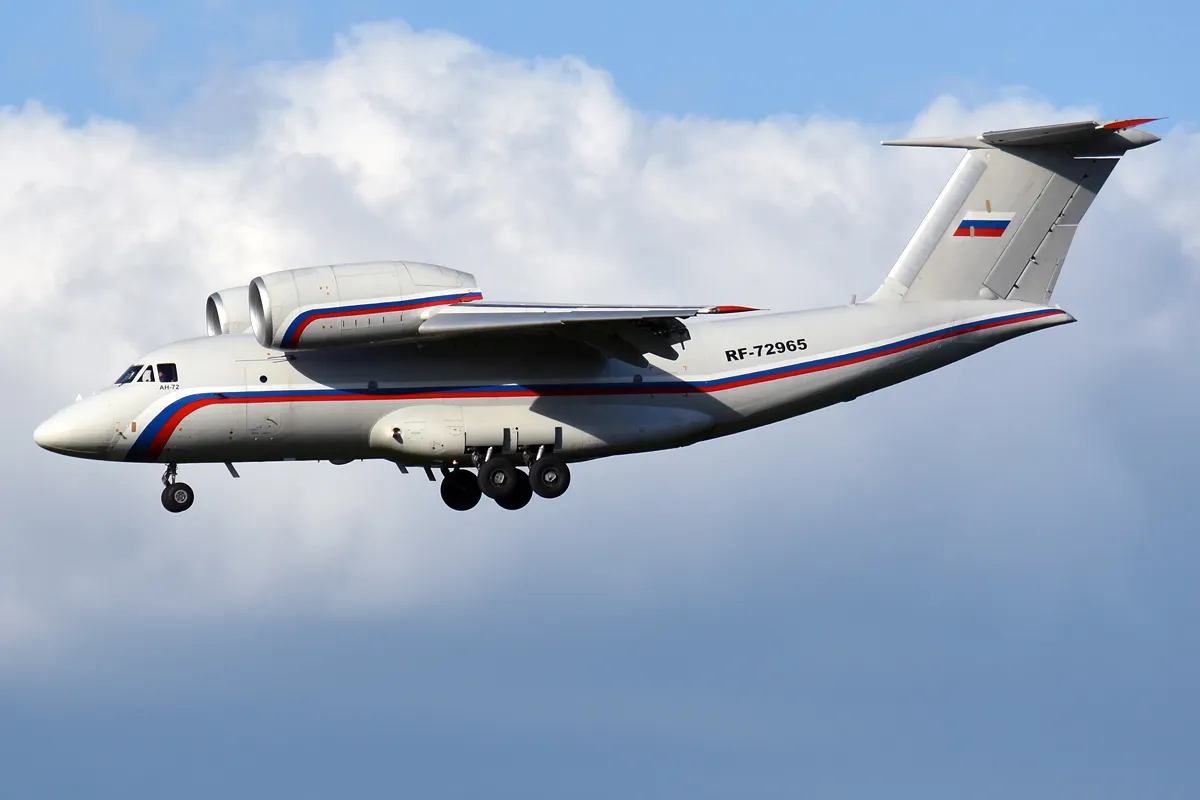
The An-72 is an Antonov-designed short takeoff and landing jet transport built for austere airstrips, with over-wing D-36 engines using blown flaps and the Coanda effect for lift augmentation. Antonov records Kharkiv production from 1984 to 1992, while 2026 conflict reporting places a Russian An-72P patrol aircraft among military aviation assets struck by Ukrainian forces at Kirovske airfield in occupied Crimea.
Role in Conflicts
Profile / Specs
Profile
- Origin
- Soviet Union / Ukraine
- Built by
- Antonov Design Bureau
- Type
- Short takeoff and landing jet transport aircraft
- Service note
- Late Cold War Soviet STOL transport design with continuing post-Soviet military and security-service use
- Designer
- Antonov Design Bureau
- Designed
- 1974-1977
- Produced
- 1984-1992
- Number built
- 114 aircraft, according to Antonov
- Developed into
- Antonov An-71 and Antonov An-74
Specifications
- Crew
- Five to six personnel in typical military transport references
- Payload role
- Cargo, passengers, paratroops, casualty evacuation, patrol, and airdrop missions through a rear loading ramp
- Length
- 28.07 m
- Wingspan
- 31.89 m
- Height
- 8.65 m
- Wing area
- 98.78 sq m
- Cruise speed
- 540 km/h
- Operational range
- 4,320 km
- Operational ceiling
- 10,100 m
- Airdrop payload
- Up to 7.5 tons, according to GlobalSecurity
- Transport seating
- 42 paratroops or 52 passengers, according to GlobalSecurity
- Powerplant
- Two Lotarev/Ivchenko-Progress D-36 turbofans mounted above the wing
STOL Transport Design
The An-72's catalog relevance is its logistics and patrol utility from short or poorly prepared strips rather than a primary strike role. Antonov describes a 600 m non-equipped-strip requirement, while GlobalSecurity details the rear loading ramp and troop, passenger, casualty, and airdrop arrangements that made the airframe useful for military transport work.
Over-wing turbofans blow exhaust across the wing and flap surfaces to augment lift during takeoff and landing.
Designed around short takeoff and landing from non-equipped airstrips about 600 m long.
A rear ramp and sliding rear fairing support loading, airdrop, and mixed passenger or casualty configurations.
Variants
Open references use An-72 for the STOL transport family and distinguish specialized patrol, freight, executive, demilitarized, early-warning, and polar-support derivatives. The An-74 is treated as the cold-weather derivative, while the An-72P is the armed patrol configuration most directly tied to the sourced conflict-use row.
| Variant | Configuration | Designation notes |
|---|---|---|
| An-72A | Initial production STOL transport | The production transport version incorporated the longer fuselage and increased-span configuration that followed the prototype and preproduction aircraft. Sources: Wikipedia An-72, GlobalSecurity An-72 COALER |
| An-72AT | Freight transport | Variant lists identify the An-72AT as a freight configuration adapted for standard international cargo containers. Sources: Wikipedia An-72 |
| An-72S | Executive and convertible transport | The An-72S appears in reference material as a VIP transport that could also be reconfigured for freight, passenger transport, or medical evacuation. Sources: Wikipedia An-72 |
| An-72P | Maritime patrol and armed patrol aircraft | GlobalSecurity describes the An-72P with observation windows, cameras, liferaft provision, and offensive stores including rocket pods, a podded cannon, and bombs dropped through the rear ramp. Sources: GlobalSecurity An-72 COALER |
| An-72R / An-72BR | Electronic intelligence prototype | Variant lists identify the An-72R or An-72BR as an ELINT prototype with conformal antenna fairings along the fuselage. Sources: Wikipedia An-72 |
| An-74 | Arctic and Antarctic support derivative | The An-74 derivative is described as a cold-weather support model with additional fuel, navigation, de-icing, radar, and optional wheel-ski features for polar operations. Sources: Wikipedia An-72 |
Timeline
An-72 Key Events
Development decision issued
Antonov dates the joint Soviet aviation-industry, air force, and civil-aviation development decision for a light military transport aircraft to May 16-27, 1974.
Sources: Antonov AN-72 history
Prototype rollout
Antonov records the first An-72 prototype leaving the assembly shop on May 6, 1977.
Sources: Antonov AN-72 history
First flight
The first An-72 flew on August 31, 1977, with Volodymyr Terskyi as captain, according to Antonov's chronology.
Sources: Antonov AN-72 history
An-72P patrol variant flies
Antonov records the first An-72P patrol flight on November 29, 1984.
Sources: Antonov AN-72 history
First production aircraft flies
Antonov says the first production An-72, serial number 01-01, flew at Kharkiv on December 22, 1985.
Sources: Antonov AN-72 history
Production aircraft enter service
Antonov's chronology places the start of production An-72 service entry in May 1987.
Sources: Antonov AN-72 history
Russian An-72P reported destroyed in Crimea
Ukrainian and Ukrainian-linked reporting said an April 2, 2026 strike at Kirovske airfield in occupied Crimea destroyed a Russian An-72P patrol aircraft alongside Orion drone infrastructure and a radar system.
Sources: Kyiv Independent Kirovske An-72P strike, Ukrainska Pravda Kirovske An-72P strike
Media
Related Weapon Systems