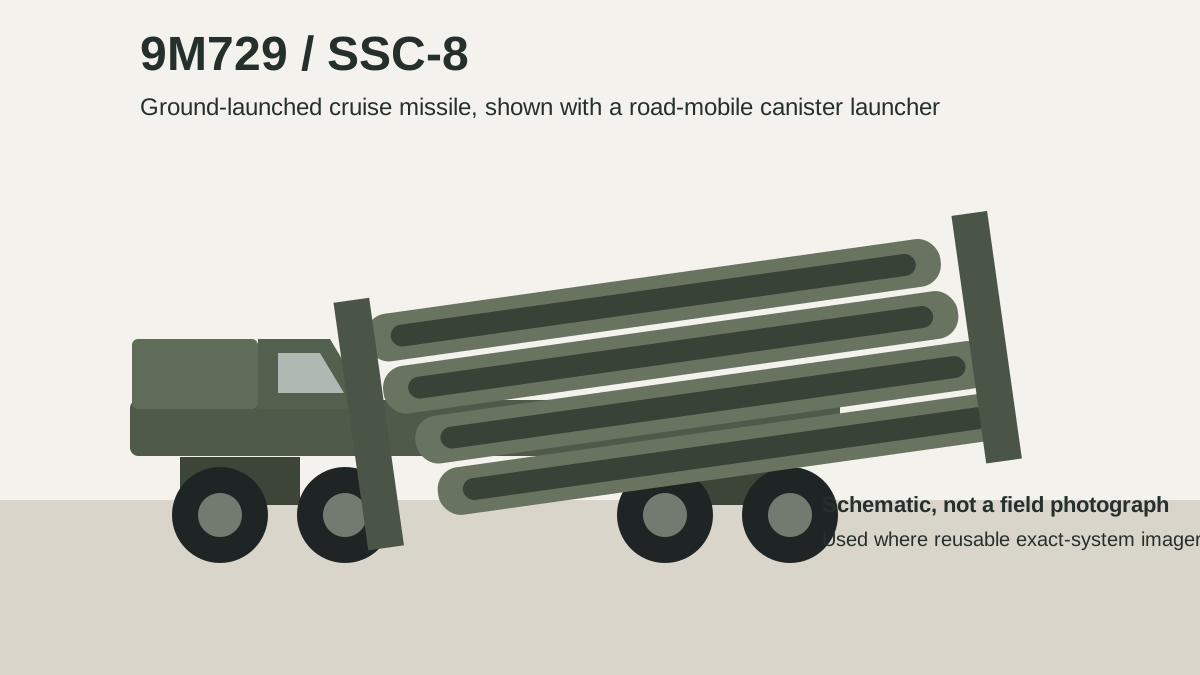
Direct proof of use
The documented conflict use of the 9M729 rests on Ukrainian official statements, Reuters reporting, and imagery of marked debris supplied by Ukrainian law-enforcement sources. Ukrainian Foreign Minister Andrii Sybiha told Reuters in October 2025 that Russia had used the 9M729 against Ukraine, while a senior Ukrainian official said Russia had fired the missile 23 times since August 21, 2025, after two recorded launches in 2022.
Reuters-derived reporting on the October 5, 2025 strike at Lapaiivka in Lviv region described imagery of missile debris marked 9M729 and said a military source reported a flight distance of about 1,200 kilometers before impact. Reuters Connect separately published a February 2026 licensable image entry for fragments that Ukrainian law-enforcement sources identified as 9M729 debris, with the date given as September 10, 2025 and the location given as Khmelnytskyi region.
Sources: Moscow Times Reuters 9M729 Report, Kyiv Post Reuters Debris Report, Reuters Connect Khmelnytskyi 9M729 Image
Timeline
Publicly reported 9M729 use begins with two Ukrainian-recorded launches in 2022, followed by a larger reported firing pattern after August 21, 2025. The October 5, 2025 Lapaiivka strike is the most specific open incident in the record because Reuters-derived reports tied it to marked fragments, a stated launch distance, and fatal damage at the impact site.
Follow-on reporting in February 2026 added imagery-based evidence from Ukrainian law-enforcement sources and reported at least four more Russian 9M729 launches on February 17, 2026. That later reporting treated the 2025 debris images and additional launch claims as evidence that the missile had become part of Russia's long-range strike inventory in the war.
Sources: Moscow Times Reuters 9M729 Report, Kyiv Post Reuters Debris Report, United24 February 2026 9M729 Wreckage Report
Narrative
In the Ukraine theater, the 9M729 appears in the record as a Russian long-range ground-launched cruise missile used for deep strikes rather than as a front-line battlefield munition. The reported Lapaiivka strike, the 1,200-kilometer flight claim, and the Khmelnytskyi-region debris imagery all point to use from well behind the front line against targets inside Ukraine.
The weapon's use is also important because the 9M729, known to NATO as SSC-8, was central to the INF Treaty dispute before the United States left the treaty in 2019. CSIS describes the 9M729 as a Russian NPO Novator ground-launched cruise missile associated with the Iskander launcher family, while NATO has described the system as mobile and nuclear-capable. Those background points explain why Reuters-derived reports framed its combat use in Ukraine as both a battlefield development and an arms-control marker.
Sources: Moscow Times Reuters 9M729 Report, Kyiv Post Reuters Debris Report, TWZ 9M729 Ukraine Use Analysis, CSIS 9M729 SSC-8, NATO INF Treaty Background