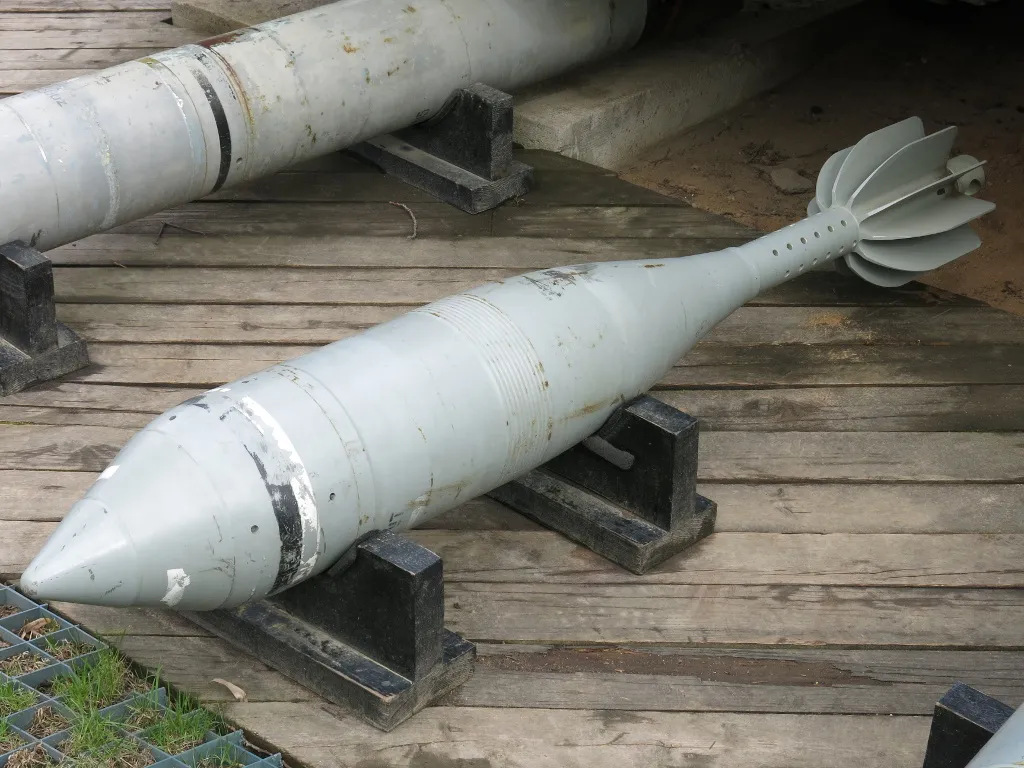

Human Rights Watch reviewed Homs footage showing 240 mm F-864 high-explosive mortar bombs used by the Syrian army in Baba Amr, while AOAV identified the M-240 as the firing system seen in Syria.
Role detailsMunitions
53-F-864 / F-864 240 mm mortar bomb
Also known as
- F-864
- 53-F-864
- 3OF-864
- 240 mm F-864 high explosive mortar bomb
- Soviet 240 mm mortar shell
The 53-F-864, commonly cited as F-864 and also rendered 3OF-864 in Tyulpan references, is a Soviet 240 mm high-explosive fragmentation mortar bomb for the M-240 / 2S4 Tyulpan heavy-mortar family. It is notable as a very heavy conventional mortar round: Human Rights Watch documented F-864 bombs in Syrian army shelling of Homs, and technical references report a projectile mass of about 130 kg and a maximum Tyulpan range of about 9.65 km.
Role in Conflicts
Profile / Specs
Profile
- Origin
- Soviet Union
- Built by
- Soviet ordnance production
- Type
- 240 mm high-explosive fragmentation mortar bomb
- Service note
- Soviet-era ammunition for the 240 mm M240 / 2B8 mortar family
- Designer
- Soviet artillery design establishment
- Designed
- Soviet period
- Produced
- Soviet-era production
Specifications
- Caliber
- 240 mm
- Projectile type
- High-explosive fragmentation mortar bomb
- Projectile mass
- About 130 kg
- Explosive charge
- 31.93 kg TNT
- Maximum range from 2S4 Tyulpan
- About 9,650 m
- Associated mortar family
- M240 / 2B8 heavy mortar
Firing Weapons
The F-864 family is documented as 240 mm mortar ammunition for Soviet heavy-mortar systems rather than as a stand-alone weapon.
| Firing weapon | Weapon type | Firing evidence |
|---|---|---|
 | 240 mm self-propelled heavy mortar | Army Recognition identifies the 2S4 as firing the conventional high-explosive fragmentation bomb 3OF-864 / 53-F-864, described as one of its basic 240 mm mortar bombs. Sources: Army Recognition 2S4 Tyulpan M-1975 |
Designation And Firing Context
Sources use several close designations for the same 240 mm high-explosive mortar bomb. The conflict-specific record is strongest where sources identify F-864 in Homs; broader Tyulpan references connect the 53-F-864 / 3OF-864 designation to the 2S4 ammunition set.
| Designation | Where it appears | Catalog treatment |
|---|---|---|
| F-864 | Human Rights Watch and AOAV Syria reporting | Used for the directly sourced 2011 Syrian Civil War conflict-use row. |
| 53-F-864 | Tyulpan ammunition references and Commons image identification | Primary catalog designation for the Soviet 240 mm HE fragmentation bomb. |
| 3OF-864 | Army Recognition Tyulpan ammunition description | Listed as an alias because the source ties it to the same conventional HE fragmentation round. |
Timeline
53-F-864 / F-864 240 mm mortar bomb Key Events
F-864 bombs documented in Homs footage
Human Rights Watch said Homs residents posted footage that documented 240 mm F-864 high-explosive mortar bombs used by the Syrian army in the city.
Sources: Human Rights Watch Homs F-864
Human Rights Watch reports 240 mm mortar use
Human Rights Watch reported that reviewed Homs footage indicated Russian-made 240 mm mortar systems and F-864 bombs had been used during the shelling of Baba Amr.
Sources: Human Rights Watch Homs F-864
AOAV profiles the M-240 in Syria
Action on Armed Violence described the 53-F-864 240 mm bomb as the heavy mortar munition associated with the M-240 system seen in Syria.
Sources: AOAV Syria Dirty Dozen M-240
Media
53-F-864 / F-864 240 mm mortar bomb Videos
Related Weapon Systems


Sources
Human Rights Watch Homs F-864Publisher: Human Rights Watch | Note: Directly supports 2011 Syrian Civil War use by identifying 240 mm F-864 high-explosive mortar bombs in Syrian army shelling of Homs, and supports projectile mass and TNT charge figures. | Accessed: 2026-06-29AOAV Syria Dirty Dozen M-240Publisher: Action on Armed Violence | Note: Supports 2011 Syrian Civil War context by describing the 53-F-864 240 mm bomb and the M-240 system seen in Syria, with an embedded directly relevant AOAV video. | Accessed: 2026-06-29Army Recognition 2S4 Tyulpan M-1975Publisher: Army Recognition | Note: Supports the 53-F-864 / 3OF-864 bomb as the conventional high-explosive fragmentation round fired by the 2S4 Tyulpan, including its reported mass and range. | Accessed: 2026-06-29File:Soviet 240mm mortar shell.jpgPublisher: Wikimedia Commons | Note: Image provenance for the 53-F-864 / F-864 shell image; the file page identifies the round and subject matter. | Accessed: 2026-06-29CAT-UXO MortarsPublisher: CAT-UXO | Note: Supports the designation F-864 / 240 mm mortar bomb as a Russian/Soviet high-explosive-fragmentation mortar bomb. | Accessed: 2026-06-29