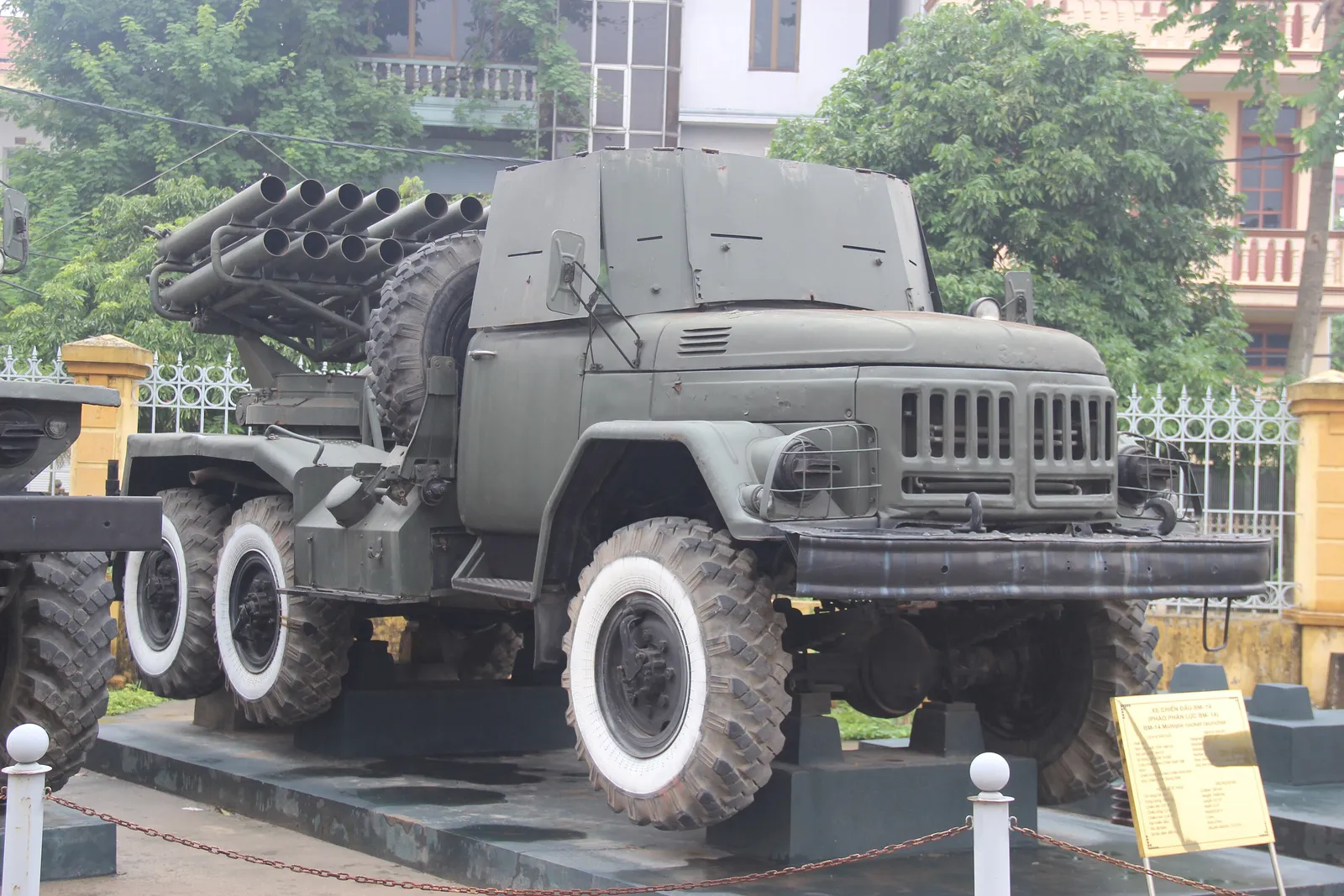

Human Rights Watch identified a Soviet-era 140 mm M-14 rocket motor in the 21 August 2013 Moadamiya/Western Ghouta attack and assessed Syrian government responsibility; the UN mission documented sarin-bearing surface-to-surface rockets in Moadamiyah, and GPPi later treated the Mu'addamiyat ash Shaykh case as M-14-S artillery-rocket use while the public recovery evidence centered on the motor rather than an intact warhead.
Munitions
140 mm M-14 rocket
Also known as
- M-14
- M14 artillery rocket
- 140mm M-14
- M-14-OF
- M-14OF
- M-14-D
- M-14D
- M-14KChR
- TRS-140
- 53-OF-949
- TC-60
- M-140F
The 140 mm M-14 is a Soviet spin-stabilized artillery rocket family developed for BM-14 and RPU-14 multiple rocket launchers. Open references identify high-explosive fragmentation, smoke/incendiary, and chemical-warhead branches; conflict documentation places an M-14 rocket motor in the 2013 Western Ghouta attack during the Syrian Civil War, with attribution and payload evidence handled narrowly because public imagery and UN reporting identify the motor and attack context more clearly than a recovered intact M-14 warhead.
Role in Conflicts
Profile / Specs
Profile
- Origin
- Soviet Union
- Built by
- Soviet ordnance production
- Built in
- Soviet UnionPoland
- Type
- 140 mm unguided artillery rocket
- Service note
- Early Cold War Soviet rocket artillery munition with later export and legacy-stock use
- Designer
- KB-2 MSKhM / Soviet design organizations
- Designed
- 1947-1951 development period
- Produced
- 1952 onward in Soviet and allied production lines
Specifications
- Caliber
- 140 mm
- Rocket family
- M-14 artillery rockets for BM-14, BM-14-17, and RPU-14 launchers
- Guidance
- Unguided ballistic flight
- Stabilization
- Spin-stabilized by angled rocket-motor nozzle flow; no fins
- Propulsion
- Solid-propellant rocket motor
- M-14-OF length
- 1,085 mm with fuze in Missilery data; WeaponSystems.net lists about 1.092 m
- M-14-OF weight
- 39.6 kg
- M-14-OF warhead
- 18.4 kg head section with 4.2 kg explosive filler
- M-14D warhead
- Smoke/incendiary payload; WeaponSystems.net lists white-phosphorus content
- Chemical-warhead branch
- Chemical-warhead rocket branch is reported in reference sources; conflict-use claims require separate direct evidence
- Maximum range
- About 9.8 km for M-14-OF under normal conditions
- Reduced range
- Missilery describes braking rings for roughly 7.55-5.4 km and 5.42-1.0 km range bands
- Maximum speed
- About 400-402 m/s
- Temperature range
- -40 C to +50 C in Missilery data
Variants
Public references separate the M-14 family chiefly by warhead: high-explosive fragmentation, smoke/incendiary, and chemical-agent configurations fired from BM-14, BM-14-17, and RPU-14 launchers.
| Variant | Configuration | Designation notes |
|---|---|---|
| M-14-OF | High-explosive fragmentation rocket | Missilery identifies M-14-OF as index 53-OF-949 / TC-60 and lists a 39.6 kg projectile with an 18.4 kg head section and 4.2 kg explosive filler. Sources: Missilery M-14-OF projectile |
| M-14D | Smoke and incendiary rocket | WeaponSystems.net and FAS both identify M-14D as the smoke round in the 140 mm M-14 family. |
| M-14KChR | Chemical-warhead rocket | WeaponSystems.net lists a chemical-warhead branch introduced in 1955, and HRW cited declassified and Jane's references for a chemical warhead containing sarin in the 140 mm rocket family. Sources: WeaponSystems.net 140mm M-14, HRW Attacks on Ghouta |
Launch Platforms
The 140 mm M-14 rocket family was fired from BM-14 truck launchers, the BM-14-17 launcher used on trucks and vessels, and the RPU-14 towed launcher.
| Launcher | Launcher type | Launch evidence |
|---|---|---|
 | 16-tube multiple rocket launcher | Missilery describes the BM-14 fighting vehicle as adopted for launching 140 mm M-14-OF rockets, and FAS identifies BM-14-16 as firing the same high-explosive, chemical, and M-14D smoke rounds as BM-14-17 and RPU-14. Sources: Missilery M-14 system, FAS RPU-14 launcher |
 | 17-tube multiple rocket launcher | Missilery identifies M-14-OF as the main projectile for BM-14-17, with M-14D smoke and chemical-warhead rocket branches also documented for the launcher family. Sources: Missilery BM-14-17 launcher |
 | 16-tube towed rocket launcher | FAS says RPU-14 fires the same high-explosive fragmentation, chemical, and M-14D smoke rounds as BM-14-16 and BM-14-17. Sources: FAS RPU-14 launcher |
 | River artillery boat with BM-14-17 launcher | Project 1204 Shmel boats carried a 140 mm BM-14-17 rocket launcher; Missilery identifies the BM-14-17 family as using M-14-OF rockets as its main projectile. Sources: Victory Museum Project 1204 Shmel, Missilery BM-14-17 launcher |
Rocket Family Context
The M-14 page is a munition record, so the key distinctions are warhead branch, spin-stabilized tube launch, and the evidence boundary around the Ghouta conflict-use row.
Stabilization
Missilery describes rotation generated by angled nozzle flow, with ten rear nozzles on the M-14-OF projectile.
Warhead family
Open references identify high-explosive fragmentation, smoke/incendiary, and chemical-agent branches rather than one single payload.
Ghouta evidence
HRW identified a 140 mm M-14 motor at Moadamiya; the UN report documented sarin-bearing surface-to-surface rocket use in Moadamiyah and other Ghouta sites; GPPi later cataloged the Mu'addamiyat ash Shaykh case as M-14-S artillery-rocket use.
This record does not treat generic BM-14 service history as proof of M-14 use in other conflicts.
Sources: Missilery M-14-OF projectile; WeaponSystems.net 140mm M-14; HRW Attacks on Ghouta; UN Ghouta Mission Report; GPPi Munitions Typology.
Timeline
140 mm M-14 rocket Key Events
M-14 family development begins
WeaponSystems.net places M-14 development in 1947-1951 for the BM-14 multiple rocket launcher family.
Sources: WeaponSystems.net 140mm M-14
M-14 enters service
WeaponSystems.net lists 1952 service entry and identifies M-14-OF as the standard high-explosive fragmentation branch.
Sources: WeaponSystems.net 140mm M-14, Missilery M-14-OF projectile
Specialized warhead branches appear
WeaponSystems.net dates the M-14D smoke/incendiary and M-14KChR chemical-warhead variants to 1955.
Sources: WeaponSystems.net 140mm M-14
BM-14-17 launcher completed
Missilery reports BM-14-17 development completion in 1958 and identifies M-14-OF as the main projectile for the 17-tube launcher.
Sources: Missilery BM-14-17 launcher
M-14 motor documented after Western Ghouta attack
HRW identified a Soviet-era 140 mm M-14 rocket motor from the Moadamiya attack, the UN mission documented sarin-bearing surface-to-surface rocket use in Moadamiyah and other Ghouta sites, and GPPi later cataloged the Mu'addamiyat ash Shaykh case as M-14-S artillery-rocket use.
Sources: HRW Attacks on Ghouta, UN Ghouta Mission Report, GPPi Munitions Typology
Related Weapon Systems


Sources
WeaponSystems.net 140mm M-14Publisher: WeaponSystems.net | Note: Supports M-14 identity, Soviet origin, 1947-1951 development period, 1952 service entry, KB-2 MSKhM developer attribution, producer-country context, design, warhead branches, variants, and general launcher-family relationship. | Accessed: 2026-07-13Missilery M-14-OF projectilePublisher: Missilery.info | Note: Supports M-14-OF designation, 53-OF-949 / TC-60 indexes, projectile construction, spin stabilization, braking-ring range data, dimensions, weights, explosive filler, speed, range, and temperature range. | Accessed: 2026-07-13Missilery M-14 systemPublisher: Missilery.info | Note: Supports BM-14 / BM-14-16 launcher identity, 1952 adoption for launching 140 mm M-14-OF rockets, BM-14 launcher composition, and the M-14 family relationship to BM-14-17 and RPU-14 launchers. | Accessed: 2026-07-13Missilery BM-14-17 launcherPublisher: Missilery.info | Note: Supports BM-14-17 development timing, 17-tube launcher configuration, M-14-OF as the main projectile, M-14D smoke projectile context, and chemical-warhead rocket branch context. | Accessed: 2026-07-13FAS RPU-14 launcherPublisher: Federation of American Scientists | Note: Supports RPU-14 use of the same high-explosive fragmentation, chemical, and M-14D smoke rounds as BM-14-16 and BM-14-17 launchers, plus spin-stabilization and 9,810 m maximum range context. | Accessed: 2026-07-13HRW Attacks on GhoutaPublisher: Human Rights Watch | Note: 2011 Syrian Civil War: directly supports the Moadamiya/Western Ghouta conflict-use row by identifying a Soviet-era 140 mm M-14 rocket motor in the 21 August 2013 attack, describing the associated 140 mm rocket system and possible warhead branches, and assessing Syrian government responsibility. | Accessed: 2026-07-13UN Ghouta Mission ReportPublisher: United Nations | Note: 2011 Syrian Civil War: directly supports the Ghouta attack context by documenting the UN mission's Moadamiyah inspection, surface-to-surface rocket evidence, sarin findings, and munitions observations consistent with an M14 artillery rocket variant. | Accessed: 2026-07-13GPPi Munitions TypologyPublisher: Global Public Policy Institute | Note: 2011 Syrian Civil War: directly supports the Ghouta conflict-use row by identifying the Mu'addamiyat ash Shaykh chemical attack case as use of an M-14-S artillery rocket, describing its Soviet 140 mm M-14 rocket-family characteristics, and noting the Syrian government chemical-variant attribution in the typology. | Accessed: 2026-07-13Wikimedia Commons BM-14 launcher imagePublisher: Wikimedia Commons | Note: Supports image provenance and CC0 licensing for the BM-14 launcher photograph used as the page image while no reusable standalone M-14 rocket photograph was verified. | Accessed: 2026-07-13Victory Museum Project 1204 ShmelPublisher: Victory Museum | Note: Supports Project 1204 Shmel armament context, including the BM-14-17 rocket launcher carried by the river artillery boat. | Accessed: 2026-07-13