Artillery

BM-14-17

Also known as
  • BM-14-17 8U36
  • 8U36
  • BM-14-17M
  • 8U36M

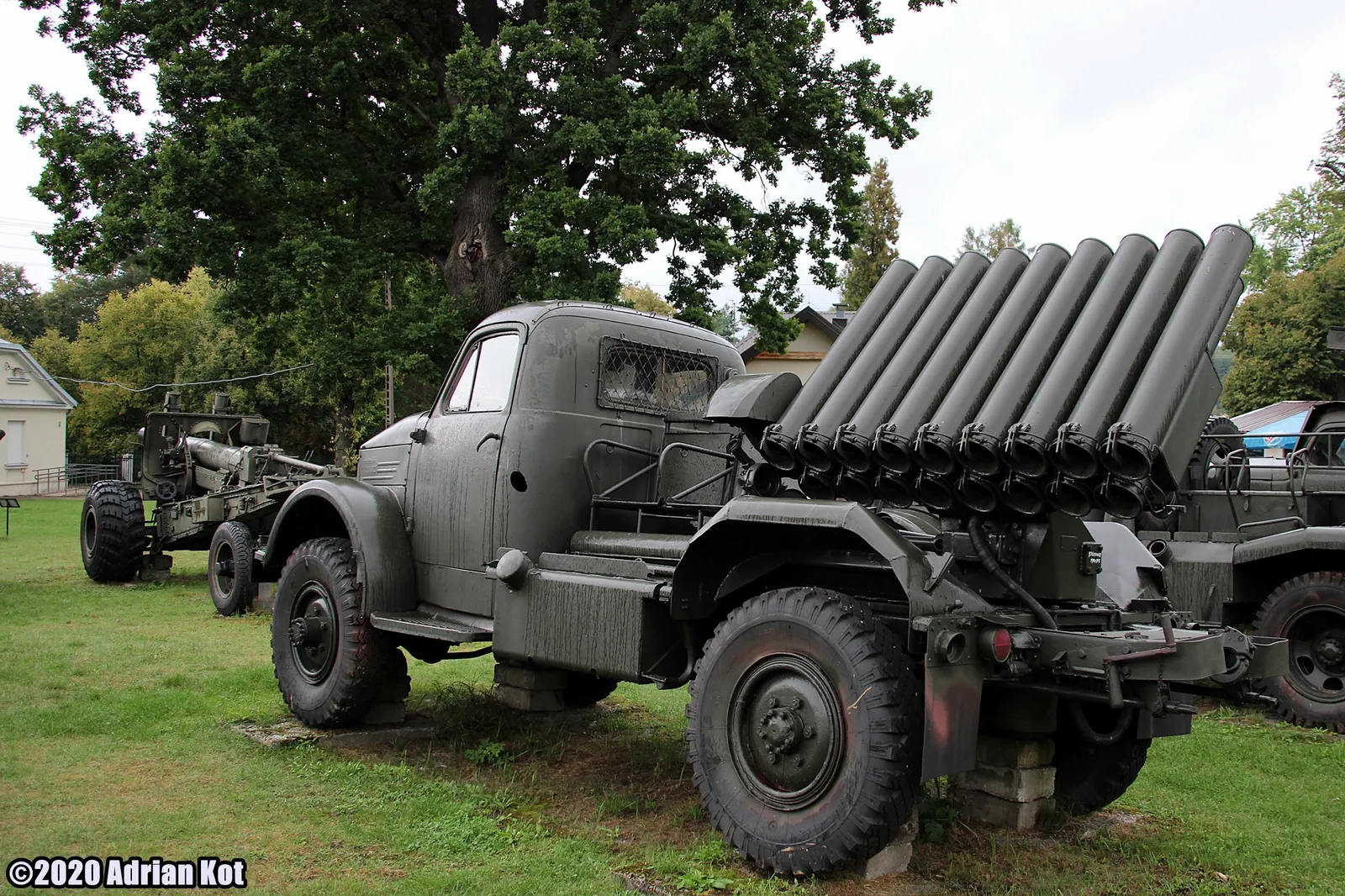
The BM-14-17 is the 17-tube Soviet launch vehicle in the M-14 rocket artillery family. This relationship-only record links the launcher to the cataloged 140 mm M-14 rocket and to the existing Project 1204 Shmel boat record where the launcher appears as carried armament.

Profile / Specs

Profile

Origin
Soviet Union
Type
140 mm 17-tube multiple rocket launcher
Service note
Cold War Soviet rocket artillery launcher
Designer
A. I. Yaskin-led Soviet design team
Designed
Development completed in 1958
Produced
Cold War Soviet production

Specifications

Caliber
140 mm
Launch tubes
17 tubes, with nine in the upper row and eight in the lower row
Primary rocket
140 mm M-14-OF spin-stabilized rocket
Other documented rockets
M-14D smoke rounds and chemical-warhead branches in M-14 family references
Truck chassis
GAZ-63 / GAZ-63A for BM-14-17; GAZ-66 for BM-14-17M in Missilery data
Full salvo
7-10 seconds in Missilery's BM-14-17 data
Reload time
90-120 seconds in Missilery's BM-14-17 data
Carried installation
Project 1204 Shmel river artillery boats carried a BM-14-17 launcher
Rockets Launched

Sources identify BM-14-17 as a 140 mm launcher for M-14 family rockets.

Launched itemItem typeLaunch evidence
140 mm M-14 rocket, 140 mm unguided artillery rocket, Munitions140 mm M-14 rocket140 mm unguided artillery rocket

Missilery identifies M-14-OF as the main projectile for BM-14-17 and says the launcher family was unified by ammunition with other BM-14 vehicles.

Sources: Missilery BM-14-17 launcher

Carrier Platforms

The launcher also appears as a carried armament item on a cataloged river artillery boat.

CarrierCarrier typeCarriage evidence
Project 1204 Shmel / Shmel-class patrol boat, Armored patrol boat / river gunboat, Naval SystemsProject 1204 Shmel / Shmel-class patrol boatRiver artillery boat

Victory Museum lists the Project 1204 Shmel armament fit with a 140 mm BM-14-17 launcher.

Sources: Victory Museum Project 1204 Shmel

Related Weapon Systems
Project 1204 Shmel / Shmel-class patrol boat, Armored patrol boat / river gunboat, Naval SystemsNaval SystemsProject 1204 Shmel / Shmel-class patrol boatArmored patrol boat / river gunboatThe Project 1204 Shmel class is a Soviet armored river gunboat family designed by Almaz Central Marine Design Bureau for shallow rivers, lakes, and coastal waters. It put a PT-76-derived 76 mm turret, a BM-14-17 rocket launcher, automatic cannon, machine guns, and mine rails on a compact shallow-draft hull, making it a fire-support and patrol craft rather than an oceangoing combatant. Russian Shmel boats were documented in the Kerch and Sea of Azov security context during the Russo-Ukrainian War, while Ukrainian Sea Guard Dzhmil examples survived in Danube-area service and training.
140 mm M-14 rocket, 140 mm unguided artillery rocket, MunitionsMunitions140 mm M-14 rocket140 mm unguided artillery rocketThe 140 mm M-14 is a Soviet spin-stabilized artillery rocket family developed for BM-14 and RPU-14 multiple rocket launchers. Open references identify high-explosive fragmentation, smoke/incendiary, and chemical-warhead branches; conflict documentation places an M-14 rocket motor in the 2013 Western Ghouta attack during the Syrian Civil War, with attribution and payload evidence handled narrowly because public imagery and UN reporting identify the motor and attack context more clearly than a recovered intact M-14 warhead.
BM-27 Uragan, 220 mm self-propelled multiple launch rocket system, ArtilleryArtilleryBM-27 Uragan220 mm self-propelled multiple launch rocket systemThe BM-27 Uragan is the Soviet 9K57 220 mm multiple launch rocket system, built around the 16-tube 9P140 launcher and 9T452 transporter-loader on ZIL-135LM-family wheeled chassis. Its rocket family gives heavier payloads than BM-21 Grad-class systems, including high-explosive fragmentation, cluster, incendiary, fuel-air explosive, and mine-scattering rounds. Documented use spans Russia-Ukraine, Syria, Yemen, Nagorno-Karabakh, and the 2008 Russo-Georgian War, with the system still relevant through Ukrainian overhaul work and Bureviy modernization.

Sources