Munitions

MJU-7/10 flare family

Also known as
  • MJU-7/10
  • MJU-7A/B
  • MJU-10/B
  • MJU-7
  • MJU-10

The MJU-7/10 flare family is a U.S. expendable infrared decoy line for aircraft self-protection, centered on the MJU-7A/B one-by-two-by-eight-inch flare and the larger MJU-10/B form factor. Chemring material places the family inside Kilgore's U.S. DoD conventional-flare portfolio and identifies compatibility with common ALE-series, M130, Vicon, and BOZ dispensers, while Textron lists MJU-7/10 flares among supported AT-6 Wolverine loads.

Profile / Specs

Profile

Origin
United States
Type
Infrared decoy flare family
Unit cost
About $57 per MJU-7A/B flare, derived from the FY2020 Air Force procurement request for 139,800 flares at $7.991 million hardware end item cost

Specifications

MJU-7A/B dimensions
1 x 2 x 8 in (25 x 52 x 205 mm)
MJU-7A/B weight
Approximately 370 g
MJU-7A/B impulse cartridge
BBU-36/B
MJU-7A/B shelf life
9 years
MJU-7A/B service life
1 year
MJU-7A/B dispenser compatibility
AN/ALE-4X series
Family dispenser compatibility
ALE-39, ALE-40, ALE-45, ALE-47, M130, Vicon 78, BOZ107, and BO300Z families
MJU-10/B form factor
2 x 2.5 in flare class
Family Designations

The record is a family page because public sources group the MJU-7A/B and MJU-10/B designations under the same conventional infrared countermeasure-flare line.

DesignationConfigurationSource note
MJU-7A/B1 x 2 x 8 in infrared decoy flare using a BBU-36/B impulse cartridgeChemring MJU-7A/B brochure
MJU-10/BLarger two-by-two-and-a-half-inch flare class in the same conventional countermeasures familyChemring countermeasures brochure
Dispenser Compatibility

Chemring material describes the family as aircraft-dispensed infrared expendables rather than stand-alone weapons. Public sources support broad dispenser compatibility for the family and a narrower AN/ALE-4X-series fit for MJU-7A/B.

FieldDocumented compatibilitySource note
Family-level dispenser fitALE-39, ALE-40, ALE-45, ALE-47, M130, Vicon 78, BOZ107, and BO300Z dispenser familiesChemring Countermeasures USA presentation
MJU-7A/B dispenser fitAN/ALE-4X-series dispenser systemsChemring MJU-7A/B brochure
AT-6 supported loadMJU-7/10 flares listed for the AT-6 WolverineTextron Aviation Defense AT-6 loadout page
Carrier Aircraft

Textron Aviation Defense lists MJU-7/10 flares among the AT-6 Wolverine's supported loads.

CarrierCarrier typeCarriage evidence
AT-6 Wolverine, Light attack and armed reconnaissance turboprop aircraft, Aircraft & UAVsAT-6 WolverineLight attack and armed reconnaissance aircraft

Textron lists MJU-7/10 flares in the AT-6 Wolverine supported-load set, alongside other guided weapons, rockets, gun pods, bombs, and illumination flares.

Sources: AT-6 Wolverine and Beechcraft T-6 Texan II | Textron Aviation Defense

Timeline

MJU-7/10 flare family Key Events

  1. Chemring lists the U.S. DoD flare set

    Chemring Countermeasures USA material identified the MJU-7A/B and MJU-10/B among U.S. DoD conventional infrared flares, with compatibility across ALE-series, M130, Vicon, and BOZ dispenser families.

    Sources: Chemring Countermeasures USA presentation

  2. Air Force FY2020 MJU-7A/B procurement request

    The U.S. Air Force FY2020 ammunition book requested 139,800 MJU-7A/B flares and described the type as a training-use flare after the MJU-53 replacement for wartime and operational use.

    Sources: FY20 Air Force Procurement Ammunition

  3. Blue Flag handling photo

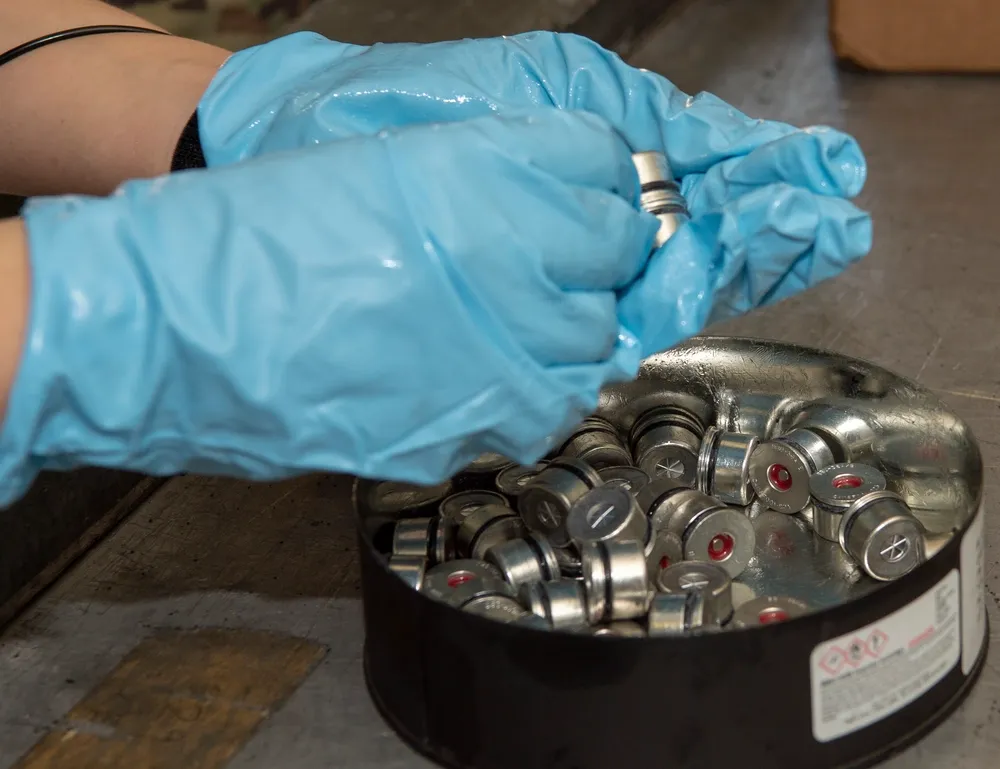
    A U.S. Air Force DVIDS photograph from Blue Flag 2019 shows 52nd Maintenance Squadron personnel preparing impulse cartridges before inserting them into MJU-7 flares at Uvda Air Base, Israel.

    Sources: DVIDS MJU-7 flare at Blue Flag 2019

Related Weapon Systems
AN/ALE-50 towed decoy, Towed decoy countermeasure, Electronic WarfareElectronic WarfareAN/ALE-50 towed decoyTowed decoy countermeasureThe AN/ALE-50 is a Raytheon airborne towed decoy countermeasure developed from Naval Research Laboratory work to draw radar-guided missiles away from combat aircraft. It entered production in December 1996, pairs a launcher/controller installation with expendable decoy canisters, and is documented on F-16, F/A-18E/F Super Hornet, and B-1B aircraft as a compact radio-frequency self-protection system used from Kosovo and Iraq to later U.S. air operations.
AT-6 Wolverine, Light attack and armed reconnaissance turboprop aircraft, Aircraft & UAVsAircraft & UAVsAT-6 WolverineLight attack and armed reconnaissance turboprop aircraftTextron Aviation Defense's AT-6 Wolverine is the armed version of the T-6 family, a turboprop light attack and armed reconnaissance aircraft built around a digital cockpit, seven hardpoints, NATO-compatible weapons stations, and a combat-oriented sensor suite. Thailand's AT-6TH variant gives the catalog a documented conflict-use path through Royal Thai Air Force reporting on the 2025 border fighting with Cambodia.
Igla, Man-portable infrared-homing surface-to-air missile system, Air DefenseAir DefenseIglaMan-portable infrared-homing surface-to-air missile systemThe Igla family is a Soviet/Russian shoulder-fired MANPADS built to give small air-defense teams a mobile, infrared-guided weapon against low-flying aircraft, helicopters, drones, and cruise missiles. Documented conflict use and fielding spans Ukrainian mobile air-defense teams, PKK use against a Turkish AH-1W helicopter, Syrian armed-group inventories, RSF fielding in Sudan, and Indian Army Igla-S teams reported in Operation Sindoor coverage.
AC-208 Combat Caravan, Armed ISR and light attack aircraft, Aircraft & UAVsAircraft & UAVsAC-208 Combat CaravanArmed ISR and light attack aircraftThe AC-208 Combat Caravan is an armed Cessna Caravan conversion that combines a rugged single-engine turboprop airframe with electro-optical surveillance, mission-system operator controls, datalinks, and precision strike. Iraq fielded Hellfire-armed AC-208s during the 2013-2017 war against ISIS, while Afghan Air Force AC-208 Eliminators later provided ISR, strike, and laser-designation support during the final phase of the 2001 War in Afghanistan.

Sources