- Side
- Pakistan

Operation Swift Retort reporting tied Pakistan Air Force JF-17s to Mk 83-class GIDS REK / Takbir glide bombs used for stand-off strikes against Indian Army target areas near the Line of Control.
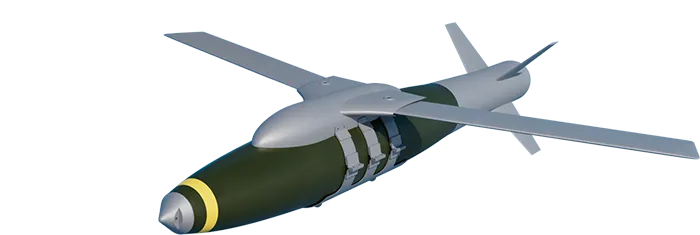
GIDS REK / Takbir is a Pakistani range-extension kit family that turns general-purpose steel bombs into GPS/GNSS-aided stand-off glide weapons. GIDS presents Takbir with a tail guidance unit, deployable wing unit, 100 km class range, and MIL-STD-1760 interface, while Qaswa and Quwa sources place the newer AZB/REK line across Mk 80-series bomb bodies and tie the Mk 83-class configuration to JF-17 strike reporting from Operation Swift Retort.
Operation Swift Retort reporting tied Pakistan Air Force JF-17s to Mk 83-class GIDS REK / Takbir glide bombs used for stand-off strikes against Indian Army target areas near the Line of Control.
Public sources use REK, Takbir, and AZB for overlapping Pakistani range-extension kits; this family page covers the broader GIDS-marketed kit, while linked rows identify bomb-body-specific applications.
| Variant | Configuration | Designation notes |
|---|---|---|
 | Mk 83 / PK-83-class application | The linked record covers the 1,000-pound-class REK configuration that ThePrint tied to Operation Swift Retort and Qaswa/Quwa sources describe in the AZB-83 family. Sources: Qaswa AZB Range Extension Kits, Quwa AZB Range-Extension Kit overview, ThePrint Operation Swift Retort analysis |
| AZB-83LR | Extended-range Mk 83 / PK-83-class AZB variant | Qaswa lists AZB-83LR separately from AZB-83 with a heavier weight class and 250-280 km range band; it is retained here as an unlinked designation because the current catalog page is for the broader REK / Takbir family. Sources: Qaswa AZB Range Extension Kits, Quwa AZB Range-Extension Kit overview |
Public carrier evidence is strongest for the JF-17, where integration reporting and Operation Swift Retort reporting both connect the aircraft to the REK / Takbir family.
| Carrier | Carrier type | Carriage evidence |
|---|---|---|
 | Strike fighter | PAC announced JF-17 integration of the stand-off weapon in March 2017, and ThePrint later described JF-17 strike elements carrying REK/Takbir bombs in Operation Swift Retort. Sources: Quwa REK integration on JF-17, ThePrint Operation Swift Retort analysis |
REK / Takbir is a kit family rather than a standalone airframe: it adds guidance, tail control, and wing surfaces to conventional bomb bodies.
| Compatible item | Item type | Compatibility evidence |
|---|---|---|
| Mk 83 / PK-83-class guided bomb application | Qaswa and Quwa list AZB-83 around the Mk 83 / PK-83 class, while GIDS describes the underlying REK / Takbir kit architecture for general-purpose bomb bodies. Sources: GIDS Products - REK / Takbir, Qaswa AZB Range Extension Kits, Quwa AZB Range-Extension Kit overview |
GIDS describes REK / Takbir as a range-extension kit for general-purpose steel bombs: a tail unit provides guidance and navigation, while a wing unit adds the lift needed for a stand-off glide. Qaswa and Quwa place the related AZB family across several bomb-body classes, including the Mk 83 / PK-83 class represented by the linked Mk 83 REK guided-bomb page.
GIDS describes autonomous AHRS guidance aided by GPS, while AZB-family descriptions use GNSS/INS terminology.
The kit adds a control tail and deployable wings to a conventional bomb body rather than replacing the bomb payload.
GIDS states the weapon can accept WGS-84 coordinates during mission planning or in flight.
Quwa reported Pakistan Aeronautical Complex and Pakistan Air Force announcements that the GIDS REK stand-off weapon had been integrated with the JF-17 Thunder.
Sources: Quwa REK integration on JF-17
ThePrint's reconstruction of the 2019 retaliatory strike package described JF-17 elements carrying REK/Takbir Mk 83-class glide bombs.
Sources: ThePrint Operation Swift Retort analysis, Kaiser Tufail Pulwama analysis
Janes reported that GIDS was developing AZB-V and AZB-VI guidance kits for Mk 84-class bombs, while noting earlier AZB kits for smaller Mk 80-series bodies.
Sources: Janes IDEF 2023 AZB guidance kit report
Qaswa and Quwa public material described an expanded AZB/REK lineup with Mk 82, Mk 83, Mk 83LR, and Mk 84-class configurations.
Sources: Qaswa AZB Range Extension Kits, Quwa AZB Range-Extension Kit overview