Munitions

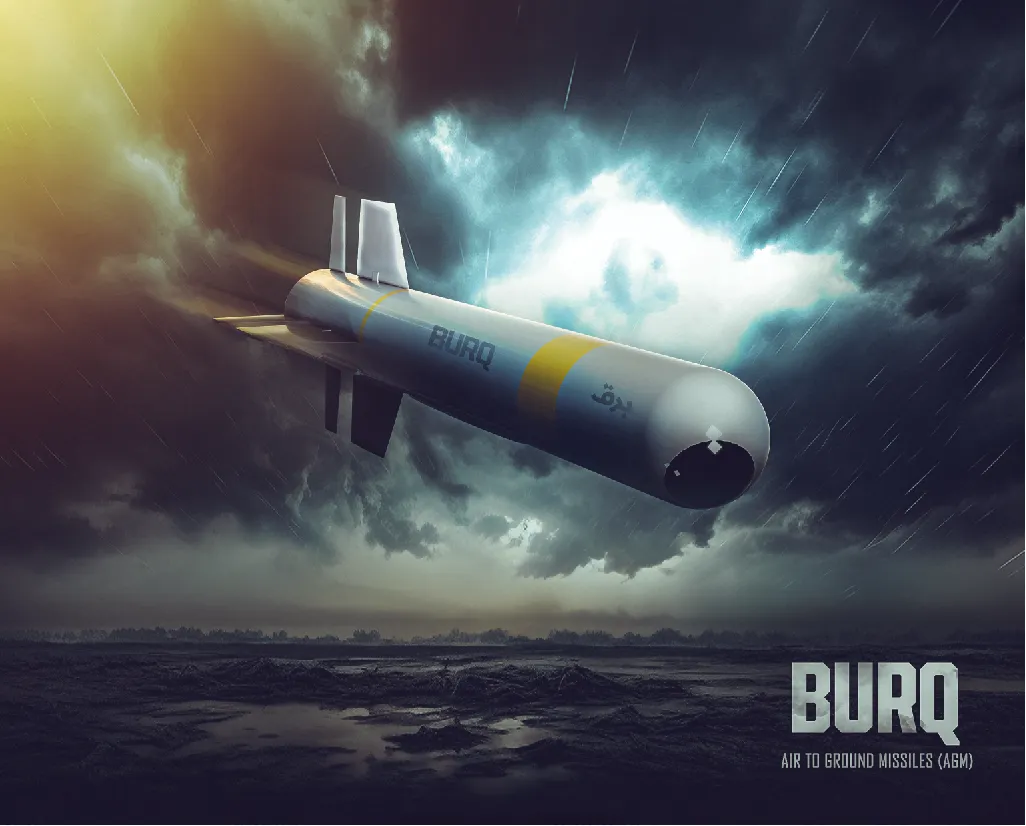
Burq air-to-ground missile

Also known as
  • BURQ
  • Burq AGM
  • Barq air-to-ground missile
  • BARQ
  • Burq-50P
  • Burq-45P
  • Burq-25G
  • GIDS Burq

Burq is a Pakistani laser-guided air-to-ground missile lineage that includes the earlier Burq/Barq munition fired from the NESCOM Burraq armed UAV and the later GIDS Burq-50P, Burq-45P, and Burq-25G family for UAVs and combat helicopters. Direct public conflict evidence ties a Burq missile to Pakistan's 2015 Shawal Valley operations, while current GIDS and Quwa sources define the newer 25G/45P/50P specifications and Shahpar carrier relationships.

Role in Conflicts

Side
Pakistan

Quwa reported that ISPR said a Burraq UAV fired a Burq laser-guided air-to-ground missile during Pakistan's Shawal Valley operations in September 2015; Dawn separately reported the Burraq strike in North Waziristan and the earlier Barq missile test.

Profile / Specs

Profile

Origin
Pakistan
Type
Laser-guided air-to-ground missile family
Service note
2015 original Burq/Barq missile; 2024-present GIDS Burq AGM family
Designer
National Engineering and Scientific Commission (NESCOM); current family marketed by Global Industrial & Defence Solutions
Unit cost
Not publicly disclosed
Produced
Original Burq/Barq publicly tested in 2015; current GIDS 25G/45P/50P family publicly described by 2024
Number built
Not publicly disclosed

Specifications

Guidance
Semi-active laser homing; optional GNSS listed by GIDS for Burq-50P and Burq-25G
Range
2.5-12.0 km for Burq-50P and Burq-45P; 3.0-12.0 km for Burq-25G in current GIDS data
Launch platforms
UAVs and combat helicopters; source-backed carrier links include Shahpar-II and Shahpar-III
Designation
Onboard EO payload or ground designator
Engagement modes
Lock-on before launch and lock-on after launch
Weights
Up to 50 kg (50P), 45 kg (45P), and 25 kg (25G)
Warhead mass
About 20 kg (50P), 10 kg (45P), and 9 kg (25G)
Original combat carrier
Burraq armed UAV, reported in 2015 Shawal Valley use
Variants

Public sources separate the earlier Burq/Barq missile associated with Burraq from the current GIDS Burq-family variants, which GIDS lists as the 50P, 45P, and 25G.

VariantConfigurationDesignation notes
Burq / BarqOriginal laser-guided air-to-ground missile

Dawn reported the Pakistan Army's March 2015 test of Burraq armed with a laser-guided Barq missile, and Quwa later described Burq as the missile fired from Burraq in Shawal Valley.

Sources: Dawn Burraq North Waziristan Strike, Quwa Burraq UAV Strike

Burq-50PLaser-guided propelled weapon

GIDS lists a 2.5-12.0 km range, 180 mm diameter, 1,450 mm length, weight up to 50 kg, and about 20 kg warhead mass.

Sources: GIDS Air Products

Burq-45PLaser-guided propelled weapon

GIDS lists a 2.5-12.0 km range, 180 mm diameter, 1,450 mm length, weight up to 45 kg, and about 10 kg warhead mass.

Sources: GIDS Air Products

Burq-25GLaser-guided glide weapon

GIDS lists the 25G as a lighter weapon for smaller UAVs, with a 3.0-12.0 km range, 160 mm diameter, 1,000 mm length, weight up to 25 kg, and about 9 kg warhead mass.

Sources: GIDS Air Products

Carrier UAVs

Public sources support Burq carriage or intended integration on Pakistani armed UAVs. The conflict-use row relies on the 2015 Burraq evidence; the linked catalog carriers below cover Shahpar-family relationships that are separately sourced.

CarrierCarrier typeCarriage evidence
Shahpar-II, Medium-altitude long-endurance unmanned combat aerial vehicle, Aircraft & UAVsShahpar-IIMALE/UCAV carrier

EDEX coverage said Shahpar-II can carry a Burq laser-guided air-to-ground missile on each wing, and Military Africa reported a Shahpar-II live-fire demonstration with Burq missiles.

Sources: EDEX Shahpar-II UAV Coverage, Military Africa Shahpar-II Demonstration

Shahpar-III, Medium-altitude long-endurance unmanned combat aerial vehicle, Aircraft & UAVsShahpar-IIIMALE UCAV carrier

Quwa described the current Burq family as intended for Shahpar 2 and Shahpar-3 UAVs, while GIDS lists Shahpar-III as an armed Group 4+ MALE UCAV with six wing hardpoints.

Sources: Quwa Burq AGM Database, GIDS Air Products

Lineage And Evidence Boundary

Open sources use Burq and Barq for a Pakistani laser-guided air-to-ground missile associated first with Burraq and later with GIDS's displayed Burq-family variants. The page therefore separates the documented 2015 Burraq missile use from the newer 25G, 45P, and 50P specifications.

2015 combat trail

Quwa tied the Shawal Valley strike to a Burq missile fired by Burraq, while Dawn corroborated the Burraq strike and the earlier Barq missile test.

Current family

GIDS currently lists 50P, 45P, and 25G variants with semi-active laser homing, LOBL/LOAL modes, and UAV or helicopter launch context.

Carrier context

EDEX and Military Africa tie Burq carriage and firing to Shahpar-II, while Quwa links the current family to Shahpar 2 and Shahpar-3 UAVs.
Timeline

Burq air-to-ground missile Key Events

  1. Burraq and Barq publicly tested

    Dawn reported that Pakistan's army tested the Burraq armed UAV with an indigenously developed laser-guided Barq missile in March 2015.

    Sources: Dawn Burraq North Waziristan Strike

  2. Burq reported fired in Shawal Valley

    Quwa reported that ISPR said Burraq fired a Burq laser-guided missile during Pakistan's ongoing Shawal Valley operations.

    Sources: Quwa Burraq UAV Strike

  3. Shahpar-II carrier relationship reported

    EDEX coverage said GIDS disclosed Shahpar-II could carry one Burq laser-guided air-to-ground missile on each wing.

    Sources: EDEX Shahpar-II UAV Coverage

  4. Shahpar-II live-fire demonstration

    Military Africa reported that Shahpar-II Block II fired Burq laser-guided missiles at still and moving targets during a GIDS demonstration for foreign military delegations.

    Sources: Military Africa Shahpar-II Demonstration

  5. Current Burq family described

    Quwa profiled the current GIDS Burq-25G, Burq-45P, and Burq-50P family and tied it to Shahpar 2 and Shahpar-3 UAVs.

    Sources: Quwa Burq AGM Database

Related Weapon Systems
Fatah-II / Fatah-2, Surface-to-surface guided multiple launch rocket system, ArtilleryArtilleryFatah-II / Fatah-2Surface-to-surface guided multiple launch rocket systemFatah-II, also written Fatah-2, is a Pakistani surface-to-surface guided multiple launch rocket system developed by NESCOM and marketed by GIDS for long-range conventional precision fires. GIDS's current product page lists a 250 km range, 150 kg warhead, INS+GNSS guidance, and sub-10 m CEP, while earlier launch-era reporting cited 400 km and 365 kg claims. In the 2025 India-Pakistan Conflict it was tied to Pakistan's Operation Bunyan-un-Marsoos strike narrative and to a reported intercept near Sirsa.
Fatah-I 301 mm guided rocket, 301 mm guided artillery rocket, MunitionsMunitionsFatah-I 301 mm guided rocket301 mm guided artillery rocketThe Fatah-I 301 mm guided rocket is a Pakistan-origin guided artillery rocket associated with the Fatah-I/Fatah-1 multiple-launch rocket system. GIDS lists Fatah-I with at least 140 km range, sub-50 m CEP, and eight rockets per launch vehicle, while Janes described a 2025 Fatah GMLRS display model with a four-round pod for 301 mm Fatah-I rockets. Pakistan state media reported Fatah-1 and Fatah-2 use in Operation Bunyan-un-Marsoos during the 2025 India-Pakistan Conflict.
Fatah-I / Fatah-1, Guided multiple launch rocket system, ArtilleryArtilleryFatah-I / Fatah-1Guided multiple launch rocket systemThe Fatah-I, also written Fatah-1, is a Pakistani guided multiple launch rocket system developed by NESCOM and marketed by GIDS for conventional precision fires. GIDS lists a range of at least 140 km, CEP under 50 m, and eight rockets per launcher, while Dawn reported Pakistan's first public test announcement in August 2021. In the 2025 India-Pakistan Conflict, Pakistani accounts and subsequent reporting identified Fatah-1 alongside Fatah-2 as part of Operation Bunyan-un-Marsoos strikes against Indian military targets.
GIDS REK / Takbir, Range-extension guided glide bomb kit, MunitionsMunitionsGIDS REK / TakbirRange-extension guided glide bomb kitGIDS REK / Takbir is a Pakistani range-extension kit family that turns general-purpose steel bombs into GPS/GNSS-aided stand-off glide weapons. GIDS presents Takbir with a tail guidance unit, deployable wing unit, 100 km class range, and MIL-STD-1760 interface, while Qaswa and Quwa sources place the newer AZB/REK line across Mk 80-series bomb bodies and tie the Mk 83-class configuration to JF-17 strike reporting from Operation Swift Retort.

Sources