Support Equipment

APE-5 command post

Also known as
  • APE-5
  • APE 5
  • APE-5 mobile command post
  • APE-5 automated mobile unit
  • Automated mobile unit APE-5
  • АПЕ-5
  • Автоматизированная подвижная единица АПЕ-5
  • 83T19-10.05-08

The APE-5 is a Russian automated mobile command-post module built by RusBITech for field work and rest by a 9-11-person planning group. Open Russian references describe the system on a KamAZ-63501 chassis with an expandable KK6.3.32 container body, networked workstations, GLONASS navigation, protected videoconferencing, life-support equipment, and a 600 km road range. During the 2014 Russia-Ukraine War, open-source loss trackers have identified Russian APE-5 command posts destroyed in Ukraine, making the system a documented command-and-communications target rather than only a peacetime staff vehicle.

Role in Conflicts

Side
Russia

Oryx lists six Russian APE-5 command posts destroyed during the full-scale invasion of Ukraine. WarSpotting identifies destroyed Russian examples at Zirka in Kyiv Oblast on 2022-03-16, Chornobaivka/Kherson airport on 2022-11-21, and Chornozemne in Zaporizhzhia Oblast on 2023-01-25; Espreso separately reported an APE-5 on a KamAZ chassis in a Russian military echelon moving from Belarus toward Rostov Oblast and the combat zone in February 2023.

Role details
Profile / Specs

Profile

Origin
Russia
Built by
RusBITech
Type
Mobile automated command-post module
Service note
Entered Russian service in 2019 and documented with Russian forces during the 2014 Russia-Ukraine War
Designer
RusBITech and the Research Institute of Communication and Control Systems
Designed
Late 2010s
Produced
In service from 2019; 2018 state-defense-order contract deliveries reported in 2019

Specifications

Role
Deployable automated field command-post workspace for a 9-11-person planning group
Chassis
KamAZ-63501 truck chassis in Vooryzhenie.rf and CNews descriptions
Container body
KK6.3.32 expandable container body in Vooryzhenie.rf description
Automated workstations
9-11
Deployment time
30 minutes to deploy to full working condition with a two-person crew
Stowage time
15 minutes in Army Standard reporting
Mobility
60 km/h on highway, 45 km/h on dirt roads, 10 km/h cross-country, and 600 km range in Army Standard reporting
Navigation and mapping
GLONASS satellite navigation and cartographic information-processing devices in Army Standard and InformNapalm descriptions
Communications fit
Local network with protected videoconferencing; Army Standard also reports satellite data transmission up to 10 Mbit/s and HF radio connection to 300 subscribers within 30 km
Electrical supply
400/230 V, 50 Hz nominal
Backup power endurance
Up to 30 minutes for functional equipment after power loss or out-of-limit input
Life support
Two air conditioners, two heaters, and a filtration-ventilation unit
Habitable volume
50 cubic meters
Transport dimensions
10,810 mm length, 2,568 mm width, 3,945 mm height
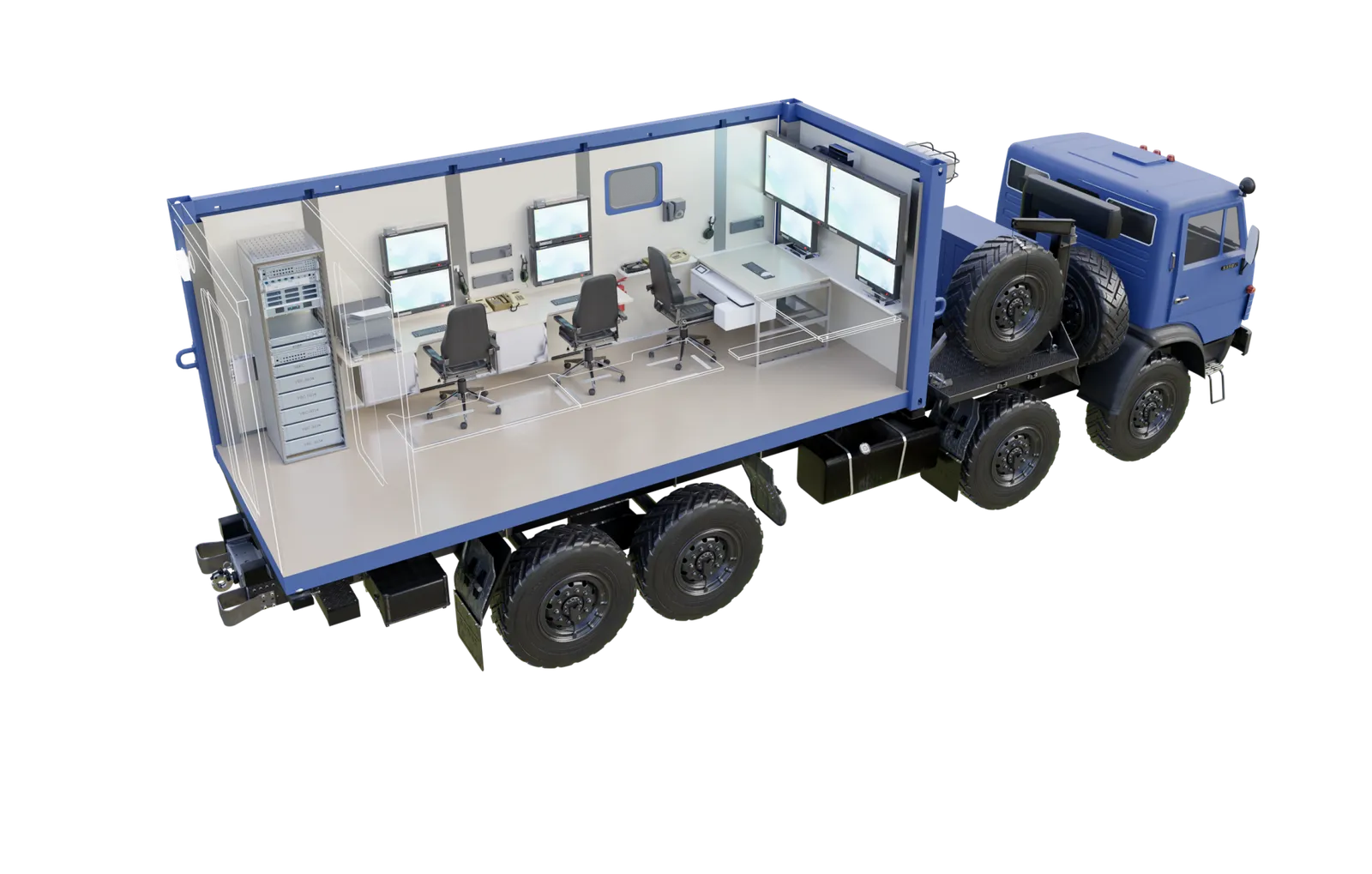
Command-Post Layout

The APE-5 is a deployable staff workspace rather than an armed fighting vehicle. Sources describe a KamAZ-63501-based module with an expandable container body, automated workstations, power-conditioning equipment, heating, air conditioning, filtration and ventilation, and a closed local information network for command-post work.

Staff capacity

RusBITech and Vooryzhenie.rf describe the APE-5 as supporting work and rest for a 9-11-person group.

Deployment

Army Standard lists 30 minutes to deploy to full working condition and 15 minutes to stow.

Networked workstations

CNews and Army Standard describe 9-11 workstations integrated into a local network, with Army Standard also noting protected videoconferencing.

Loss context

The Ukraine conflict row is based on identified Russian APE-5 loss and movement records; it does not imply every APE-family module in Russian service was deployed in Ukraine.

Sources: RusBITech APE-5 product page; Army Standard APE-5 profile; Vooryzhenie.rf APE-5 profile; CNews RusBITech APE contract dispute; Oryx Russian equipment losses; WarSpotting APE-5 loss records.

Variants

Open sources usually describe APE-5 together with the smaller APE-3 module as a deployable command-post set.

VariantConfigurationDesignation notes
APE-3Smaller towed automated mobile unit

CNews describes the APE set as an APE-5 module on a KamAZ-63501 chassis paired with a towed APE-3 module; RusBITech lists APE-3 for 4-5 people and APE-5 for 9-11 people.

Sources: CNews RusBITech APE contract dispute, RusBITech products page

APE-5KCommand-post variant named in Russian delivery reporting

Russian delivery reporting in 2019 referred to APE-5K automated mobile command posts supplied to Central Military District communications units.

Sources: Sdelano U Nas APE-5K delivery report

Timeline

APE-5 command post Key Events

  1. APE-5 enters Russian service

    Vooryzhenie.rf states that the APE-5 began entering service in 2019 and identifies RusBITech as the manufacturer.

    Sources: Vooryzhenie.rf APE-5 profile

  2. State-defense-order deliveries inspected

    CNews reported, citing Russian Ministry of Defence material, that 76 APE-5 and APE-3 sets had already been delivered under a 2018 contract, with 18 more sets planned by November 2019.

    Sources: CNews RusBITech APE contract dispute

  3. Strategic-exercise use reported

    Army Standard reported that APE-5 systems had been checked in the troops, including during Tsentr-2019 and Kavkaz-2020.

    Sources: Army Standard APE-5 profile

  4. Chornozemne APE-5 loss recorded

    WarSpotting records a Russian APE-5 command post destroyed near Chornozemne in Vasylivka raion.

    Sources: WarSpotting APE-5 loss record

  5. APE-5 noted in Russian echelon from Belarus

    Espreso reported that a Russian military echelon seen at Slonim, Belarus, included an APE-5 field command post on a KamAZ chassis while moving toward Rostov Oblast.

    Sources: Espreso Belarus-to-Rostov echelon report

Related Weapon Systems
1B44-1 RPMK-1 Ulybka radiosonde weather radar, Mobile radiosonde weather radar complex, Support EquipmentSupport Equipment1B44-1 RPMK-1 Ulybka radiosonde weather radarMobile radiosonde weather radar complexThe 1B44-1 is the radar and operator vehicle of the RPMK-1 Ulybka mobile radiosonde meteorological complex, an automated support system that tracks free-flight radiosondes and distributes upper-air data for artillery, rocket, missile, aviation, and contamination-area calculations. Rosoboronexport lists the 1B44 set as a three-part complex with 40 km altitude and 200 km range limits, while visual-loss tracking and Ukrainian reporting document both Russian and Ukrainian Ulybka equipment destroyed during the 2014 Russia-Ukraine War.
1V1003 command-observation vehicle, Artillery command-observation vehicle, Support EquipmentSupport Equipment1V1003 command-observation vehicleArtillery command-observation vehicleThe 1V1003 is the BTR-80-based command-observation vehicle in Russia's 1V198 Kanonada automated artillery fire-control system, used to help detect targets and automate fire missions for artillery batteries. Rostec says the 1V198 package was developed and produced by VNII Signal and includes 1V1003 vehicles with 1V1004 command-staff vehicles; open-source loss tracking and Ukrainian reporting documented at least one Russian 1V1003 captured during the 2022 phase of the Russia-Ukraine War.
1V110 BM-21 Grad battery command vehicle, Artillery battery command and fire-control vehicle, Support EquipmentSupport Equipment1V110 BM-21 Grad battery command vehicleArtillery battery command and fire-control vehicleThe 1V110 Bereza is the senior battery officer's command vehicle in the Soviet 1V17 Mashina-B artillery fire-control complex, used with towed and rocket-artillery units including BM-21 Grad batteries. Built on a GAZ-66 truck chassis, it carries navigation, communications, meteorological, and fire-control equipment for battery-level coordination; Oryx has documented Russian 1V110 BM-21 Grad battery command vehicles among losses in the 2014 Russia-Ukraine War.
1V119 Reostat, Airborne artillery reconnaissance and fire-control vehicle, Support EquipmentSupport Equipment1V119 ReostatAirborne artillery reconnaissance and fire-control vehicleThe 1V119 Reostat is a Soviet airborne, amphibious tracked artillery reconnaissance and fire-control vehicle based on the BTR-D chassis. Developed in the late 1970s for Soviet airborne artillery units, it combined observation, navigation, communications, and ballistic fire-control equipment to support self-propelled artillery formations, especially 2S9 Nona batteries. OSCE monitoring and Ukrainian reporting document Ukrainian 1V119s in the Donbas phase of the 2014 Russia-Ukraine War, while visual-loss records and defense reporting document Russian examples destroyed or captured after the 2022 full-scale invasion.
1V12(M) Mashina-S/Faltset fire control system, Tracked artillery command and fire-control system, Support EquipmentSupport Equipment1V12(M) Mashina-S/Faltset fire control systemTracked artillery command and fire-control systemThe 1V12 Mashina-S is a Soviet tracked artillery command and fire-control set for self-propelled artillery battalions, later modernized as the 1V12M Faltset family. Built around MT-LBu-based command vehicles, the set includes 1V13(M) battery fire-control centers alongside battalion and battery command vehicles, linking reconnaissance, topographic preparation, meteorological inputs, and firing-data calculation for systems such as 2S1, 2S3, 2S4, 2S5, 2S7, and 2S19. Loss trackers and Ukrainian reporting document Russian 1V12-family vehicles destroyed, abandoned, and captured during the 2014 Russia-Ukraine War.
1V14 battery command and forward observer vehicle, Artillery battery command and forward observer vehicle, Support EquipmentSupport Equipment1V14 battery command and forward observer vehicleArtillery battery command and forward observer vehicleThe 1V14 is the battery commander's mobile observation and fire-control vehicle in the Soviet 1V12 Mashina-S artillery command system. Built on the MT-LBu tracked chassis, it carries observation, navigation, rangefinding, communications, and fire-control equipment so a battery commander can reconnoiter targets, correct artillery fire, and coordinate with supported maneuver units from a protected forward position. Russian and Ukrainian 1V14 vehicles are documented in the 2014 Russia-Ukraine War through visually confirmed loss and capture records.

Sources