Profile
- Origin
- Russia
- Built by
- NPO Splav
- Type
- 300 mm rocket with 9N268 self-guiding submunitions
- Service note
- 2000s-present
- Designer
- NPO Splav
- Designed
- 2004
- Unit cost
- Price on request
- Produced
- 2004-present
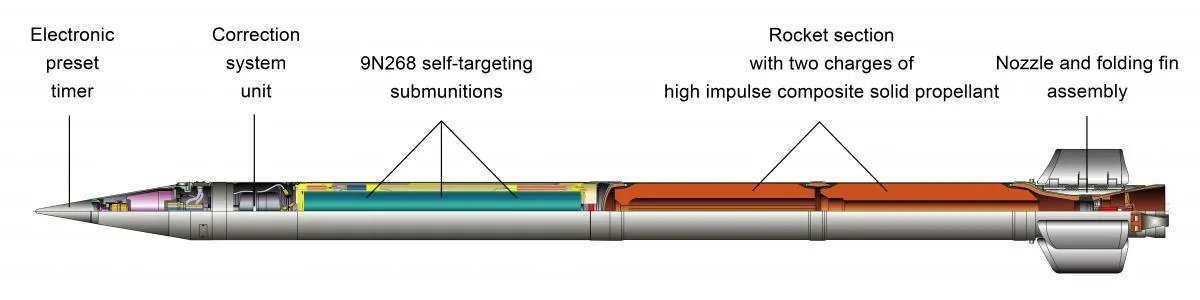
The 9M55K6 is a Russian 300 mm Smerch-family cargo rocket built around five 9N268 sensor-fuzed submunitions for top-attack strikes on armored vehicles and tank groupings. Missilery lists the round at 800 kg, 7,600 mm long, and 25 to 70 km range, METIS places it in the standard-range 9M55 family, and Army Recognition lists it among older Smerch rockets compatible with the Tornado-S launcher.
The 9M55K6's combat effect comes from the 9N268 submunitions rather than from a unitary warhead.
| Element | Documented detail | Why it matters |
|---|---|---|
| Carrier rocket | 300 mm Smerch-family cargo rocket with a 25-70 km firing range. | Places the munition inside the long-range BM-30 / 9K58 rocket family. |
| Payload | Five 9N268 sensor-fuzed submunitions, each listed at 17.3 kg with 5.8 kg explosive content. | Shows why the round is an anti-armor cluster munition rather than a fragmentation cargo rocket. |
| Attack mechanism | Missilery describes ripple-fired rockets as top-attack weapons against armored groupings and tanks; Human Rights Watch describes SPBE-type submunitions as detecting vehicles and firing downward. | Explains the top-attack anti-armor role without implying a documented conflict-use row for this exact rocket. |
Sources: 9M55K6 rocket | Missilery.info; METIS 9M55K6 munition profile; Human Rights Watch Syria SPBE report.
METIS identifies 9M55K6 as part of the standard-range 9M55 Smerch rocket family, which includes cargo, mine-laying, thermobaric, high-explosive, and sensor-fuzed anti-armor rounds.
| Variant | Configuration | Designation notes |
|---|---|---|
 | Standard-range cargo rocket | METIS lists 9M55K in the same standard-range 9M55 family as the 9M55K6. Sources: METIS 9M55K6 munition profile |
 | Self-targeting anti-tank submunition rocket | METIS lists 9M55K1 in the same standard-range 9M55 family; Missilery describes both K1 and K6 as Smerch rockets with self-targeting anti-armor submunitions. Sources: METIS 9M55K6 munition profile, 9M55K6 rocket | Missilery.info |
 | Remote mine-laying rocket | METIS lists 9M55K4 alongside 9M55K6 in the standard-range 9M55 family. Sources: METIS 9M55K6 munition profile |
 | Cumulative-fragmentation submunition rocket | METIS lists 9M55K5 alongside 9M55K6 in the standard-range 9M55 family. Sources: METIS 9M55K6 munition profile |
The 9M55K6 is a Smerch-fired 300 mm rocket with self-targeting submunitions.
| Launcher | Launcher type | Launch evidence |
|---|---|---|
 | 300 mm multiple launch rocket system | Missilery says the rocket is designed to use from the 9K58 Smerch multiple launch rocket system, and Rosoboronexport lists it in the 300 mm ammunition catalog. Sources: 9M55K6 rocket | Missilery.info, Rosoboronexport 300 mm ammunition catalog |
 | 300 mm multiple launch rocket system | Army Recognition lists the 9M55K6 among the older Smerch rockets that Tornado-S can fire, while the Tornado-S record documents its legacy Smerch compatibility. Sources: Tornado-S 9K515 MLRS |
Missilery cites export and advertising passport records for the 300 mm 9M55K6 rocket re-registered on 2004-09-02.
Sources: 9M55K6 rocket | Missilery.info
Human Rights Watch reported SPBE sensor-fuzed submunitions near Kafr Halab and noted that 9M55K6 could deliver five such submunitions, while also stating it had not seen 300 mm rocket remnants there.
Sources: Human Rights Watch Syria SPBE report
Open-source conflict reporting documents Smerch-family rockets and SPBE sensor-fuzed submunitions in several wars, but the cited evidence for this munition does not directly identify 9M55K6 remnants or firing in a specific conflict. Human Rights Watch's Syria report is a useful boundary case: it says a 300 mm 9M55K6 rocket can deliver five SPBE sensor-fuzed submunitions, but for Kafr Halab it assessed an air-delivered RBK-500 SPBE as more likely because no 300 mm rocket remnants were visible.
Sources: Human Rights Watch Syria SPBE report; SPBE submunitions employed in Syria.


