Human Rights Watch reported Russia-backed separatist use of 9M22S Grad rockets in Ilovaisk and Luhansk in 2014, while ARES documented 9M22S or 9M28S remnants and likely 9M22S visual signatures in Ukraine during the 2022 full-scale invasion.
Role details122 mm 9M22S Grad rocket
- 9M22C
- MZ-21
- 9M22S incendiary rocket
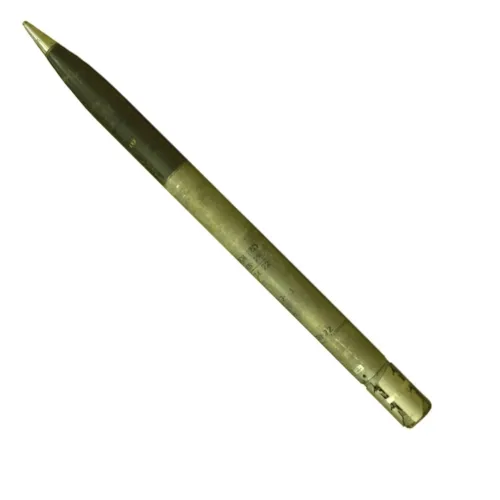
The 122 mm 9M22S Grad rocket is a Soviet incendiary rocket for BM-21 family launchers, developed by Splav in 1971 and fitted with a 9N510 warhead carrying 180 ML-5 incendiary elements. Human Rights Watch documented 9M22S Grad use by Russia-backed separatist forces in eastern Ukraine in 2014, and ARES later documented 9M22S or 9M28S remnants and likely 9M22S functioning signatures in Ukraine in 2022.
Role in Conflicts
Incendiary Payload Notes
The 9M22S is often described in battlefield reporting as phosphorus-like because of its bright falling fire pattern, but the sourced technical record points to a thermite-like ML-5 magnesium incendiary payload rather than a white-phosphorus smoke payload.
ARES and Missilery describe a 9N510 warhead with 180 ML-5 incendiary elements and about 5.94 kg of incendiary-element mass.
This distinguishes the round from standard HE-fragmentation Grad rockets and from white-phosphorus smoke munitions.
ARES describes ignition and expulsion of the elements over roughly an 80 m by 80 m area after fuze functioning.
The area figure describes munition functioning, not precision or a guaranteed burn footprint.
HRW names 9M22S Grad rockets in 2014 Ilovaisk and Luhansk use by Russia-backed separatist forces; ARES documented 2022 remnants in Novoiakovlivka and likely 9M22S signatures near Popasna; OSMP indexes exact 9M22S Grad records from Ukraine.
The 2022 remnant evidence supports the 9M22S or 9M28S incendiary family, while ARES assessed the Novoiakovlivka remnants as highly likely 9M22S.
Missilery lists BM-21-family firing vehicles for the MZ-21 / 9M22S, and ARES says 2022 examples were likely fired by Grad or Tornado-G launchers.
This page links only cataloged launcher records and does not treat every Grad-derived vehicle as a separate supported relationship.
Source labels used here: 9M22S incendiary rockets documented in Ukraine (2022), ARES 9M22S components in eastern Ukraine, HRW Incendiary Weapons in Ukraine Q&A, OSMP 9M22S Grad records, DFRLab Russian War Report Mariupol incendiaries, and MZ-21 (9M22S).
Profile / Specs
Profile
- Origin
- Soviet Union
- Built in
- Soviet UnionRussia
- Type
- 122 mm incendiary rocket
- Service note
- Cold War incendiary rocket in continued service
- Designer
- Splav State Research and Production Association
- Designed
- 1971
- Developed from
- 9M22 / M-21OF Grad high-explosive fragmentation rocket
Specifications
- Caliber
- 122 mm
- Length
- 2.97 m
- Weight
- 65.6 kg
- Warhead
- 9N510 incendiary warhead
- Incendiary elements
- 180 ML-5 elements
- Warhead weight
- 17.8 kg
- Total incendiary-element weight
- 5.94 kg
- Effect area
- About 80 m x 80 m when functioning
- Range
- About 19.9 km
- Fuze
- GDT-90 or TM-120 time fuze
Variants
The 9M22S belongs to the 122 mm Grad rocket family but replaces the standard high-explosive fragmentation payload with an incendiary 9N510 warhead. Public sources also mention the shorter 9M28S as carrying the same incendiary warhead family.
| Variant | Configuration | Designation notes |
|---|---|---|
| 9M28S short-range incendiary rocket | Shorter-range incendiary Grad-family rocket | ARES treats the 9M28S as a shorter incendiary rocket carrying the same 9N510 warhead family as the 9M22S. Sources: 9M22S incendiary rockets documented in Ukraine (2022), OSMP 9M22S Grad records |
Launch Platforms
ARES documents 9M22S incendiary rockets in Ukraine and says they were likely fired by 9K51 Grad or 9K51M Tornado-G launchers.
| Launcher | Launcher type | Launch evidence |
|---|---|---|
![]() | 122 mm multiple rocket launcher | Missilery lists the BM-21 among firing platforms for the MZ-21 (9M22S) rocket family, matching the Grad-family launcher link described by ARES. Sources: MZ-21 (9M22S), 9M22S incendiary rockets documented in Ukraine (2022) |
![]() | 122 mm multiple rocket launcher | ARES says the 2022 remnants were likely fired by 9K51 Grad or upgraded 9K51M Tornado-G multiple-barrel rocket launchers. Sources: 9M22S incendiary rockets documented in Ukraine (2022) |
Timeline
122 mm 9M22S Grad rocket Key Events
Incendiary Grad rocket developed
ARES identifies 1971 as the development year for the Splav 9M22S 122 mm incendiary rocket.
Sources: 9M22S incendiary rockets documented in Ukraine (2022)
ARES documents 2014 remnants
ARES published documentation of 9M22S incendiary components recovered from eastern Ukraine in late July 2014.
Sources: ARES 9M22S components in eastern Ukraine
HRW summarizes 2014 use
Human Rights Watch reported that Russia-backed separatist forces used 9M22S Grad rockets in Ilovaisk and Luhansk during July-August 2014.
Sources: HRW Incendiary Weapons in Ukraine Q&A
Likely 9M22S signatures near Popasna
ARES assessed night-time incendiary-weapon footage near Popasna as visually consistent with 9M22S rockets.
Sources: 9M22S incendiary rockets documented in Ukraine (2022)
Novoiakovlivka remnants photographed
ARES assessed photographed incendiary elements and sheet-metal remnants near Zaporizhzhia as highly likely evidence of 9M22S employment.
Sources: 9M22S incendiary rockets documented in Ukraine (2022)
Azovstal incendiary strike assessed
The Atlantic Council's DFRLab geolocated an incendiary strike on the Azovstal plant and reported that 9M22S Grad incendiary munitions were the more likely munition than white phosphorus.
Sources: DFRLab Russian War Report Mariupol incendiaries
Related Weapon Systems


