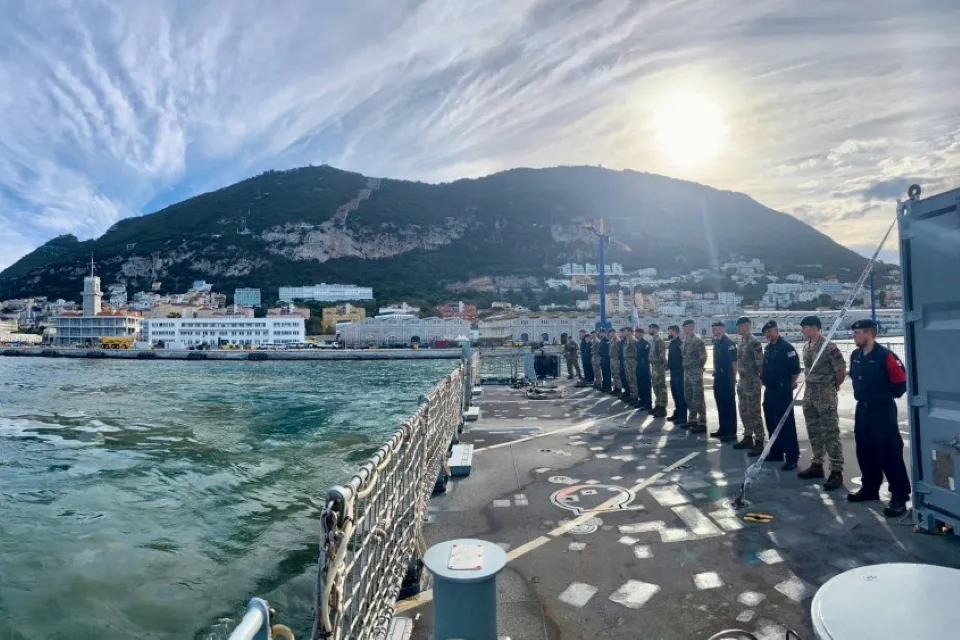
HMS Trent, a Batch 2 River-class offshore patrol vessel, was diverted from a Caribbean counter-smuggling deployment to Guyana after Venezuela renewed its Essequibo claim. Royal Navy reporting says the ship anchored off Georgetown, hosted Guyanese defence officials, and completed training and combined manoeuvres; Associated Press reporting through VOA said Venezuela ordered air and naval exercises in response.
Naval Systems
River-class offshore patrol vessel
Also known as
- River Class
- River-class OPV
- River class OPV
- River-class offshore patrol vessels
- Batch 1 River-class OPV
- Batch 2 River-class OPV
- HMS Forth
- HMS Medway
- HMS Trent
- HMS Tamar
- HMS Spey
The River-class offshore patrol vessel is the Royal Navy's British-built patrol-ship family for territorial-water security, maritime security, law-enforcement support, and sustained overseas presence. BAE Systems and Royal Navy sources distinguish the early Batch 1 ships from the larger Batch 2 vessels, whose 90 metre hull, 30 mm gun, Merlin-capable flight deck, and rotating forward-deployed crews make them useful for Caribbean, South Atlantic, Mediterranean, West African, and Indo-Pacific tasks. HMS Trent gives the class a specific documented crisis role through its 2023-2024 deployment to Guyana during the Guyana-Venezuela Essequibo crisis.
Role in Conflicts
Profile / Specs
Profile
- Origin
- United Kingdom
- Built by
- BAE Systems
- Type
- Offshore patrol vessel
- Service note
- 2000s-present
- Designer
- BAE Systems
- Number built
- 9 Royal Navy ships built, including four Batch 1 ships and five Batch 2 ships
Specifications
- Batch 2 displacement
- 1,800 tonnes
- Batch 2 length
- 90 metres
- Batch 2 beam
- 13.5 metres
- Batch 2 top speed
- 25 knots
- Batch 2 range
- 5,500 miles
- Batch 2 crew
- 70 listed by BAE Systems; Royal Navy deployment reporting describes smaller rotating crews in service
- Embarked personnel
- Up to 50 troops or mission specialists
- Batch 2 endurance
- 35 days
- Main gun
- 30 mm automated small calibre gun on Batch 2 ships
- Flight deck
- Merlin-capable flight deck on Batch 2 ships
- Batch 1 length
- 81.5 metres for the 80 metre BAE Systems OPV design
- Batch 1 endurance
- 21 days
Batch And Deployment Pattern
The River-class page is best read as a Royal Navy patrol-ship family rather than a single hull. The first generation covers UK patrol work, while the Batch 2 ships are the forward-presence element spread across overseas stations and long patrol arcs.
| Group | Ships | Reader context |
|---|---|---|
| Batch 1 | Tyne, Severn, Mersey; former HMS Clyde | BAE's 80 metre OPV design and Royal Navy reporting place the first-generation ships around fisheries protection, territorial-water security, and general patrol duties. |
| Batch 2 | Forth, Medway, Trent, Tamar, Spey | The 90 metre ships add the heavier patrol fit, flight deck, embarked-personnel capacity, and rotating overseas presence used in the South Atlantic, Caribbean, Mediterranean, West Africa, and Indo-Pacific. |
| Crisis role | HMS Trent | Trent's Guyana tasking shows the class being used for maritime presence and partner engagement during a live territorial crisis rather than only routine patrol work. |
Sources: Offshore Patrol Vessel; HMS Spey ready for action after Invergordon commissioning; Patrol ships bid farewell to Portsmouth as they begin Indo-Pacific deployment; Royal Navy patrol ship visits Guyana amid border claim.
Variants
Royal Navy River-class records group the ships into an early 80 metre generation and a larger 90 metre Batch 2 generation. HMS Clyde was a modified Batch 1 ship and has left Royal Navy service, while Tyne, Severn, Mersey, Forth, Medway, Trent, Tamar, and Spey form the current Royal Navy family.
| Variant | Configuration | Designation notes |
|---|---|---|
| Batch 1 River-class offshore patrol vessel | UK waters patrol generation | BAE Systems lists the 80 metre River-class design with 1,700 tonne displacement, 20 knot top speed, 36 crew, and 21 day endurance; Royal Navy sources describe Tyne, Severn, and Mersey as the first-generation ships focused on fisheries protection and general duties. Sources: Offshore Patrol Vessel, HMS Spey ready for action after Invergordon commissioning |
| HMS Clyde modified Batch 1 | Former Falklands patrol ship | BAE Systems includes HMS Clyde among the UK River-class ships it designed and built. Royal Navy reporting identifies HMS Forth as the later South Atlantic presence, replacing the older generation's Falklands tasking. Sources: Offshore Patrol Vessel, HMS Spey ready for action after Invergordon commissioning |
| Batch 2 River-class offshore patrol vessel | Forward-presence generation | The five Batch 2 ships - Forth, Medway, Trent, Tamar, and Spey - use the larger 90 metre BAE Systems OPV design with 25 knot top speed, 35 day endurance, 30 mm gun, Merlin-capable flight deck, and space for up to 50 embarked personnel. Sources: Offshore Patrol Vessel, HMS Spey ready for action after Invergordon commissioning, HMS Medway fires its 30mm gun |
Shipboard Gun Fit
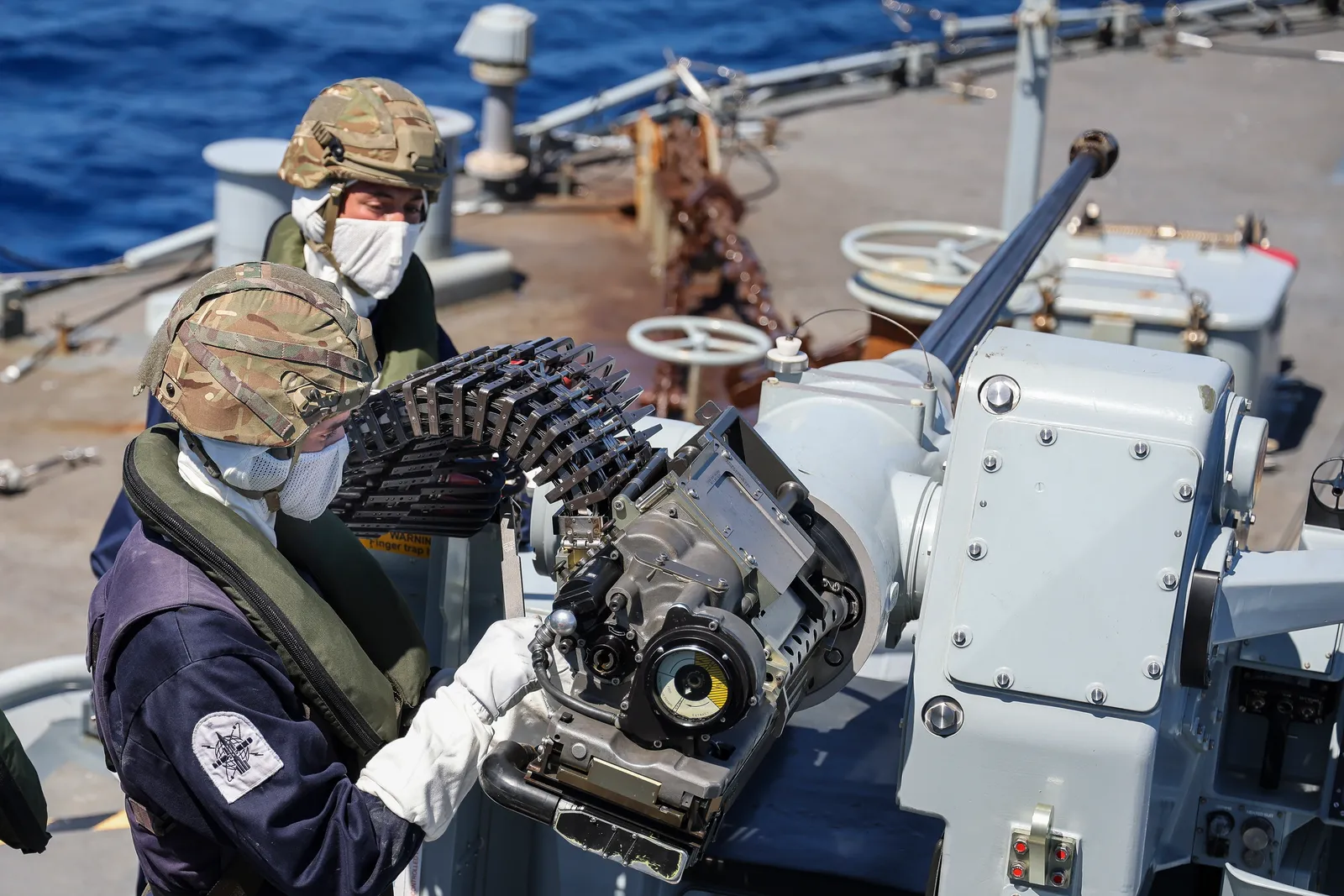
The Batch 2 River-class patrol ships carry a 30 mm gun as their main close-range armament.
| Carried item | Item type | Carriage evidence |
|---|---|---|
 | 30 mm naval gun | Wikimedia Commons image metadata from the UK Ministry of Defence identifies HMS Medway firing its 30 mm DS30M Mark 2 naval gun, while BAE Systems describes the 90 metre OPV design with an automated 30 mm small-calibre gun. Sources: HMS Medway fires its 30mm gun, Offshore Patrol Vessel |
Timeline
River-class offshore patrol vessel Key Events
Batch 2 River-class ships are named
The Royal Navy and BAE Systems named HMS Forth, starting the five-ship Batch 2 River-class series.
Sources: The first of five new patrol ships is named on the Clyde - Royal Navy
HMS Forth is commissioned
HMS Forth entered Royal Navy service as the first Batch 2 River-class offshore patrol vessel.
Sources: HMS Forth is officially commissioned into the Royal Navy
HMS Medway deploys to the Caribbean
HMS Medway sailed for the Caribbean as a forward-deployed patrol vessel supporting reassurance, humanitarian aid, and maritime-security tasks.
Sources: HMS Medway sets sail for the Caribbean - Royal Navy
HMS Spey completes the Batch 2 commissioning sequence
HMS Spey was commissioned as the fifth and final second-generation River-class vessel built for the Royal Navy.
Sources: HMS Spey ready for action after Invergordon commissioning
HMS Tamar and HMS Spey depart for the Indo-Pacific
HMS Tamar and HMS Spey began a long-term Indo-Pacific deployment intended to provide persistent Royal Navy presence across the Indian and Pacific oceans.
Sources: Patrol ships bid farewell to Portsmouth as they begin Indo-Pacific deployment
HMS Tamar conducts North Korea sanctions patrol
HMS Tamar joined international efforts in the East China Sea to enforce UN sanctions on North Korea, collecting evidence for the Enforcement Coordination Cell.
Sources: HMS Tamar enforces UN sanctions against North Korea
HMS Trent completes Guyana crisis tasking
The Royal Navy reported HMS Trent's Guyana visit, onboard briefings, training, and combined manoeuvres after the ship was diverted to support Guyana during Venezuela's renewed Essequibo claim.
Sources: Royal Navy patrol ship visits Guyana amid border claim
HMS Spey conducts UN sanctions enforcement with Japan
HMS Spey worked with Japan Maritime Self-Defence Force partners to monitor suspect maritime activity connected to UN Security Council resolutions on North Korea.
Sources: HMS Spey joins Japanese in enforcing sanctions against North Korea
Media
River-class offshore patrol vessel Images
Related Weapon Systems


Sources
River Class Offshore Patrol VesselPublisher: Royal Navy | Note: Supports the class role, the two generations serving under the White Ensign, and the territorial-water and law-enforcement mission set. | Accessed: 2026-07-01Offshore Patrol VesselPublisher: BAE Systems | Note: Supports the Batch 1 and Batch 2 OPV design data, BAE Systems manufacturing context, 80 metre and 90 metre key facts, and the 90 metre automated 30 mm gun and helicopter-capable design features. | Accessed: 2026-07-01The first of five new patrol ships is named on the Clyde - Royal NavyPublisher: Royal Navy | Note: Supports the naming of HMS Forth as the first Batch 2 River-class ship. | Accessed: 2026-07-01HMS Forth is officially commissioned into the Royal NavyPublisher: Royal Navy | Note: Supports HMS Forth entering Royal Navy service as the first Batch 2 River-class offshore patrol vessel. | Accessed: 2026-07-01HMS Medway sets sail for the Caribbean - Royal NavyPublisher: Royal Navy | Note: Supports Medway's Caribbean deployment, reassurance mission, humanitarian aid role, and maritime-security patrol tasking. | Accessed: 2026-07-01HMS Trent Offshore Patrol VesselPublisher: GOV.UK / Ministry of Defence | Note: Supports the 90-metre Batch 2 ship fit, the 30 mm cannon, Merlin-capable flight deck, and the counter-terrorism and anti-smuggling mission set. | Accessed: 2026-07-01HMS Trent deploys to West Africa to support maritime securityPublisher: GOV.UK / Ministry of Defence | Note: Supports HMS Trent's West Africa deployment, maritime-security patrol role, and partner-navy training tasking. | Accessed: 2026-07-01HMS Spey ready for action after Invergordon commissioningPublisher: Royal Navy | Note: Supports the two-generation River-class structure, the completion of the Batch 2 fleet, Batch 2 mission distribution, 90 metre flight deck, embarked Royal Marines capacity, and global forward-presence role. | Accessed: 2026-07-01Patrol ships bid farewell to Portsmouth as they begin Indo-Pacific deploymentPublisher: Royal Navy | Note: Supports HMS Tamar and HMS Spey's long-term Indo-Pacific deployment, rotating crews, mission range, and forward-presence context. | Accessed: 2026-07-01HMS Tamar enforces UN sanctions against North KoreaPublisher: Royal Navy | Note: Supports HMS Tamar's East China Sea UN sanctions patrol and evidence collection during the Indo-Pacific deployment. | Accessed: 2026-07-01HMS Spey joins Japanese in enforcing sanctions against North KoreaPublisher: Royal Navy | Note: Supports HMS Spey's 2025 UN sanctions enforcement patrol with Japanese partners in the Sea of Japan. | Accessed: 2026-07-01Royal Navy patrol ship visits Guyana amid border claimPublisher: Royal Navy | Note: Supports 2023 Guyana-Venezuela Crisis: HMS Trent was diverted from Barbados to Guyana after Venezuela renewed its Essequibo claim, anchored off Georgetown, hosted Guyanese defence officials, and completed training and combined manoeuvres. | Accessed: 2026-07-01Venezuela to Hold Military Exercises Off Coast While British Warship Heads to GuyanaPublisher: Associated Press via Voice of America | Note: Supports 2023 Guyana-Venezuela Crisis: Associated Press reporting says Venezuela ordered air and naval exercises after the United Kingdom sent HMS Trent toward Guyana's territorial waters, and that the ship would conduct joint operations with Guyana's defence forces. | Accessed: 2026-07-01Americas Minister visits Guyana to demonstrate UK support for its territorial integrityPublisher: GOV.UK / Foreign, Commonwealth & Development Office | Note: Supports the UK diplomatic context for Guyana after Venezuela renewed its Essequibo claim and the UK position on Guyana's territorial integrity. | Accessed: 2026-07-01Guyana: Venezuela written answerPublisher: UK Parliament | Note: Supports UK parliamentary context on the Guyana-Venezuela border dispute, the St Vincent non-escalation statement, and UK support for Guyana's sovereignty. | Accessed: 2026-07-01HMS Medway fires its 30mm gunPublisher: Wikimedia Commons | Note: Supports image provenance and public-domain licensing for HMS Medway firing its 30 mm DS30M Mark 2 naval gun. | Accessed: 2026-07-01HMS Trent departs Gibraltar imagePublisher: GOV.UK / Ministry of Defence | Note: Supports the primary image provenance for a Royal Navy River-class offshore patrol vessel. | Accessed: 2026-07-01Dawn over Medway imagePublisher: Royal Navy | Note: Supports one gallery image provenance for a Royal Navy River-class offshore patrol vessel. | Accessed: 2026-07-01