Direct proof of use
The 9K720 Iskander appears in the 2014 Russia-Ukraine War as a Russian ground-launched missile system used for long-range strikes. The clearest early physical evidence is munition-level: Bellingcat reported that local police documented remains of a cluster variant of an Iskander-M 9M723 missile near Kramatorsk on March 9, 2022, after Ukrainian forces said it had been shot down. Human Rights Watch later listed the same Kramatorsk case as the first reported use of an Iskander-M 9M723 cluster-munition variant in Ukraine.
The launcher-family record also includes Iskander-K cruise missiles. Ukrainian Air Force reporting carried by Ukrinform said Russia fired ten Iskander missiles toward Kyiv from Bryansk Oblast at about 02:45 on June 1, 2023: seven Iskander-M ballistic missiles and three Iskander-K cruise missiles. Babel, citing Ukraine's Air Force, reported that Russia's July 23, 2023 attack on Odesa included five Iskander-K cruise missiles and two Iskander-M ballistic missiles launched from occupied Crimea.
Sources: Bellingcat Cluster Munitions Ukraine, HRW Cluster Munition Attacks Ukraine, Ukrinform Kyiv Iskander Attack, Babel Odesa Iskander Attack
Timeline
Open reporting places Iskander use in the full-scale phase from March 2022 onward. CSIS assessed that Russia's most frequently used ballistic missile in the war was the 9M723, commonly called the Iskander, and cited Ukrainian data that counted 124 Iskander launches through July 2022 and nearly 750 by January 2023. CSIS also described 9M727 and 9M728 ground-launched cruise missiles as fired from the 9K720 Iskander launcher, with imagery confirming a role in Russian strike operations.
Later incident investigations and air-defense summaries show continued use in mixed strike packages. Truth Hounds assessed the June 27, 2023 attacks on Kramatorsk and Bilenke as Iskander-K cruise-missile attacks, with stronger physical-remnant support at Bilenke and trajectory, witness, and damage-pattern analysis for Kramatorsk. RUSI's 2025 analysis treated Russian 9M723 Iskander-M missiles as a continuing challenge for Ukrainian air defense and discussed reported modifications affecting interception.
Sources: CSIS Putin's Missile War, Truth Hounds Kramatorsk and Bilenke Investigation, RUSI Iskander Improved
Narrative
In Ukraine, the Iskander record should be read as a launcher-family record rather than a single missile type. The Iskander-M branch fires 9M723-series ballistic missiles, while the Iskander-K branch fires ground-launched cruise missiles such as 9M727 and 9M728. The cited sources support Russian operation of both branches against Ukrainian territory, with incident evidence ranging from remnants and munition identification to Ukrainian Air Force strike summaries and independent forensic investigations.
The documented role is long-range strike by Russian forces. The sources describe attacks on Ukrainian cities and other targets, interceptions over Kyiv, launches from Russia or occupied Crimea, and investigated impact sites in Donetsk and Odesa-region contexts. They support use, launch direction in specific air-defense summaries, and munition-family identification; they do not by themselves establish a complete list of launch units, all target sets, or every Iskander missile fired during the war.
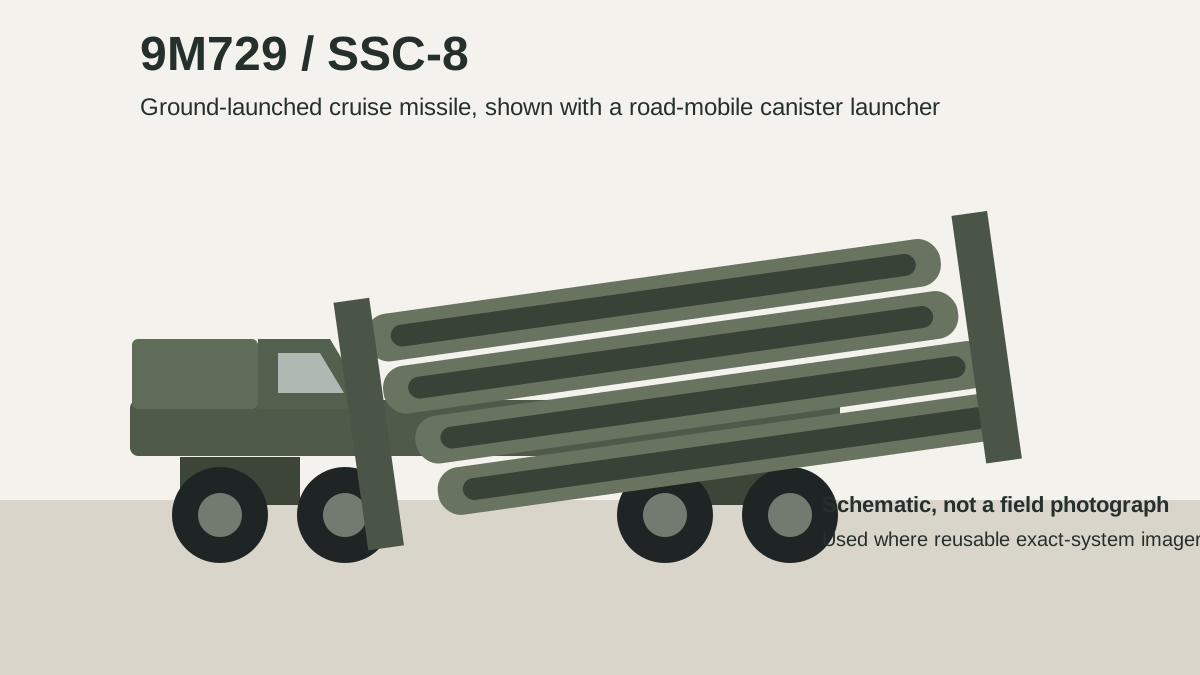
Separate munition pages in the catalog cover the 9M723 ballistic missile, 9M728/R-500 cruise missile, and 9M729 cruise missile in more detail. This page keeps the parent 9K720 Iskander entry focused on the system-level conflict role: Russian mobile launchers supplying both ballistic and ground-launched cruise-missile options for long-range strike operations.
Sources: CSIS Putin's Missile War, Bellingcat Cluster Munitions Ukraine, Ukrinform Kyiv Iskander Attack, Babel Odesa Iskander Attack, Truth Hounds Kramatorsk and Bilenke Investigation, RUSI Iskander Improved