

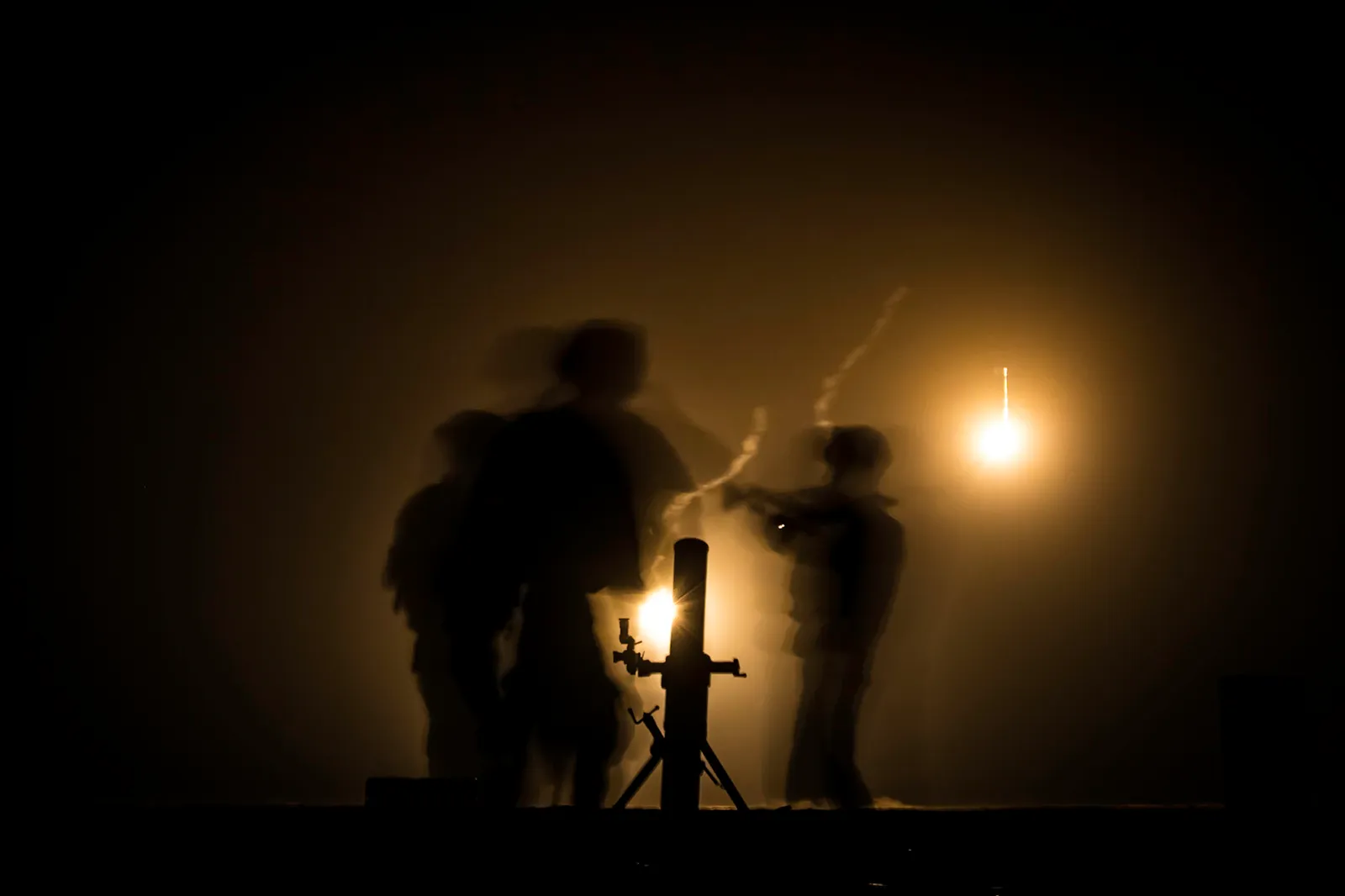
U.S. Marines with Task Force Southwest fired 120 mm mortar illumination rounds at Bost Airfield, Afghanistan, on April 24, 2018, to support Afghan National Defense and Security Forces maneuvers during combat operations in Helmand Province.
Role detailsMunitions
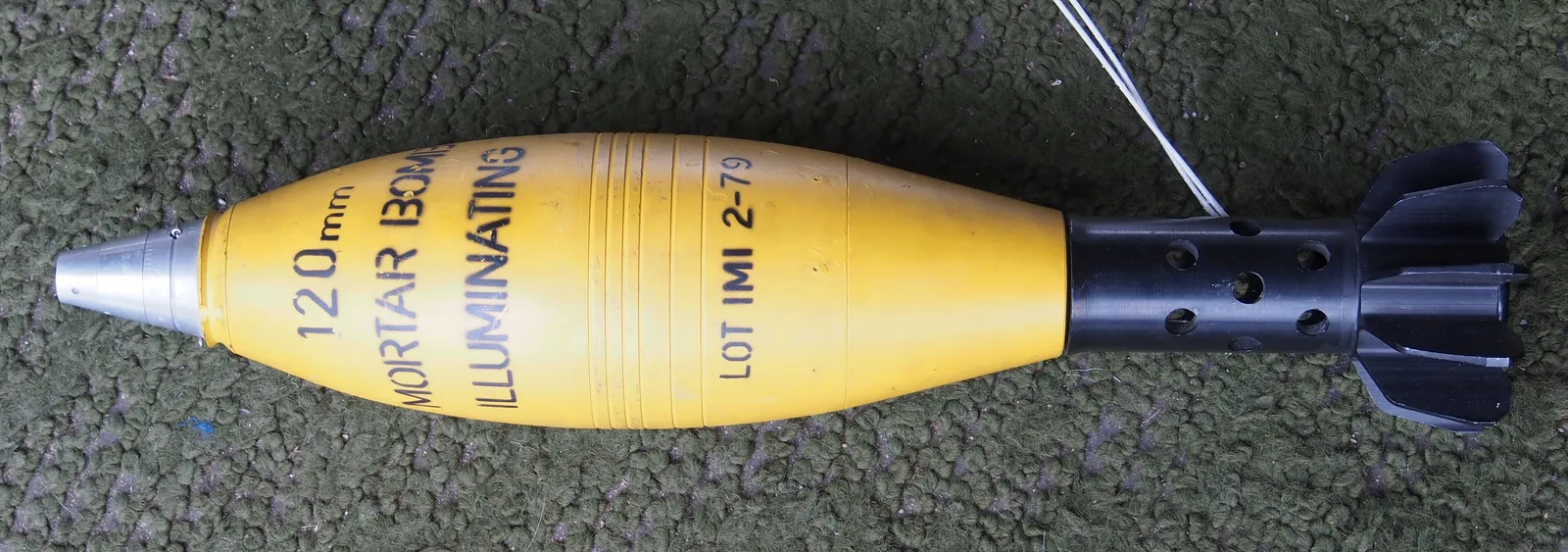
120 mm illumination ammunition
Also known as
- 120 mm mortar illumination rounds
- 120 mm illuminating mortar round
- 120 mm mortar illuminating bomb
- 120 mm MILL
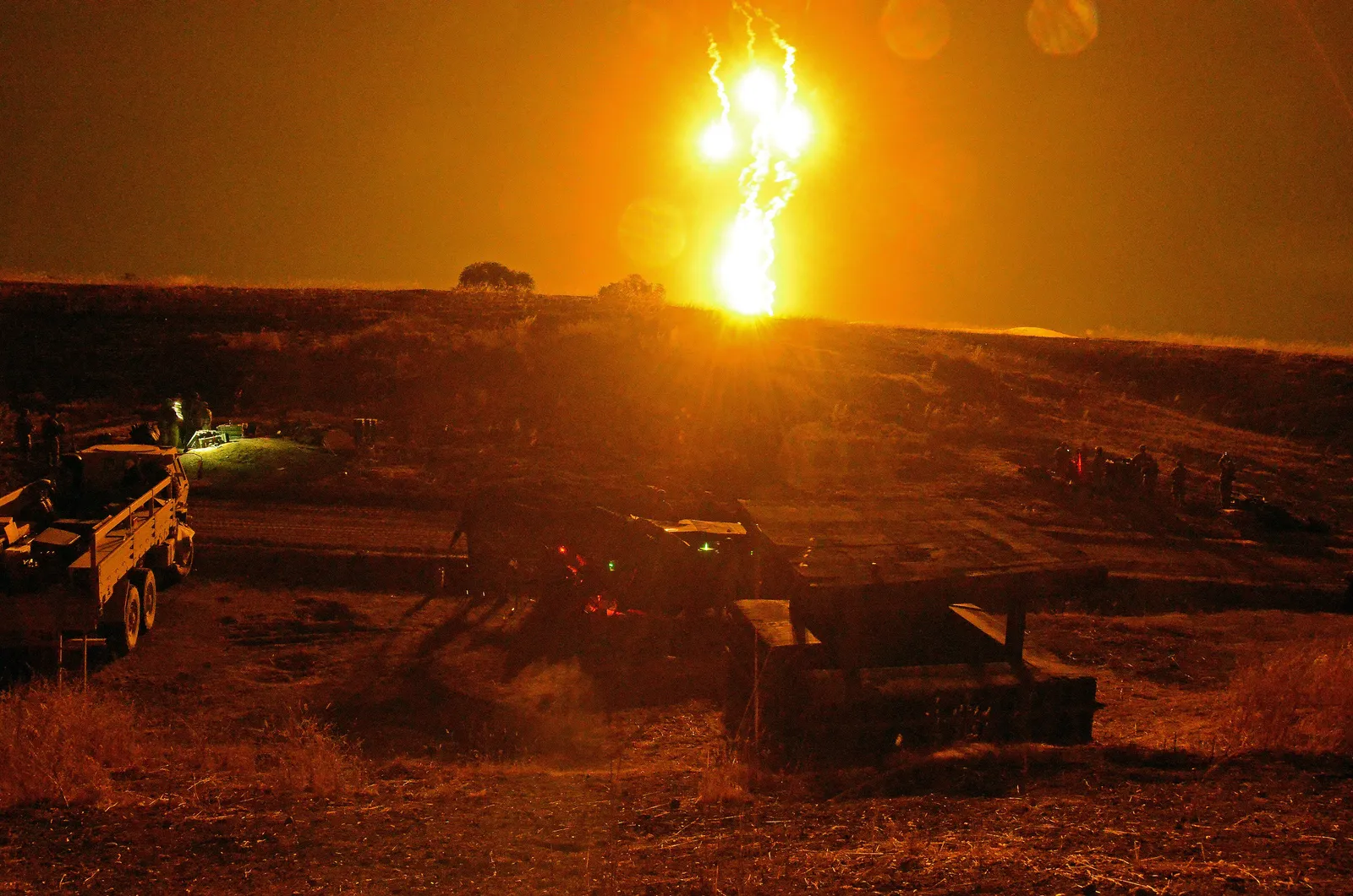
120 mm illumination ammunition is a heavy mortar munition class that ejects a parachute-retarded candle to light target areas for night observation, signaling, and fire adjustment. Nammo publishes a representative 120 mm illuminating round with time-fuze deployment at 500-700 meters, while U.S. Army sources identify visible-light M930 and infrared M983 cartridges for the M120A1 and M121 mortar systems. In the 2001 War in Afghanistan, U.S. Marines with Task Force Southwest fired 120 mm mortar illumination rounds from Bost Airfield to support Afghan government forces during combat operations in Helmand Province.
Role in Conflicts
Profile / Specs
Profile
- Origin
- Multiple countries
- Built by
- Various manufacturers
- Type
- 120 mm illuminating ammunition
- Service note
- 20th century-present
- Designed
- 20th century
- Produced
- 20th century-present
Specifications
- Caliber
- 120 mm
- Munition class
- Illuminating mortar projectile
- Illumination method
- Representative modern rounds use a time fuze to open the body and deploy a parachute-retarded illumination kit
- Representative deployment height
- 500-700 m for Nammo's 120 mm Mortar Illuminating Round
- Representative output
- 1,000,000 cd luminosity for at least 50 s on Nammo's published 120 mm illuminating round
- Representative mass
- 14.0 kg flying mass for Nammo's 120 mm illuminating round
- Representative range
- 300 m minimum / 8,300 m maximum for Nammo's published 120 mm illuminating round
- Compatible systems
- Standard smoothbore muzzle-loaded 120 mm mortar systems; Patria AMOS and NEMO with stub case; compatible rifled gun-mortars including the 2A60 Nona ordnance on the 2S23 Nona-SVK where sources identify illumination ammunition
- Typical role
- Night battlefield illumination and target marking
Illumination Package
Representative 120 mm illumination rounds are built around a timed ejection sequence rather than blast effect. The round opens above the target area, releases a parachute-suspended candle, and trades explosive payload for temporary overhead light.
| Feature | Documented value | Reader context |
|---|---|---|
| Deployment | Time-fuze ejection at about 500-700 m for Nammo's 120 mm round | Places the light source above the target area long enough for observation and movement. |
| Light output | 1,000,000 cd for at least 50 s in the Nammo example | Gives a concrete benchmark for the visible-light class. |
| Visible and IR split | Army references list M930 visible-light and M983 infrared 120 mm illumination cartridges | Shows why similar-looking 120 mm illumination ammunition may support either unaided observation or night-vision-equipped forces. |
| Combat-support example | Task Force Southwest fired 120 mm illumination rounds at Bost Airfield in April 2018 | Connects the munition class to a directly documented Afghanistan fire mission. |
Variants
The page covers the broader 120 mm illumination-ammunition class. The linked U.S. entries split visible-light and infrared 120 mm mortar illumination cartridges into separate catalog records.
| Variant | Configuration | Designation notes |
|---|---|---|
 | Visible-light 120 mm mortar illumination cartridge | U.S. Army ammunition references list M930 as the 120 mm visible-light illumination cartridge for M120A1 and M121 mortar systems. Sources: Mortar Ammunition, PEO Ammunition 2017 Portfolio Book |
 | Infrared 120 mm mortar illumination cartridge | The Army portfolio book describes M983 as a 120 mm infrared illumination cartridge developed for the M120A1 and M121 Battalion Mortar Systems. Sources: Mortar Ammunition, PEO Ammunition 2017 Portfolio Book |
Firing Weapons
Published ammunition references place 120 mm illumination rounds in both standard smoothbore mortar families and compatible gun-mortar systems.
| Firing weapon | Weapon type | Firing evidence |
|---|---|---|
 | 120 mm mortar system | U.S. Army ammunition references list M930 visible-light and M983 infrared illumination cartridges under 120 mm mortar ammunition, and Nammo states its 120 mm illuminating round is compatible with standard smoothbore 120 mm mortar systems. |
 | 120 mm gun-mortar | Forecast International explicitly lists illumination among the ammunition types fired by the 2A60 Nona rifled ordnance on the 2S23 Nona-SVK. Sources: SM-120 (2S23) Nona-SVK 120mm Self-Propelled Howitzer/Mortar |
Timeline
120 mm illumination ammunition Key Events
M930 production and fielding baseline
The Army portfolio book places M930 visible-light illumination cartridge production and deployment with U.S. Army 120 mm mortar units from March 2003.
Sources: PEO Ammunition 2017 Portfolio Book
Afghanistan illumination fire mission
U.S. Marines with Task Force Southwest fired 120 mm mortar illumination rounds from Bost Airfield to support Afghan National Defense and Security Forces maneuvers during combat operations in Helmand Province.
Sources: U.S. Marines with Task Force Southwest fire 120mm mortar illumination rounds
Media
120 mm illumination ammunition Images
Related Weapon Systems


Sources
SM-120 (2S23) Nona-SVK 120mm Self-Propelled Howitzer/MortarPublisher: Forecast International | Note: Supports the 2A60 Nona ammunition family context, including illumination rounds, and the broader 120 mm gun-mortar relationship to the 2S23 Nona-SVK. | Accessed: 2026-06-23Nammo Ammunition Handbook 2021Publisher: Nammo | Note: Supports representative 120 mm illuminating mortar-round data, including time-fuze parachute deployment, 500-700 m deployment height, 14.0 kg flying mass, 300-8,300 m range, 1,000,000 cd luminosity, at least 50 s illumination, and compatibility with standard 120 mm mortar systems plus AMOS/NEMO with a stub case. | Accessed: 2026-06-29Mortar AmmunitionPublisher: U.S. Army Capability Program Executive Ammunition & Energetics | Note: Supports U.S. Army 120 mm mortar illumination ammunition context by listing M930 visible-light and M983 infrared illumination cartridges and explaining visible-light and IR illumination roles. | Accessed: 2026-06-29PEO Ammunition 2017 Portfolio BookPublisher: U.S. Army Capability Program Executive Ammunition & Energetics | Note: Supports the M930 visible-light and M983 infrared 120 mm illumination cartridge descriptions, M120A1/M121 mortar-system compatibility, and M930 March 2003 production and deployment context. | Accessed: 2026-06-29U.S. Marines with Task Force Southwest fire 120mm mortar illumination roundsPublisher: PICRYL / Defense Visual Information Distribution Service | Note: 2001 War in Afghanistan: documents U.S. Marines with Task Force Southwest firing 120 mm mortar illumination rounds from Bost Airfield, Afghanistan, on April 24, 2018, to support Afghan National Defense and Security Forces maneuvers during combat operations in Helmand Province. | Accessed: 2026-06-29120 mm Mortar Illuminating RoundPublisher: Nammo | Note: Supports manufacturer and specification context for a representative 120 mm illuminating mortar round, including illumination role, time-fuze operation, and parachute-retarded light deployment. | Accessed: 2026-06-23120mm mortar bomb illuminating, photographed at the Aalborg Forsvars- og Garnisonsmuseum.JPGPublisher: Wikimedia Commons | Note: Supports image provenance and public-domain attribution for the representative 120 mm illumination mortar image. | Accessed: 2026-06-23Mortar night fire 140318-A-TW035-307.jpgPublisher: Wikimedia Commons | Note: Supports image provenance and public-domain attribution for a 120 mm mortar night-fire image that shows illumination round employment. | Accessed: 2026-06-23Illumination rounds shot from mortar ignite the midnight sky 150607-A-YY327-038.jpgPublisher: Wikimedia Commons | Note: Supports image provenance and public-domain attribution for a mortar illumination image. | Accessed: 2026-06-23